Introducing Agentless Data Capture™: See Everything, Install Nothing

An AI SRE platform investigating a live incident has to clear three fundamental requirements before it's even useful:
- It needs read-only, agentless access: no agents installed on hosts, no sidecars, nothing new for a security team to approve running next to your production environment.
- It has to read what it finds natively without forcing every source into a common schema first, since Datadog, Splunk, and a decade-old data lake each speak their own format. Normalizing them is real data engineering work, not a formatting afterthought.
- This is where most tools quietly fail, it has to get past the rate limits that come with pulling data from an API built for a person clicking through a dashboard, not an agent issuing thousands of queries in parallel, in the middle of an incident.
AI SRE platforms typically only solve the first requirement, and stall at the requirements two and three. Read-only access gets you in the door and lets you read what you find. But having to manually map the schema of every tool a customer has become untenable and requires too many engineering resources. Further, if every question during an incident still has to go out as a live, pull-based query, you're rationing which hypotheses are even worth testing the moment volume spikes. Overcoming that isn't a matter of a faster API client; it takes talking to data at scale via a push-based mechanism.
Agentless Data Capture™ is built on all three at once: read-only, schemaless, and pushed continuously, so the live queries an investigation still needs are few and targeted, not the bulk of the work. See Traversal in action today.
1. Read-Only Is the Prerequisite, Not the Differentiator
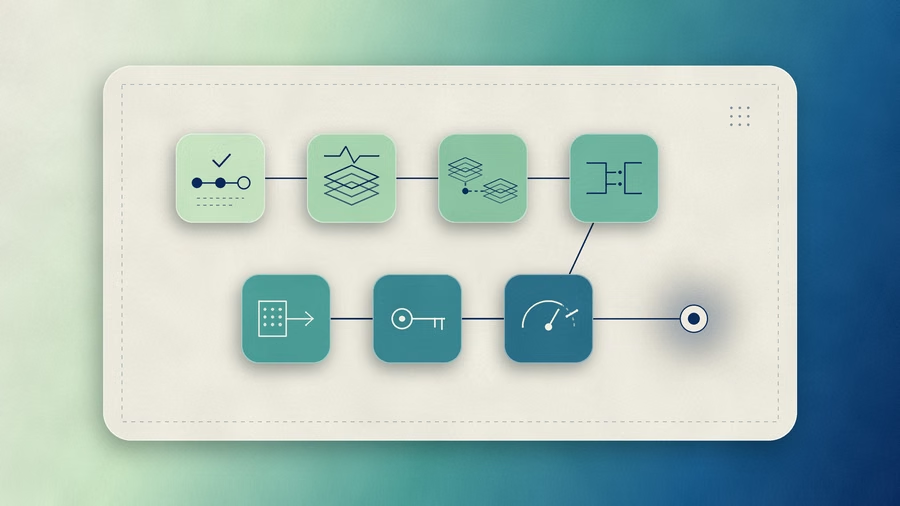
Agentless Data Capture™, a core layer of Traversal's architecture, connects over read-only, schemaless APIs and captures what you already run: your telemetry, your code, your infrastructure, your deploy history, in whatever format each source already speaks, natively, with nothing to map or normalize before it can be used. Nothing installs on your hosts and no sidecar rides alongside your services. Security teams also keep the same controls they'd apply to any other consumer of their observability stack: which query types are permitted, and what rate limits govern them, are configurable, not something Traversal negotiates around after the fact. To a security team, Traversal is simply as a read-only consumer of telemetry it already trusts and has already approved, operating inside limits the team already set, so the review tends to be short. But this layer isn't the differentiator so much as the baseline every AI SRE tool should be clearing, and most still aren't.
2. No Schema to Normalize First
Every one of those sources speaks its own schema, too. Datadog structures a metric differently than Splunk structures a log line, and neither resembles how a decade-old internal data lake has been storing events for years. The conventional fix is a data engineering project: normalize everything into a common schema before an AI can reason across it. This is genuinely difficult: schemas drift as vendors update their platforms and teams invent their own log formats over the years. Consequently, most companies solve it the only way it's historically been solvable: throwing engineers at it, indefinitely.
Agentless Data Capture™ skips that project entirely. Reading arbitrary, unmapped schemas natively is a hard problem, and Traversal has built proprietary technology specifically to solve it. It parses each source natively, in whatever schema it already speaks, so a metric from Datadog and a log line from that legacy data lake can inform the same investigation without anyone building an ETL layer to reconcile them first. Traversal also infers your environment's topology directly from the telemetry itself, and folds in uploaded runbooks and documentation through Knowledge Bank™ as a last-mile refinement layer, not a prerequisite to deploy.
3. Pull Asks. Push Already Knows.
Underneath that read-only access are two structurally different ways of getting data in: pull and push.
- Pull is what nearly every AI SRE tool relies on, querying an observability tools API source on demand when an incident occurs, synchronously, whenever a specific question needs an answer.
- Push is what almost none of them implement: a continuous, event-driven stream of telemetry as it's generated, arriving the way modern observability infrastructure already moves data, through a Kafka topic, a log forwarder, a streaming pipeline, not a periodic pull. A deploy to the checkout service, for instance, lands in the Production World Model™, Traversal's live, continuously-updated model of your production environment, within seconds of shipping.
Traversal isn't holding a second copy of your raw observability data; it's continuously updating the distilled signal the Production World Model™ keeps current. Traversal runs both patterns, but push is where the architectural advantage really compounds.
Say a checkout service starts erroring at 2:47 AM. A pull-only tool has to go fetch the context it needs one call at a time: query Datadog for checkout's error rate, query GitHub for recent deploys across three upstream services, query PagerDuty for related incident history, each request metered against the same rate limit every other consumer of that API is competing for, all while the incident is still live. Pre-fetching that context on a schedule doesn't close the gap either; a periodic refresh is stale the moment something changes between polls, and incidents don't wait for the next poll. Traversal, by contrast, already holds the answer to most of those questions inside its Production World Model™, not because it stored the raw telemetry behind them, but because that telemetry has been continuously distilled into useful AI readable signals, long before 2:47 AM via a proprietary push-based mechanism. What's left for live query are the handful of targeted lookups an investigation actually needs answered in the moment, not the thousands of queries it would otherwise take to reconstruct the environment from a cold start. Minimizing that live query volume isn't a tuning detail, either. It's what keeps Traversal off the same rate limit that stalls pull-only tools in the first place.
Built to Scale, Not to Install
PepsiCo handed Traversal more than 15,000 alerts a day, with no agent deployed anywhere in their environment. American Express runs it across 250 billion log lines a day, read-only, off telemetry it was already collecting.
See Value in Days, Not Quarters
The conventional assumption is that more data, captured through more infrastructure, gets you closer to root cause. What was actually missing wasn't data volume. It was a way in that didn't require months of setup: read-only, so security reviews take days instead of quarters; schemaless, so nothing has to be normalized before it's useful; and push-based, so the answer is usually already there instead of queued behind a rate limit built for a different era of tooling.
Traversal is deployed across the Fortune 500. Book a demo and see it in your own environment.


How Can You Effectively and Efficiently Monitor Distributed Systems?