How Do You Prioritize Which Alerts Are Actually Important?

More telemetry was supposed to give leaders more control. But many teams instead got more alerts and less confidence in what requires human attention. Severity labels pile up and dashboards multiply, but the alert queue still feels random and overwhelming.
Prioritizing important alerts is not a sorting problem. It is deciding signal versus noise, taking into consideration user and business impact, actionability, and cause, then routing work to people only when human action is required and closing out alerts that are false alarms. Below, we'll discuss what prioritization means, why leaders should care, what failure costs, why old stacks stall, and how to run a framework that holds at enterprise scale.
Book a Demo to see how Traversal helps you prioritize your alerts.
What is Alert Prioritization (and What Counts as Noise)?
Alert prioritization is the practice of ranking and routing notifications by real user or business impact and the human action required. Teams act on signal and ignore or demote noise. Alert noise is any notification that is repetitive, low-value, non-actionable, or disconnected from impact.
Signal is the small set of alerts that are urgent, actionable, and tied to user-visible or business-critical failure, including imminent failure. Noise may include flappy thresholds, duplicate pages for one failure, cascade symptoms with no owner, and tickets that look like pages.
Google’s Site Reliability Engineering guidance is blunt about the bar. In Monitoring Distributed Systems, effective alerting aims for good signal and very low noise. Page a human only for conditions that are urgent, actionable, and actively or imminently user-visible. Everything else belongs in a ticket queue, an email, or a dashboard, not on a phone at 3 a.m.
Two critical distinctions:
- Urgency versus importance. A noisy disk warning on a batch host may matter for hygiene but does not require a page tonight. A checkout error-budget burn may be both urgent and important.
- Severity label versus priority. Severity is often a static field on a rule. Priority is a decision about who acts, how fast, and whether the signal maps to customer or revenue risk.
If you cannot state the user or business effect and the next human action, you do not yet have a prioritized alert, you have a notification.
Why Does Separating Real Alerts From Noise Matter?
Leaders do not own “alert volume.” They own outage risk, recovery speed, engineering capacity, and whether the pager still trains people to pay attention.
- Alert fatigue delays real pages. When most notifications are junk, responders slow down on the rare page that matters. That delay shows up as longer mean time to acknowledge and longer mean time to resolution (MTTR).
- Downtime is a board-level cost. ITIC's 2024 Hourly Cost of Downtime Survey found average hourly downtime exceeds $300,000 for over 90% of mid-size and large firms. Forty-one percent put hourly cost between $1 million and over $5 million, exclusive of litigation and penalties.
- Noise buries critical alerts. Cascades and duplicates bury the one alert that points at the failing dependency, and avoidable incidents are missed.
- Talent and toil compound. Hours spent validating false positives are hours not spent on reliability work. Burnout and on-call attrition follow.
Separating real alerts from noise is how you defend both customer trust and the attention budget of the people who run production.
What Does Poor Alert Prioritization Cost?
Poor prioritization is a tax on recovery, people, and the business.
- Operational cost. Mean time to acknowledge rises when every page needs a “is this real?” debate. War rooms expand because symptom stacks do not name a cause or an owner. MTTR stretches while engineers reconcile five tools that all shouted about the same outage.
- Human cost. Chronic false pages train people to snooze. High performers leave rotations that never sleep and rarely teach. Replacing experienced SREs is slow and expensive relative to fixing the signal design.
- Business cost. Prolonged incidents burn error budget, revenue, and brand. The ITIC bands above are average hours. Peak-period failures and regulated workloads push the downside further.
- Governance cost. When severity is theater, executives cannot trust high-sev counts or post-incident reviews. Reliability reporting becomes volume theater instead of impact truth.
Book a Demo to see how Alert Intelligence cuts the false-page tax before it shows up in MTTR.
Why Do Traditional Approaches Fall Short?
Most stacks were built to detect and display. They were not built to decide what matters and why. The shortfall is structural.
- Static thresholds optimize for detection volume. CPU, memory, and queue depth rules fire because a line was crossed, not because a user journey failed. More monitors create more pages without a better priority model.
- Severity without criticality is a label, not a decision. A "SEV-1" on a low-blast batch job can outrank a quieter revenue-path signal when labels ignore service tier.
- Dedup and grouping shrink counts, not ambiguity. Collapsing ten identical pages into one still leaves a symptom card. Correlation without cause produces ranked stacks of "related" events, not a single diagnosis path.
- Manual alert review does not scale. The ongoing work of tuning thresholds, deleting stale rules, fixing ownership, and suppressing flapping monitors is not sustainable. At enterprise fan-out across thousands of services, human review cannot keep pace with flapping, ownership drift, and tool sprawl.
The limit is purpose-built correlation and visibility, not a missing checkbox labeled “smarter sort.” Until triage answers impact and cause, you get a quieter storm.
How Do You Prioritize Which Alerts Are Actually Important?
Use a repeatable framework. Treat it as operating policy, not a one-time cleanup.
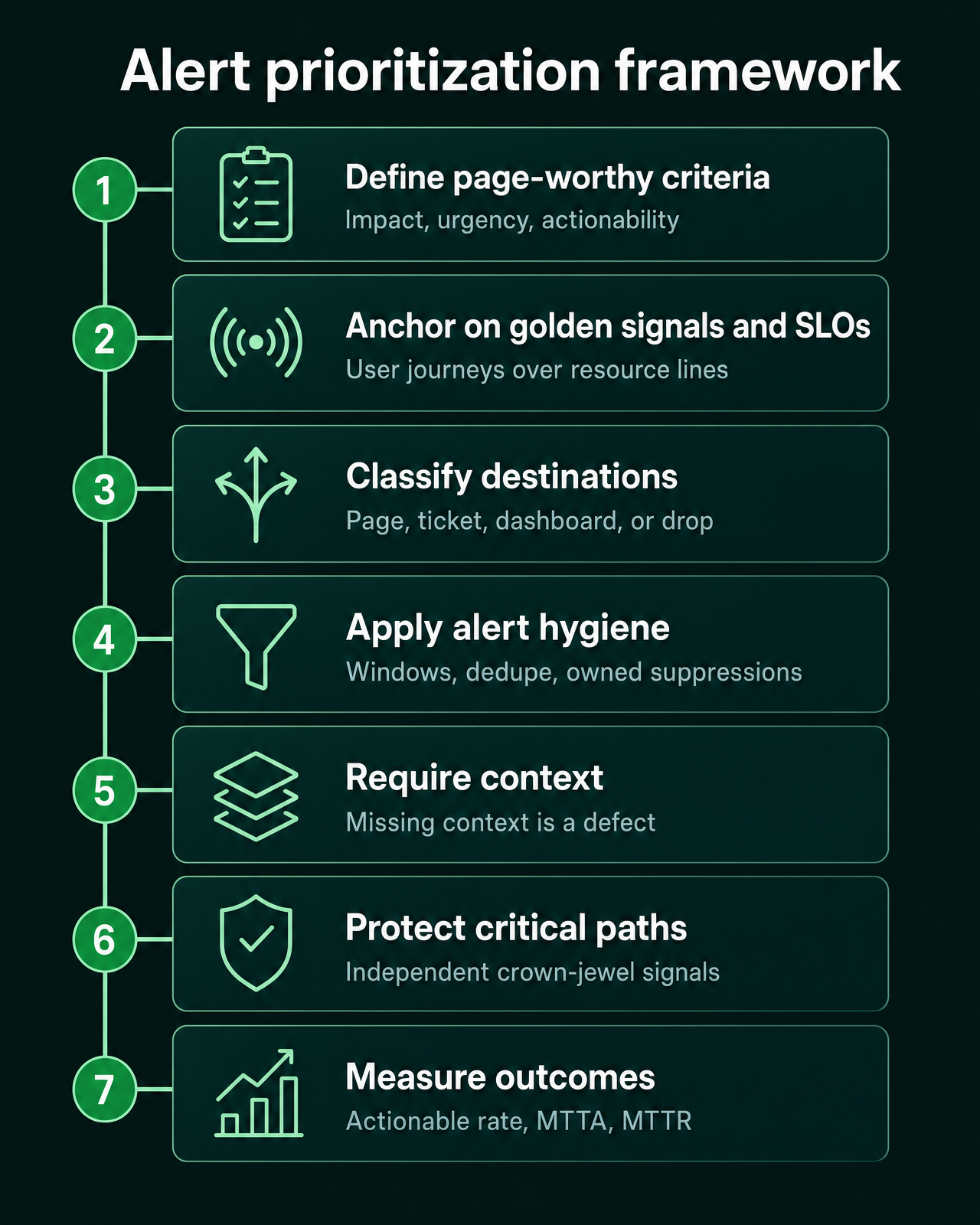
- Define page-worthy with impact, urgency, and actionability. Write the 3 a.m. test: would we wake a human if this were the only signal? Require a clear user or business effect and a concrete next action. If the action is “watch a graph,” it is not a page.
- Anchor on golden signals and SLOs, not lone resource lines. Prefer latency, traffic, errors, and saturation tied to user journeys (Google SRE). Use error-budget burn-rate alerting so pages defend customer happiness, not an arbitrary CPU percent.
- Classify destinations before you write more rules. Every notification needs a home: page, ticket, dashboard, or drop. Promote only what must interrupt a human. Demote the rest on purpose so silence is designed, not accidental.
- Apply hygiene that removes junk without hiding truth. Lengthen evaluation windows. Add recovery thresholds so flaps do not re-page. Deduplicate identical events. Allow suppressions only with an owner, a reason, and an expiry date.
- Require context. Context turns a raw page into a decision: missing context is a prioritization defect, not a responder skill gap.
- Protect critical paths with bypasses and independent signals. Noise reduction must not create a single blind spot on checkout, auth, payments, or other crown-jewel flows. Keep independent black-box checks and explicit high-sev bypasses for those paths.
- Measure outcomes leaders can defend. Track actionable rate, pages per shift, high-severity count tied to real impact, time to acknowledge, and MTTR. Do not celebrate raw alert volume dropping if customer-affecting incidents stayed flat or rose.
The Bottom Line
You prioritize alerts that are actually important by scoring impact, actionability, and cause. Noise reduction that only deduplicates and groups still leaves you with symptom stacks. Leaders need a policy for what may page, safeguards on critical paths, and metrics that track recovery and high-severity truth. Causal, AI-driven triage is how enterprises keep that policy alive at production scale.
Book a Demo to see how Traversal can transform your alert backlog.
FAQ
Rank and route alerts by real user or business impact, urgency, and a clear human action, and page only when the 3 a.m. test passes. Severity labels alone are not priority.
Treat signal as urgent, actionable, and tied to user or business impact, and treat repetitive, low-value, or non-actionable notifications as noise to ticket, dashboard, or drop. Google SRE guidance reserves pages for urgent, actionable, user-visible conditions.
Alert fatigue is desensitization caused by chronic low-value notifications, leading responders to slow down or ignore pages. It increases missed-incident risk and burns engineering time.
Severity is often a static rule label on a monitoring rule. Priority is the live decision about who acts, how fast, and whether the signal maps to customer or revenue risk.
Measure actionable rate, pages per shift, high-severity count tied to real impact, time to acknowledge, and MTTR. Reducing volume is not success if customer-affecting incidents stayed flat or rose.