The State of AI in Incident Response in 2026

AI went mainstream in incident response in 2026. Nearly every enterprise reliability team now runs some form of it. Yet the operational data tells an uncomfortable story: most of that AI made teams faster at correlating signals, not faster at isolating root cause. Site reliability engineering (SRE) has long capped operational toil at 50% of an engineer's time, and first-wave AI has not bought that time back, per Google's SRE book.
That gap is the real state of the field. This is an honest, data-backed look at where AI in incident response stands for reliability leaders, and why speed at the wrong layer has not fixed the hard part of an incident. The distinction that runs through everything below is simple: correlation tells you what broke together, causation tells you why. Most tools still stop at the first.
Book a Demo: See what causal, evidence-backed root cause analysis looks like running on your own production stack.
What "AI In Incident Response" Actually Means In 2026
AI in incident response is the use of machine learning and agentic systems to detect, investigate, and act on production incidents, reducing the manual work engineers spend finding and fixing what broke. That is the featured-snippet version. The reality underneath it spans a wide spectrum, and readers routinely conflate three very different things.
At the surface sits AIOps, which Gartner defines around correlation, anomaly detection, and grouping related signals. One layer up are generative copilots that summarize logs, draft timelines, and answer questions in natural language. Further up still is AI SRE, which applies AI to reliability engineering and takes action rather than only correlating or summarizing.
The difference is not marketing. AIOps and copilots are built to surface information to a human faster. AI SRE is built to do the investigation and the work. Treating all three as "AI" is how buyers end up disappointed when a summarizer cannot tell them why an incident happened.
The State Of Adoption: AI Is Everywhere In Incident Response Now
Adoption is no longer the question. Gartner predicts that 40% of enterprise applications will feature task-specific AI agents by 2026, up from less than 5% in 2025. Broader enterprise use is already high, with 78% of organizations reporting they used AI in 2024, up from 55% the year before, according to Stanford HAI's 2025 AI Index Report.
The pressure driving this is structural. Production environments keep getting more complex, alert volume keeps climbing, and downtime is expensive in ways leadership feels directly.
- Severe outages are costly. More than half (54%) of significant outages cost over $100,000, per the Uptime Institute Annual Outage Analysis.
- The worst outages compound. Roughly one in six (16%) cost more than $1 million, per the same Uptime Institute analysis.
- Adoption is near universal. With most enterprises already running AI in production workflows, the competitive question shifted from whether to adopt to what the AI can actually do.
When a serious outage costs six or seven figures, buying anything that promises to shorten incidents is an easy decision. The harder question is whether it shortened the right part.
The Paradox: More AI, More Toil
Here is the tension almost no vendor names. Adoption went up, and toil did not go down with it. Site reliability engineering exists to cap operational toil at 50% of an engineer's time, and first-wave AI has not bought that time back (Google, Site Reliability Engineering). More AI arrived, and engineers ended up with the same manual overhead, not less.
Delivery stability grew shakier too. The arXiv Productivity-Reliability Paradox study found that Google's 2024 DORA data tied a 25% increase in AI adoption to a 7.2% decrease in delivery stability, meaning faster shipping came with more fragile change. First-wave AI shipped more code, more alerts, and more dashboards to review without addressing the core investigation problem.
Speed to a wrong answer is negative value. No answer is better than a completely incorrect answer.
Practitioners felt it fastest. Teams describe turning off AI runbook assistants that confidently issued wrong commands during a P1, because a plausible-but-incorrect suggestion under pressure costs more than no suggestion at all. Alert fatigue never went away either. Human error contributes to two-thirds to four-fifths of downtime, and four in five serious outages were preventable with better management, process, and configuration, per the Uptime Institute Annual Outage Analysis. Faster correlation added volume on top of a signal problem teams already could not keep up with.
Correlation vs Causation: Why Most AI Stalls Before Root Cause
Correlation is the observation that several things happened together. A latency spike, a memory alert, and a failed health check all fire at once. Causation is the explanation of why: which one of those events triggered the rest, and what triggered that.
Most incident tooling was built for the first job. Observability platforms, AIOps engines, and alerting systems were designed to surface signals to a human, group them, and put them on a screen. None were built to reason over production and produce a why. So they can cluster ten alerts across ten services into one incident and still leave a human at 3 a.m. to work out which service failed first and what caused it.
That is why faster correlation has not moved the needle on the metric that matters. Grouping symptoms quicker is useful, but the investigation, the walk backward from symptom to cause across services, infrastructure, and networking, is where the minutes and the toil actually live. This is a causality problem, and it has been mistaken for an observability problem for years.
From Copilots to Autonomous, Causal AI SRE: What Changed In 2026
The shift in 2026 was from AI that suggests to AI that investigates. A copilot hands an engineer a summary and waits. An agentic AI SRE performs the analysis end to end, walks the dependency graph, and returns an evidence-backed root cause the engineer can verify. That is the line between "AI washing," a thin wrapper on a language model, and AI that reasons over production.
Reaching causation at enterprise scale takes more than a bigger model. It takes a system built to capture production reality and reason across it. That is the gap Traversal was built to close, and its architecture follows directly from the correlation-vs-causation problem above.
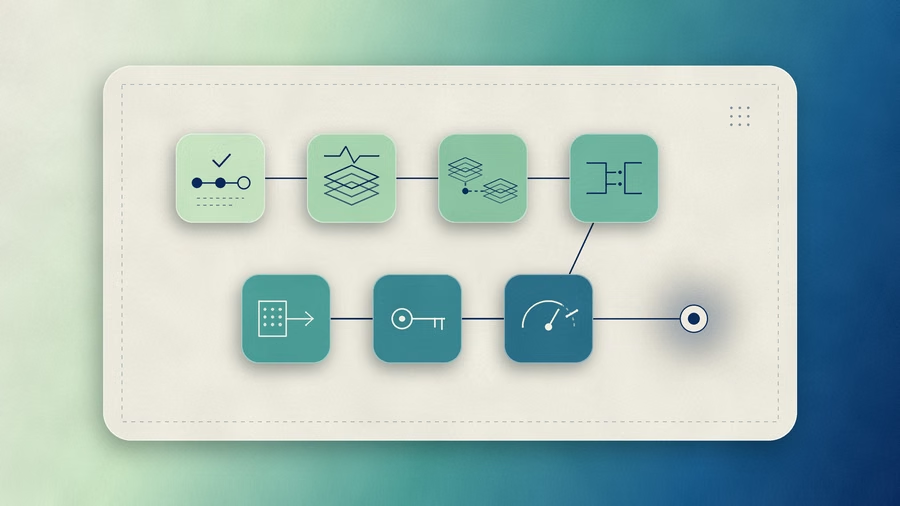
- Agentless Data Capture™ captures telemetry, code, and production data without agents or sidecars, running read-only inside the customer environment.
- Causal Indexer™ distills petabytes of telemetry to 1/1000th the size, without losing any causal signals.
- Production World Model™ maintains a continuously updated causal model of how the environment actually behaves.
- Knowledge Bank™ makes runbooks, docs, and past incidents usable in real time.
- Causal Search Engine™ reasons across 10+ hops, from apps to services to infrastructure to networking, to reach the actual root cause rather than a cluster of symptoms.
The proof is in production, not in a demo environment. Across Fortune 100 and enterprise customers including American Express, PepsiCo, and Capital One, Traversal reaches accurate root cause in under 5 minutes on average, with customers seeing value in under two weeks.
Book a Demo: Watch the Causal Search Engine™ find the root cause, in minutes, on a real incident from your environment.
How To Measure AI's Real Impact (Speed Alone is a Trap)
Speed is the metric everyone quotes and the easiest one to game. A tool can shave minutes off a summary and still send an engineer down the wrong path, which costs more time than it saved. The metrics that actually prove impact are accuracy first, then mean time to detect (MTTD), mean time to resolution (MTTR), and cost avoided.
For reliability leaders evaluating a tool, three questions separate real capability from correlation dressed up as intelligence. Does it take action, or only summarize? Does it show its evidence and reasoning so an engineer can verify the conclusion? And at what accuracy, at what production scale?
Traversal reports 82%+ accurate root causes in under 5 minutes and 85%+ improvement in MTTR and MTTD across Fortune 100 customers, with $10M+ in first-year savings. Accuracy here does not mean pointing engineers in a direction. It means output that produces the mitigation steps to fix the incident.
Risks, Guardrails, and The Human Role
Autonomy without trust is a liability, and the honest version of this topic names the failure modes directly.
- Hallucinated root cause. An AI that guesses confidently is dangerous in a P1. Insist on evidence-backed reasoning the engineer can inspect, not a black-box verdict.
- Automation bias. Teams over-trust a fluent answer. The system should show its work so humans can catch a wrong conclusion before acting on it.
- Over-suppressed alerts. Aggressive noise reduction can bury the one signal that mattered. Tune suppression against missed-incident risk, not just volume.
- Action safety. High-impact changes need human approval, audit trails, and least-privilege access. Read-only, in-environment deployment keeps the blast radius of the AI itself contained.
The goal is not autonomy for its own sake; it is causation you can trust, and a clear record of why each conclusion was reached.
What's Next for AI in Incident Response
The direction of travel is from reactive firefighting to prevention. The most valuable use of a causal model of production is not only explaining an incident after it fires, but feeding that production context back into development so the same class of failure is caught before it ships.
The winners in 2026 and beyond will pair high-fidelity production data with real causal reasoning, not another dashboard on top of the ten teams already ignore. Correlation got faster this cycle. Causation is the frontier that turns observability spend into fewer incidents and lower risk.
Book a Demo: Turn your observability spend into prevented incidents with causal AI SRE built for enterprise scale.
FAQ
AI in incident response is the use of machine learning and agentic systems to detect, investigate, and act on production incidents, reducing the manual effort engineers spend finding and fixing what broke.
AI shortens mean time to resolution by automating the slowest part of an incident, the investigation, and by returning an accurate, evidence-backed root cause so engineers can move straight to mitigation instead of context-switching across tools.
AIOps correlates alerts and detects anomalies to surface signals to a human, while AI SRE goes further by investigating causally and taking action to reach and remediate the root cause.
Yes, when the system is built to reason causally over production rather than only correlate signals; Traversal reaches accurate root cause in under 5 minutes on average across Fortune 100 environments.
No; AI removes the toil of manual investigation so engineers spend their time on judgment, verification, and prevention rather than being replaced by the system.