Introducing Traversal MCP: Production Intelligence Inside Your AI Interface
Today, tools like Claude Code, Cursor, and ChatGPT are where many engineers spend their time, writing code and chasing down bugs. However, while these tools reason well about code, they know almost nothing about the system that code runs in.
One of them can explain a stack trace or draft a migration plan. When production actually breaks, though, the same interface goes quiet. An anomaly surfaces three services away from whatever caused it, and the assistant that just helped you write the code has nothing to say about the system it runs in, because it has no model of your full production environment. It doesn't know your topology or what changed in the last hour. So you leave it open in one window and go rebuild the context by hand somewhere else, turning one question into the six dashboard queries it takes to actually answer, right when your attention is worth the most.
Traversal MCP closes that gap. Book a demo.
Introducing Traversal MCP
MCP, the Model Context Protocol, is becoming the standard way to connect an AI interface to outside systems, so a tool like Claude Code can reach a capability and use it without leaving the conversation. Traversal MCP uses it to put production investigation inside the interfaces your engineers already work in. It runs two ways.
The first is developer-driven. Engineers spend their day in tools like Claude Code: writing code, reviewing changes, debugging systems. When something looks wrong in production, they shouldn't have to leave. Invoke Traversal directly inside the conversation, and because Claude Code already has context about the codebase, Traversal's production findings correlate with the actual code in real time. The developer and Claude steer the investigation together, with Traversal's Production World Model™, a live, AI-readable model of your entire production architecture, and the Causal Search Engine™—an agentic system that investigates your production environment to identify root cause across 10+ hops, from apps to services to infrastructure to networking.
The second is autonomous. Traversal continuously processes and enriches your production data in the background, so when an alert fires, the investigation doesn't start from scratch. By the time the on-call engineer picks up, there's already a diagnosis, not just a dashboard.
This is not just another integration. It's a shift in where system knowledge lives, from a standalone destination to embedded infrastructure that follows you into the AI-native environments where you already work.
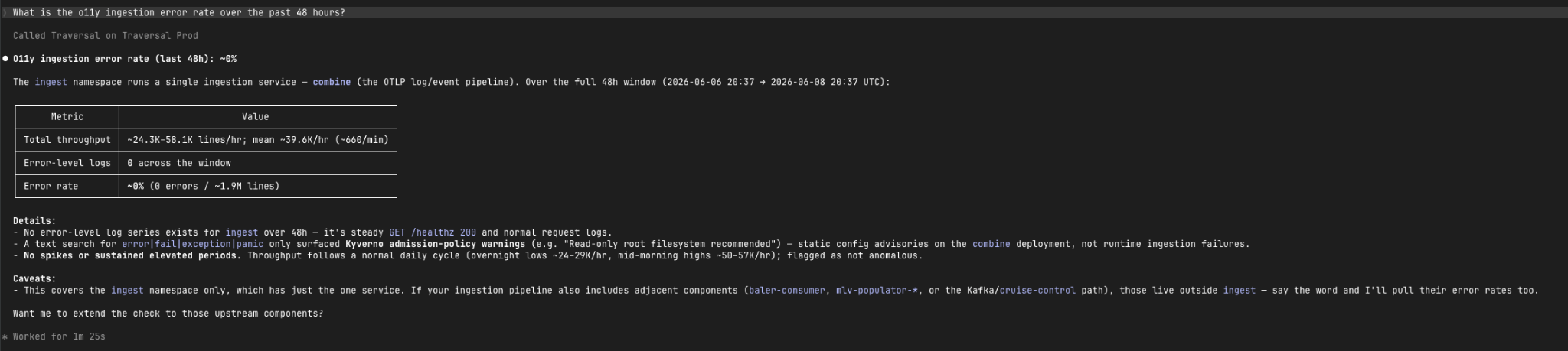
Production context, brought into code generation
The same connection changes the code you write, before any incident happens.
Right now an assistant writes against an idealized picture of your system. Connected through Traversal MCP, it writes against how your system actually behaves at that moment: your real topology, your dependencies, the baselines, what changed recently. The generated code accounts for the downstream service that can't take the extra load and steers around the pattern behind last month's cascade. The code lands already aware of where it's about to run. The cheapest incident is the one that never makes it into a pull request.
The loop compounds. Every investigation Traversal runs feeds back into the Production World Model™, which is the same model your code gets generated against. A new failure mode gets recorded. A dependency nobody had mapped gets added, and a baseline resets. The next time someone works on that part of the system, the context that would have let the same failure recur is already corrected. Production code usually decays as the system grows around it. Here, code becomes more resilient with each incident Traversal runs.
What Makes This Possible
An MCP server is only as good as the system behind it. The protocol exposes that system; it doesn't add any understanding of its own. Most MCP servers wrap an existing API, so the model fetches some data, reads it, fetches more, and rebuilds context from scratch every turn. That's fine for a quick lookup. It falls apart on a real production incident, where the work is stateful and the answer sits several hops deep.
Traversal MCP runs on two key architectural layers built for exactly that work.
The Production World Model™ is a live, AI-readable model of your whole production environment: what's running and how it all connects, with a current sense of what normal looks like. It's built from your telemetry and code, captured through Agentless Data Capture™ and re-indexed by the Causal Indexer™ so the causal signals are preserved, while keeping the cost of reasoning over petabytes of telemetry from scaling with it. It keeps itself current as you change things, discovering new services and remapping dependencies and causal relationships on its own.
The Causal Search Engine™ does the investigating on top of that model. In a real incident, the cause is rarely sitting where the symptom showed up. It's usually several hops away, in a different part of the stack, and the engine follows the chain to find it: from the app where the alert fired, down through the services behind it and the infrastructure and network underneath, often 10 or more hops out. It can trace that far because it doesn't test one hypothesis at a time. It runs roughly 10,000 analytical queries in parallel, in the time an older approach gets through a few hundred, and drops every path that doesn't fit your system's real topology and timing until one diagnosis is left.
All of it happens in one place. You're not reading raw telemetry or rebuilding a timeline out of JSON, and you're not jumping between a dashboard and a chat window to do it. Findings come back as structured output you can act on, ranked hypotheses with the evidence and the components they point to, inside the same environment where you write code.
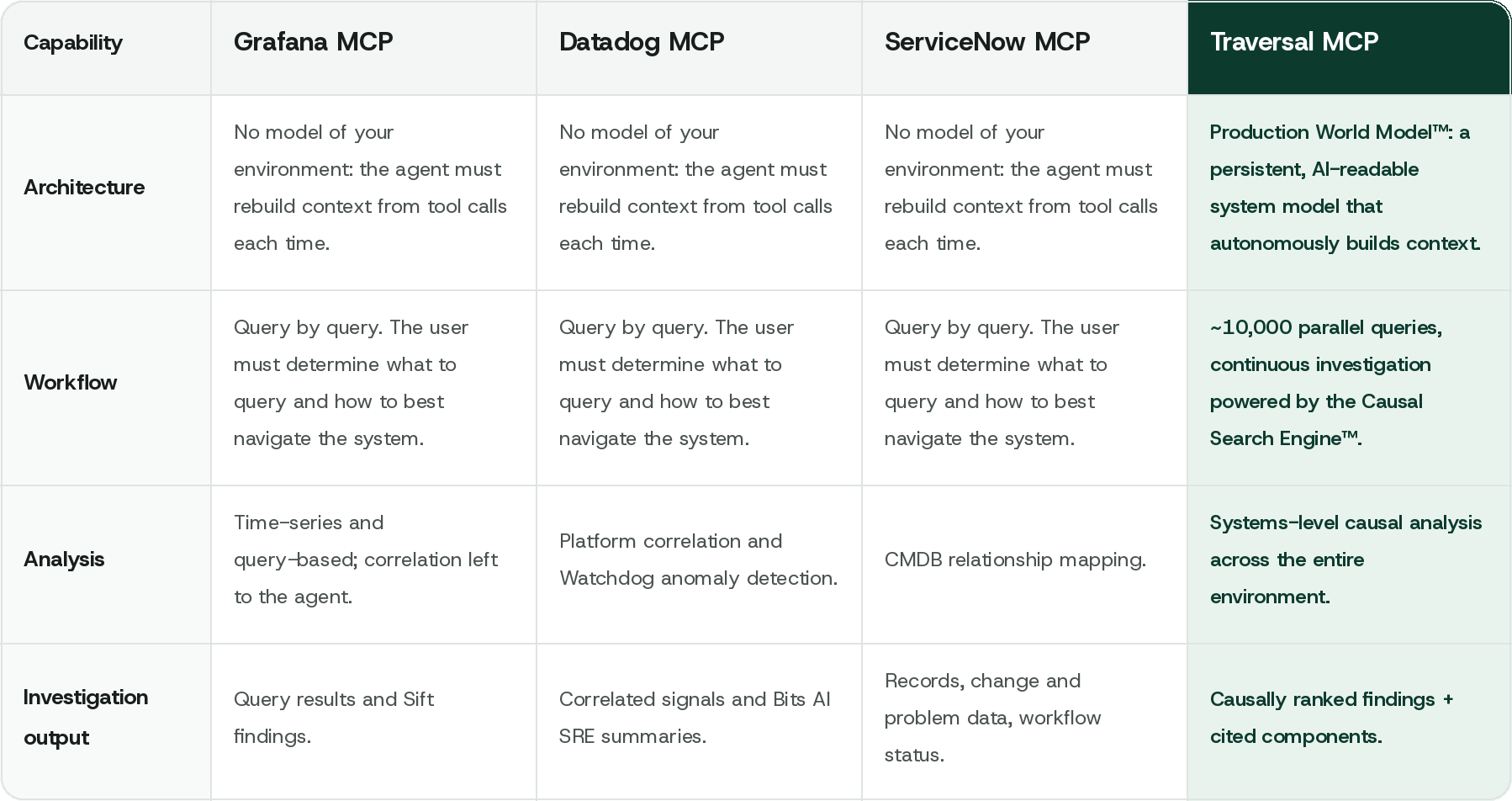
The difference shows up cleanly when you line the MCPs up by what they actually do during an investigation:
Getting Started
Companies have invested heavily in AI coding tools and have seen real acceleration in how fast code ships. However, shipping faster into a production system you can't see clearly mostly means breaking it faster. The gap between how fast code ships and how well anyone understands where it lands is where the return on those tools quietly leaks away.
Traversal MCP closes it. It turns an interface that helps engineers write code into one that helps them run the production systems that code runs in, and it keeps the whole thing in one place. Engineers investigate and ship from the interface they already work in, instead of switching tools and rebuilding context every time something breaks.
The part that compounds sits upstream of any incident. Because the same production context is available while code is being written, what your team generates is shaped by how the system actually behaves, and it ships less likely to take that system down. Each incident Traversal investigates updates that context, so the next change written against it is safer than the last.
Book a demo to see Traversal MCP in action.


What is Software Reliability? A Practical Guide for Modern Production Systems

Top 5 Systems for Managing Escalations Efficiently in 2026: What Actually Shortens the Escalation Chain