What is Site Reliability Engineering (SRE)?

Site reliability engineering (SRE) is the practice of running production systems as a software engineering problem. It uses measurable reliability targets, automation, and disciplined incident response to keep services as reliable as users need.
Ask a room of engineers "what is site reliability engineering?" and many will describe an uptime team watching dashboards. The practice was built for something sharper: turning reliability into a decision tool that tells teams when to ship and when to stop. At enterprise scale, its hardest problem is explaining why a service failed, long after the alert has confirmed that it did.
A working grasp of SRE covers its origin, core principles, daily responsibilities, the overlap with DevOps, first steps, and how AI is reshaping the work. SLOs and error budgets tell your team when reliability is slipping, and the diagnosis behind each incident is a separate problem.
What is site reliability engineering?
Site reliability engineering is a discipline that applies software engineering to operations. Teams manage reliability with code, measurable targets, and automation instead of manual effort.
SRE took shape at Google. According to Google's SRE book, Ben Treynor Sloss joined Google in 2003 and was tasked with running a small "Production Team" at the company. His description of the approach: "SRE is what happens when you ask a software engineer to design an operations team."
The acronym names both the discipline and the person who practices it, the site reliability engineer. SRE is a job role and a set of practices, and many organizations adopt the practices before they hire for the role.
Reliability itself has a plain meaning: a service does what its users need, when they need it. A service can be up and still unreliable if checkout pages time out or search results arrive stale.
What are the core principles of SRE?
Every SRE principle points at one goal: make reliability measurable, so teams make tradeoffs on purpose instead of by instinct. Targets define what good looks like, budgets decide when to slow down, and toil limits protect the time needed to improve.
What are SLIs, SLOs, and SLAs?
An SLI is the measurement, and an SLO is the internal target for that measurement. An SLA is the external contract, with consequences if the target is missed.
Together they form a ladder from raw signal to business commitment:
- SLI (service level indicator): A measured signal of user experience, such as the share of checkout requests that succeed within a latency threshold.
- SLO (service level objective): The internal target the team commits to for that SLI, measured over a rolling window.
- SLA (service level agreement): The external contract with customers, usually looser than the SLO, with credits or penalties if it is missed.
Teams set SLOs below perfect on purpose. Past a certain point users cannot tell the difference, and every additional nine costs more in redundancy, process, and slower releases. A well-chosen SLO tells the team how much reliability is enough.
What is an error budget?
An error budget is the amount of unreliability an SLO allows. It covers the failed requests or minutes of downtime a service can absorb in a period.
Budget math settles the oldest argument between developers and operators. While budget remains, teams keep shipping; once it is spent, they slow releases and put engineering time into reliability. Traversal's glossary entry on how error budgets work walks through the arithmetic behind that policy.
The common failure is an SLO with no error budget policy behind it. Practitioners often say budgets get ignored the moment a launch date looms, because nobody gave the SRE team authority to enforce them. Without that policy, the SLO becomes one more number on a dashboard.
A burning budget also has limits as a signal. It confirms that users are feeling unreliability, and it says nothing about the cause.
What is toil, and why does SRE cap it?
Google's SRE Workbook on toil defines toil as "the repetitive, predictable, constant stream of tasks related to maintaining a service." Manually freeing disk space, restarting applications that leak memory, and closing alert-generated tickets all count. The Workbook concludes that toil grows at least linearly with a service's complexity and scale.
In Google's SRE book, Google set a 50% cap on aggregate ops work for its SREs, reserving the rest for engineering that removes future work. Many teams call this the "50/50 rule." It reflects Google's own practice, and each organization should set a ceiling it can defend.
Blameless postmortems close the learning loop. After an incident, the team records what happened, which contributing causes lined up, and what follow-up work will prevent a repeat. The review focuses on systems and decisions, and no one is singled out for blame.
What does a site reliability engineer do?
A site reliability engineer keeps services within their reliability targets by defining SLOs, automating operational work, responding to incidents, and fixing the causes behind them. The daily work spreads across six areas:
- Reliability targets: Define SLIs and SLOs with product owners, so targets reflect what users actually need.
- Monitoring and alerting: Alert on symptoms users feel, such as errors and latency, rather than on every internal metric.
- Incident response and on-call: Carry the pager, coordinate responders, and restore service when an SLO starts burning.
- Root cause analysis and postmortems: Work out why an incident happened and turn the findings into follow-up engineering work.
- Capacity planning and change management: Forecast demand and ship changes safely with canaries, progressive rollouts, and rollbacks.
- Automation: Replace toil with code, such as self-service tooling and scripted runbook steps.
The role asks for a wide skill set. SRE roles typically ask for production coding in at least one language, plus working knowledge of Linux, networking, distributed systems, cloud platforms, and containers. Clear communication under pressure matters as much, because incidents are team events.
How is SRE different from DevOps?
DevOps is a broad set of principles for collaboration between development and operations. SRE is one concrete way to implement them, with specific roles, metrics, and practices.
The contrast shows up in three places:
- Scope: DevOps shapes culture across the whole software lifecycle, while SRE focuses on the reliability of production services.
- Measurement: DevOps teams often track delivery metrics, while SRE teams manage against SLOs and error budgets.
- Ownership: DevOps spreads operational responsibility across teams, while SRE assigns it to engineers with explicit reliability mandates.
Some practitioners argue the line is often just a title, and others dismiss SRE as rebranded ops. The practical test is authority: if the SRE team can slow releases when the error budget runs out, the practice is real. If it cannot, the organization has renamed its operations team.
Why does site reliability engineering matter?
SRE matters because outages are expensive and production complexity keeps rising, so reliability has to be managed as deliberately as features. Four drivers make the case for leaders:
- Outage cost: In Uptime Institute's 2026 outage analysis, 57% of respondents said their most recent major outage cost more than $100,000.
- Shared language for tradeoffs: Error budgets turn reliability arguments into data, so product and engineering leaders negotiate with the same numbers.
- Pace of change: More services, deploys, and dependencies create more ways for one change to break something downstream.
- Engineering time: Toil limits protect the senior engineers who carry system knowledge and would otherwise lose their weeks to repetitive work.
Uptime drew that figure from its 2025 Annual Survey of IT and data center operators. For a leader, the takeaway is that reliability spending competes with a real, recurring loss.
Why does SRE get harder at enterprise scale?
SRE gets harder at scale because the practice measures failure well but explaining failure depends on understanding how thousands of services affect each other. SLOs and alerts fire on symptoms. The cause often sits several dependency hops away, in a service the on-call engineer does not own and may never have opened.
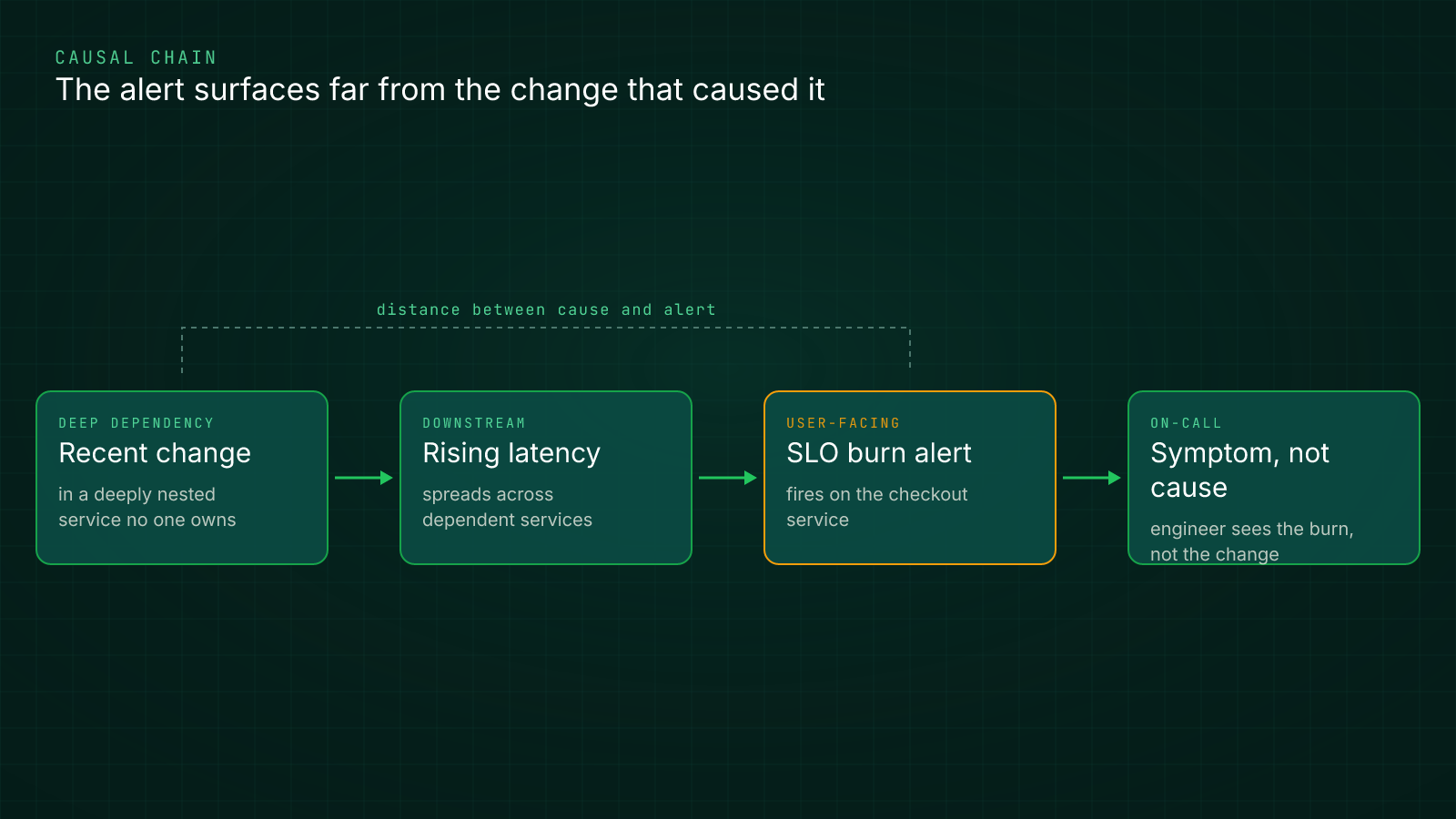
Much of the incident clock goes to diagnosis rather than the repair. Engineers open dashboards, line up timestamps across services, and test and discard hypotheses one at a time. Traversal's analysis of where incident time goes shows the investigation, more than the remediation, stretching recovery.
Measuring failure and explaining it are different jobs.
In Traversal's view, monitoring and observability tools were built mainly to collect signals and display them for a person to interpret. They do that job well, so diagnosis tends to depend on how many experienced people are in the war room. When those people are asleep, on leave, or new to the system, recovery tends to take longer.
How do you get started with site reliability engineering?
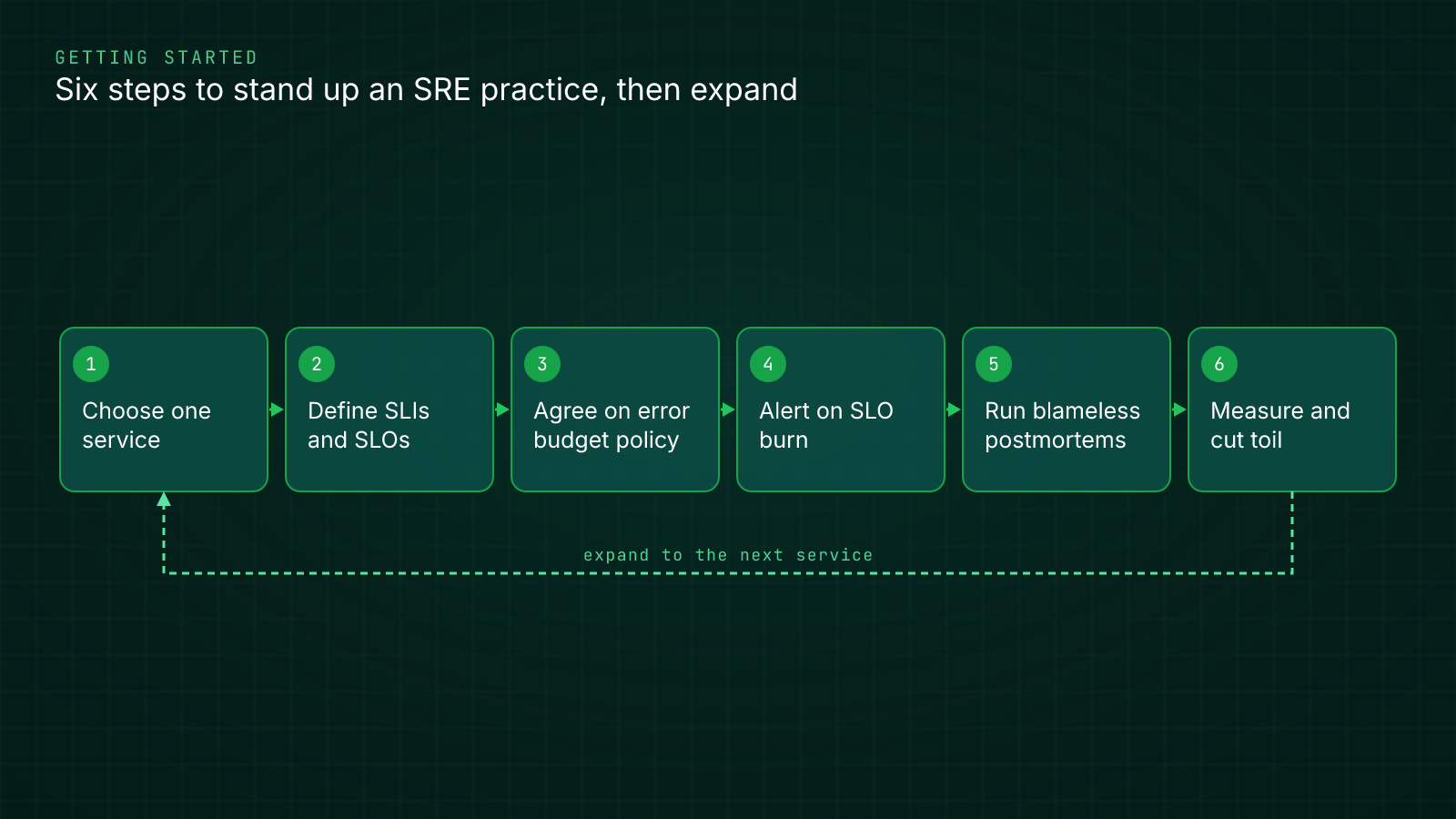
Start small: pick one critical, user-facing service, define what reliable means for its users, and build the practices around that target before expanding. Treat the steps as a sequence, because each one depends on the target set before it.
- Choose one service. Pick the service whose failure users and executives notice first.
- Criteria: User-facing, business-critical, and owned by a named team.
- Action: Write down the top user journeys the service supports.
- Define SLIs and SLOs. Translate those journeys into measurable signals and targets.
- Inputs: User journeys and recent performance data for the service.
- Action: Set each target below perfect reliability, at the level users actually need.
- Agree on an error budget policy. Decide in advance what spending the budget triggers.
- Action: Write down what happens when the budget runs out, such as a release freeze.
- Sign-off: Get product leadership to approve the policy before the first breach.
- Alert on SLO burn, not every metric. Page people only when users feel the problem.
- Action: Page on user impact and error budget burn rate.
- Routing: Send everything else to tickets for business-hours review.
- Run blameless postmortems. Treat every significant incident as a chance to learn.
- Action: Record the timeline, contributing causes, and follow-up work.
- Feedback: Feed fixes back to development so the same failure does not return.
- Measure and cut toil. Protect engineering time with data.
- Action: Track the hours that go to manual, repetitive work each week.
- Priority: Automate the largest sources of toil first.
How is AI changing site reliability engineering?
AI is changing SRE by taking on investigative work, such as triaging alerts and working out root cause. SREs keep ownership of reliability targets and decisions.
The pressure comes from the volume of change. DORA's 2025 research on AI-assisted development found that AI adoption improved software delivery throughput but still increased delivery instability. DORA called AI "an amplifier" of the practices a team already has.
DORA described AI adoption as associated with higher instability in its survey data. It measured instability through change fail rate and rework rate rather than outage counts. Even so, more change reaching production means more for SREs to keep reliable.
Two kinds of AI tend to share the label. AI added to dashboards was designed to make existing data easier to query, which leaves the reasoning with the engineer. AI SRE refers to agentic systems that investigate and diagnose incidents, working through the evidence the way an experienced SRE would.
AI SRE extends the practice rather than replacing the people in it. Engineers spend less time hunting and more time on targets, design, and prevention.
How does Traversal approach site reliability engineering?
Traversal gives SRE teams an AI SRE that explains why incidents happen, by reasoning causally over a live model of the production environment. Its architecture exists to answer one question during an incident: what caused this, across every dependency involved?
Five components do that work, and Traversal Workers deliver the result:
- Agentless Data Capture™: Ingests telemetry, code, and change data with read-only, schemaless capture and no agents to install.
- Causal Indexer™: Performs causal distillation without sampling, keeping the causal dependencies in production telemetry while discarding redundancy.
- Production World Model™: Maintains a live, machine-readable model of services, dependencies, and changes across the environment.
- Knowledge Bank™: Holds runbooks, postmortems, and debugging heuristics as mostly auto-discovered operational knowledge, with human input as a last-mile refinement layer.
- Causal Search Engine™: Tests hypotheses in parallel across many dependency hops and returns one causally consistent root cause.
- Traversal Workers: Join Slack or Microsoft Teams incident channels when an incident fires, run the investigation, and draft the postmortem when it closes.
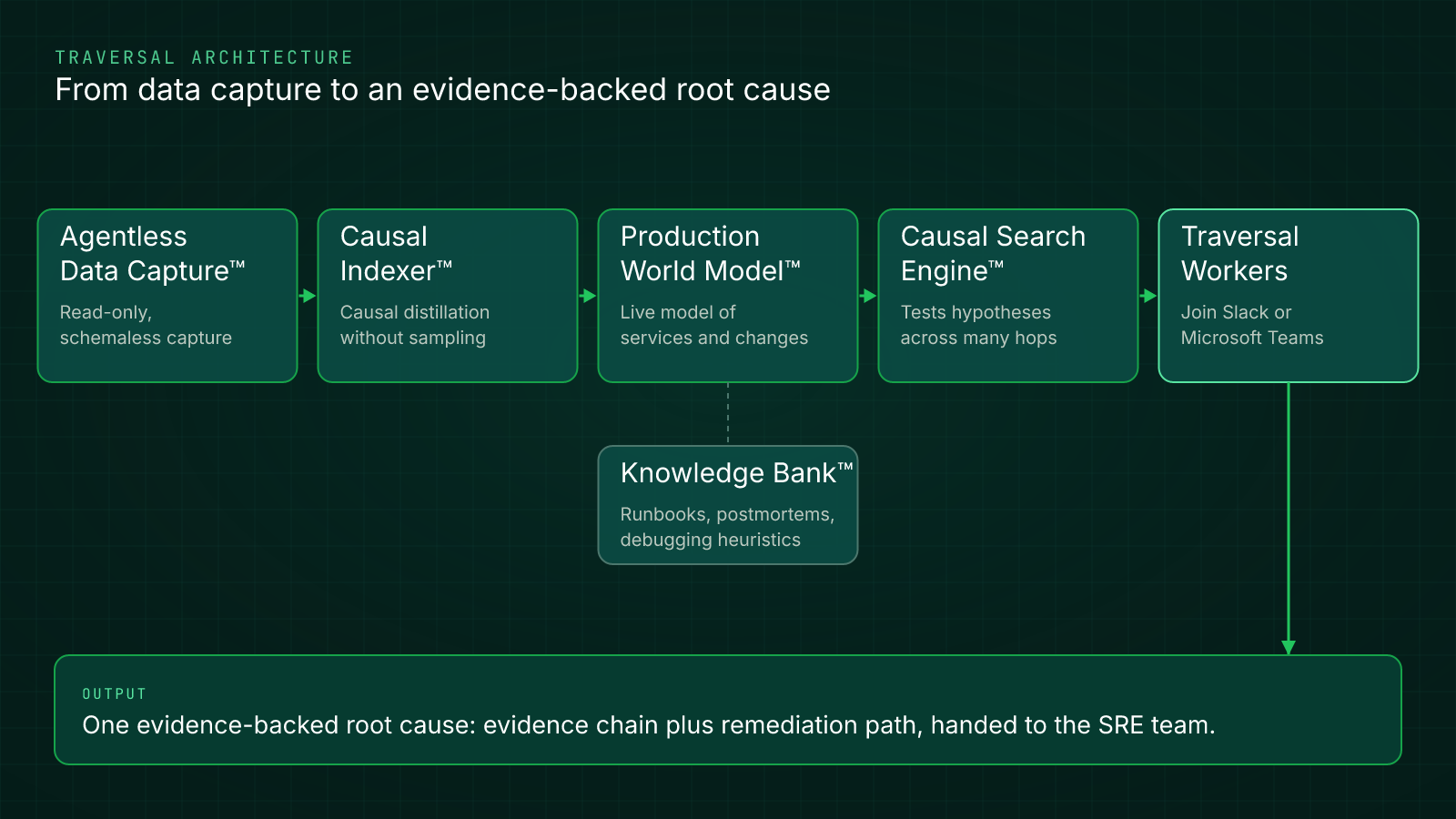
Because the investigation runs against a live model of production, the search can follow multi-hop dependencies that no single dashboard shows. The output is one evidence-backed root cause, with the evidence chain and a remediation path. Your team reviews the evidence, decides on the fix, and carries it out.
DigitalOcean's results with Traversal included a 38% reduction in mean time to recovery. In one incident, Traversal identified the root cause within minutes of the incident channel opening: a recent change in a deeply nested, non-obvious service. The team rolled back the pull request and restored service.
Low diagnostic latency matters here, because every minute spent investigating is a minute users feel the failure. Traversal runs on-premises or in your own cloud (BYOC). With BYOM, you can run Traversal with your preferred LLMs, including self-hosted or customer-managed models.
What is the bottom line?
Site reliability engineering is software engineering applied to operations, with SLOs and error budgets that turn reliability into a decision. Toil limits and blameless postmortems keep SRE teams improving instead of just keeping up. At enterprise scale the harder job is explaining why a service failed, and AI SRE extends the practice at that point.
FAQ
SRE stands for site reliability engineering, the discipline, and site reliability engineer, the role.
No. DevOps is a broad set of collaboration principles, and SRE is a specific way to practice them with defined roles, SLOs, and error budgets.
SRE roles typically call for software engineering skills plus working knowledge of Linux, networking, distributed systems, and cloud platforms. Clear communication during incidents matters too.
Small teams rarely need a dedicated SRE team, but they benefit from SRE practices such as SLOs, error budgets, and blameless postmortems from the start.
No. AI SRE takes on investigative work such as triage and root cause analysis, while engineers keep ownership of reliability targets, decisions, and system design.