Inside Traversal's Architecture: What It Takes to Find Root Cause at Scale

Every AI SRE platform promises root cause in minutes.
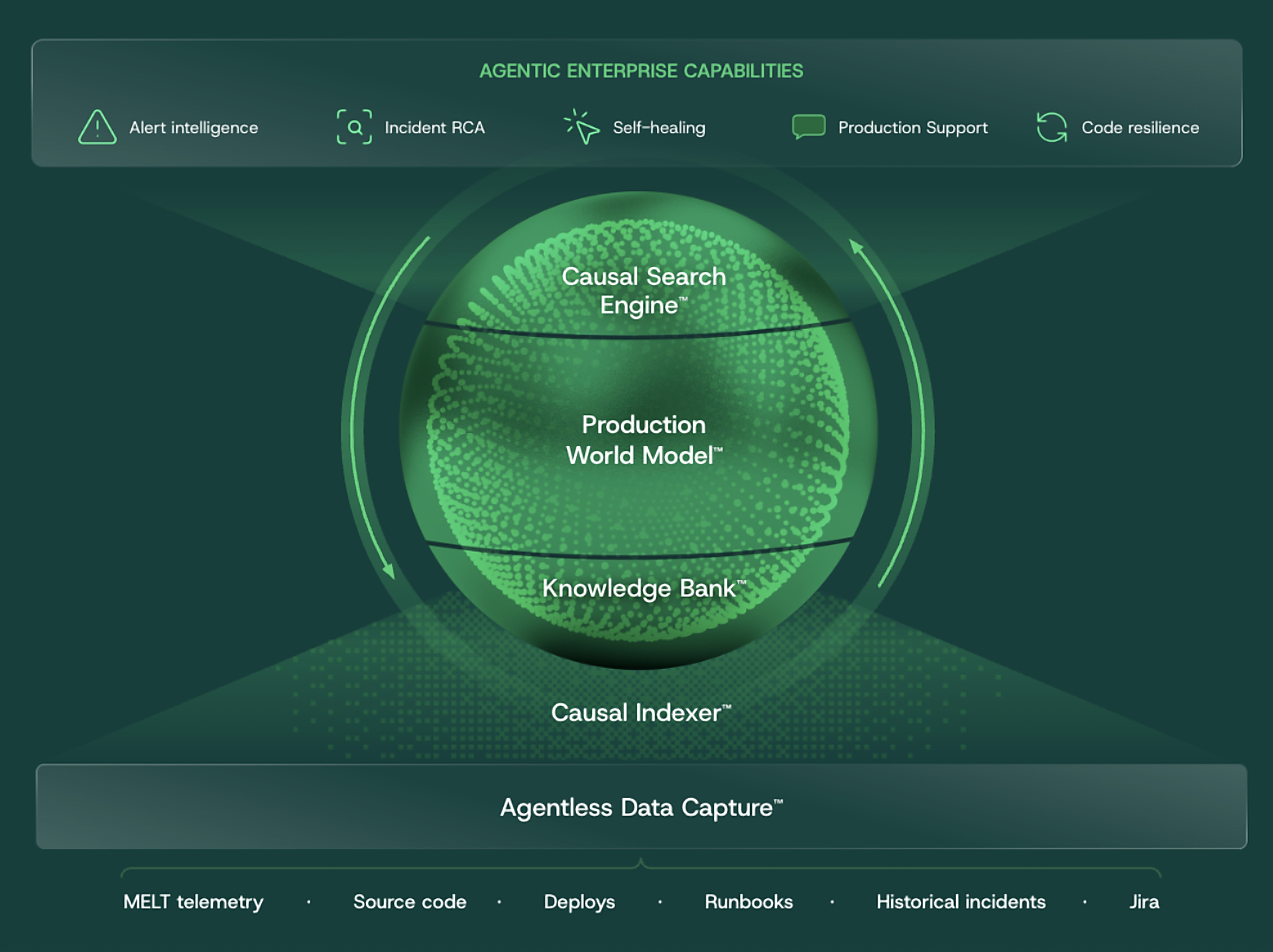
Almost none survive contact with a real production environment: petabyte-scale telemetry, dozens of unreconciled schemas, a signal-to-noise ratio that breaks naive agentic reasoning. Traversal's architecture is five layers, each engineered around a constraint that would otherwise cap accuracy, latency, or cost at enterprise scale. Here's how they fit together.
To see Traversal’s architecture in action, book a demo.
Agentless Data Capture™
Traversal first connects over read-only APIs. Agentless Data Capture™ captures everything from your existing stack, in whatever format each source already speaks: tribal knowledge and incident history; time-series metadata and error/warning logs; the telemetry pipeline (MELT); and code, infrastructure, and deploys, all captured natively, with nothing installed on your hosts: no sidecars or agents, nothing new for a security team to approve. That clears the access bar, but access alone doesn't make the data usable.
Every source—whether it’s Datadog, Splunk, or a decade-old internal data lake—encodes the same signal in a different schema. Reconciling them is normally a standing data-engineering commitment, not a one-time setup step. Traversal parses each source's native schema directly and infers topology from the telemetry itself, so nothing has to be mapped to a common format before an agent can reason across it.
Underneath that sits a second architectural choice most platforms don't make: continuous, event-driven push alongside on-demand pull, so a deploy lands in the model within seconds of shipping rather than waiting to be polled. That keeps live query volume low exactly when it matters most: during an incident, when every other consumer of the same API is competing for the same rate limit.
Causal Indexer™
Raw telemetry is too vast to reason over directly, and the naive fix—sampling—destroys exactly the information an investigation needs. At 1,000:1, random or fixed-interval sampling has no way of knowing in advance which lines will matter, and even when it keeps a deviating line, it has no mechanism for preserving how that line relates to anything else. It's lossy at the data-point level and blind at the relationship level.
The Causal Indexer™ takes a different approach: it continuously extracts the causal dependency structure between entities directly from raw MELT data, at the source, before anything reaches an inference step. Routine, in-baseline activity collapses to a pattern, a count, a statistical baseline. What deviates is preserved at full fidelity, along with the dependency edges tying it to whatever moved upstream first. The result is a footprint as much as 1,000x smaller with none of sampling's information loss: a petabyte compressed to a terabyte that still answers "how many errors between 2:47 and 2:53, and what upstream change correlates" as a queryable fact rather than a reconstruction.
Knowledge Bank™
Even a model built entirely from empirical telemetry has a ceiling: some operational knowledge was never emitted as a metric in the first place: the unwritten exception, the business constraint behind a threshold, the workaround an engineer carries but never filed. Knowledge Bank™ closes that gap, and makes the closing legible instead of implicit.
Knowledge Bank™ unifies four surfaces into one workspace: Skills that shape the steps an investigation takes, Documentation the agent can retrieve mid-investigation, Memories accumulated from prior incidents, and an auto-generated wiki, the Traversal Wiki, that regenerates continuously from your systems, code, and telemetry rather than decaying like a static doc. A correction doesn't just overwrite a file; it gets reconciled against existing evidence and prior notes, and propagates across the Production World Model™. Traversal can also propose durable knowledge from a live investigation.
If Traversal flags a service's elevated error rate as anomalous when it's actually expected behavior during a known nightly batch job, an engineer leaves a note on that entity once. It's visible to the team immediately, and folded into Traversal's reasoning for every investigation after. None of this is required setup. Skip it and Traversal still reasons from telemetry and code alone. Use it and you're compounding a foundation that already exists.
Production World Model™
Everything above feeds a single, continuously updated representation of your entire production environment: the Production World Model™. It's the structural difference between having telemetry and having understanding. Data provides empirical ground truth of how your systems behave, but on its own, it's still too vast and unstructured for an agentic system to reason over. The Production World Model™ is what makes causal relationships within your entire production environment legible to AI.
Critically, the Production World Model™ has no application-boundary silos: a dependency chain from a customer-facing frontend through a microservices layer to a third-party API to underlying database infrastructure is one connected, searchable structure. And because it rebuilds itself continuously from telemetry and code rather than being maintained as a document, it's most accurate exactly when accuracy matters most: during an incident, after a recent change, the first time a new failure mode appears.
Causal Search Engine™
A model of your environment is only as useful as the reasoning process that searches it, and this is where most of the category quietly plateaus at correlation: clustering what spiked together and handing back a ranked list of suspects, because evaluating hypotheses one at a time through a rate-limited API is the only architecture a sequential, dashboard-driven approach affords.
The Causal Search Engine™ is built on a different premise, informed by the founding team's research in causal machine learning: search the Production World Model™ in parallel, testing each hypothesis against your system's actual dependency structure, timing constraints, and propagation patterns. Over 1,000 hypotheses are evaluated at once, tracing root cause across 10+ hops and 100M+ entities, with a false positive rate under 1%.
In the end, what survives isn't the signal that looked most dramatic or the alert that fired first. It's whatever remains causally consistent with everything else the model knows, which is what turns a list of correlated suspects into a single diagnosis with an evidentiary chain and a proposed remediation path, delivered in minutes rather than hours of sequential dashboard queries.
One Architecture, Not Five Features
Most AI SRE platforms fail the same way. They get one piece right: a good model, a clever agent, a nice UI. But a model is only as good as what it can see; what it can see is only as good as what survived extraction; and none of it matters if the search process still checks hypotheses sequentially.
Traversal works because every layer was built to remove the constraint the layer above it would otherwise inherit. That's the difference between a product with an AI feature and an architecture purpose-built for causal reasoning at production scale, and it's what Traversal’s self-driving production actually runs on. Book a demo to see Traversal in action.