Introducing Knowledge Bank™ 2.0


The best SREs carry an enormous amount of tribal knowledge: configurations, workarounds, and the history of what has broken before and why. That hard-won context is what lets them debug so effectively. Capturing this knowledge, however, has traditionally meant creating another job for the team: writing runbooks, documenting every exception, updating it all as systems change. Most AI SRE tools inherit that same limitation, starting from zero and becoming useful only after your team painstakingly teaches them everything by filing out thousands of markdown files.
At Traversal, we've always taken the opposite view: you should never have to teach Traversal your systems for it to work: the agent should do the learning, autonomously and continuously. From the moment you connect it, Traversal reads your entire production environment and autonomously builds a model of every causal relationship across your system, the Production World Model™. Anything you add is a last-mile optimization, never a crutch.
Today, we're introducing the next generation of Knowledge Bank™: see what Traversal has learned about your environment, correct it with notes, add what lives in your team’s heads, and watch that understanding sharpen over time. Book a demo →
See and shape what Traversal knows
The original Knowledge Bank™ gave teams a way to augment Traversal's understanding with their own operational knowledge: you could upload runbooks, documentation, and other context that Traversal could retrieve and apply during an investigation.
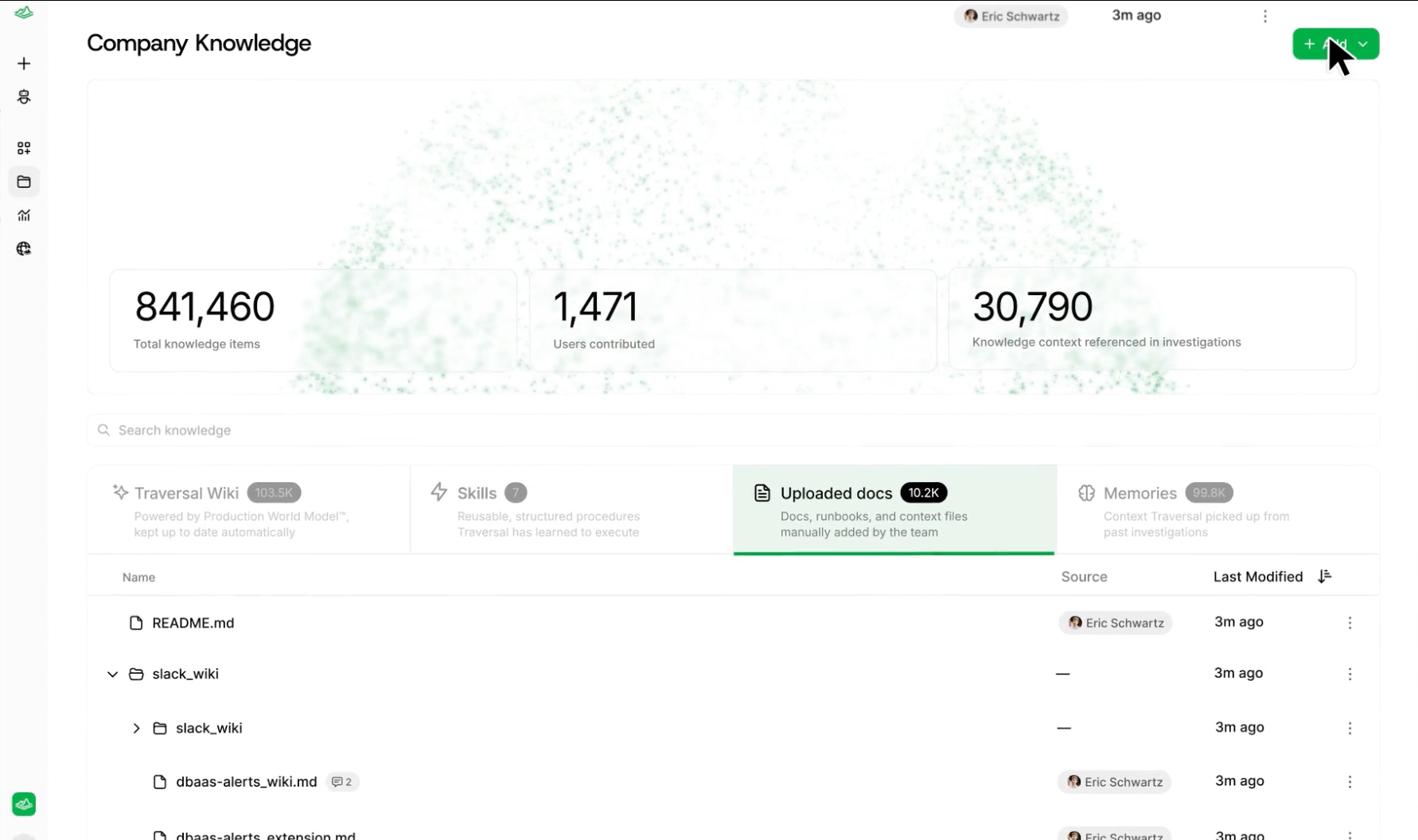
Now, Knowledge Bank™ makes Traversal's existing learning visible and gives your team clearer ways to shape it. It brings four parts together in one place:
- Traversal Wiki, an auto-generated wiki that Traversal continuously refreshes from your systems and code;
- Skills that shape the steps Traversal takes;
- Uploaded Documentation that adds information Traversal can draw on; and
- Memories captured from investigations.
The upgraded Knowledge Bank™ lets you inspect the understanding behind Traversal's investigations, add notes and corrections in context, and follow how that understanding evolves.
What's new
See what Traversal has already learned
Knowledge Bank™ makes that learning visible through the auto-generated Traversal Wiki: your services, infrastructure, recurring failure modes, and team practices, kept current as your systems, code, telemetry, documentation, and investigations change. Instead of taking Traversal's understanding as a black box, your team can open it up and see exactly what Traversal has learned, and where.
Add what only your team can know
Even the best AI can only learn from the evidence available to it. Traversal gives you a strong starting point, but some nuances live only in the experience of the people who have operated the system: the unwritten exception, business constraint, or hard-won workaround.
Knowledge Bank™ lets you add that last mile of context with a note directly on the relevant knowledge. Rather than changing the underlying file, your input moves through Traversal's knowledge pipeline, where it's reconciled with other notes and evidence and incorporated across the agent's understanding.
This is last-mile optimization, not required setup. If you never open Knowledge Bank™, Traversal still works. If you do, you sharpen a foundation it already built.
Watch Traversal learn over time
Every incident, alert, or question Traversal works on adds to the flywheel. Memories make that activity visible, showing context Traversal picked up during investigations.
Corrections, runbooks, and interactions sharpen that foundation further, closing the gap between what the data shows and what your team knows from experience.
Navigate it like a file system
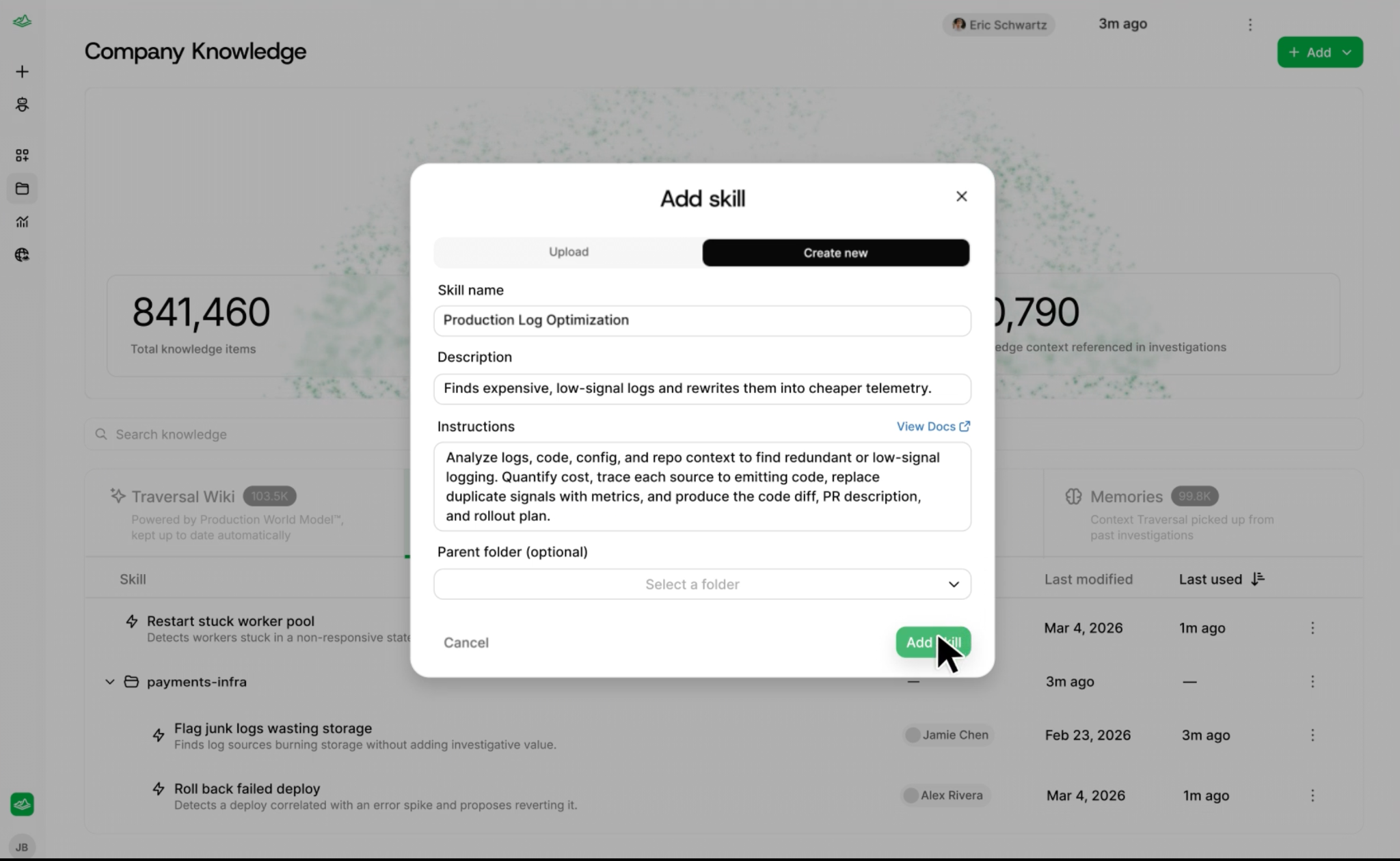
The experience has been rebuilt around a familiar file-system model. Skills, Uploaded Documentation, Memories, and the Traversal Wiki live in one organized workspace that's easier to browse and manage. Skills guide how Traversal works through an investigation; Uploaded Docs adds facts and context it can use along the way.
That makes Knowledge Bank™ useful to people, not just the agent. A new engineer can get up to speed on an unfamiliar service without hunting down the one person who remembers. A team can answer "how does this actually behave in production?" by looking instead of guessing.
Part of the Production World Model™
Everything in Knowledge Bank™ feeds into Traversal's Production World Model™, the live, AI-readable model of your entire production environment.
Every investigation adds to what Traversal knows. Traversal also proposes durable knowledge from live investigations, which your team can review before it takes effect.
Want to see what Traversal already knows about your systems? Book a demo →
FAQ
No. That's the core of it. Traversal doesn't start empty and require a lengthy onboarding process before it can be useful; Traversal learns your systems automatically and works out of the box. Knowledge Bank™ is optional refinement, not required setup. If you never open it, Traversal still works; if you do, you make it sharper.
You can create or upload skills that shape the steps Traversal takes, add documentation and notes that expand the information it can use, review memories, and browse Traversal's auto-generated wiki. Content your team authors is editable and live immediately. The Traversal Wiki is view-only: you can inspect and annotate it, but you don't edit it directly (see next question).
Anything your team authors or uploads—such as a file, runbook, instruction, or note—is available to Traversal for retrieval right away. Through its automated refresh process, Traversal also incorporates uploaded files and corrections into its generated knowledge, keeping its broader understanding unified and up to date.
Leave a note on it. It's immediately visible to your team in context, and it's folded into Traversal's understanding and weighed against everything else it knows. You're never stuck with a wrong inference and no way to say so.
Traversal can propose durable knowledge from what it learns in a live investigation: a note on an existing entity, or a new file. Those proposals are reviewed and approved by a human before they take effect. What your team writes lands immediately; what Traversal proposes is gated.


What is Software Reliability? A Practical Guide for Modern Production Systems

Top 5 Systems for Managing Escalations Efficiently in 2026: What Actually Shortens the Escalation Chain