
Traversal vs Rootly
Learn how Traversal reasons causally across your entire production environment at scale, see why it's architected for the enterprise from day one, and understand why it delivers one evidence-backed root cause instead of Rootly's confidence-ranked shortlist.

Traversal
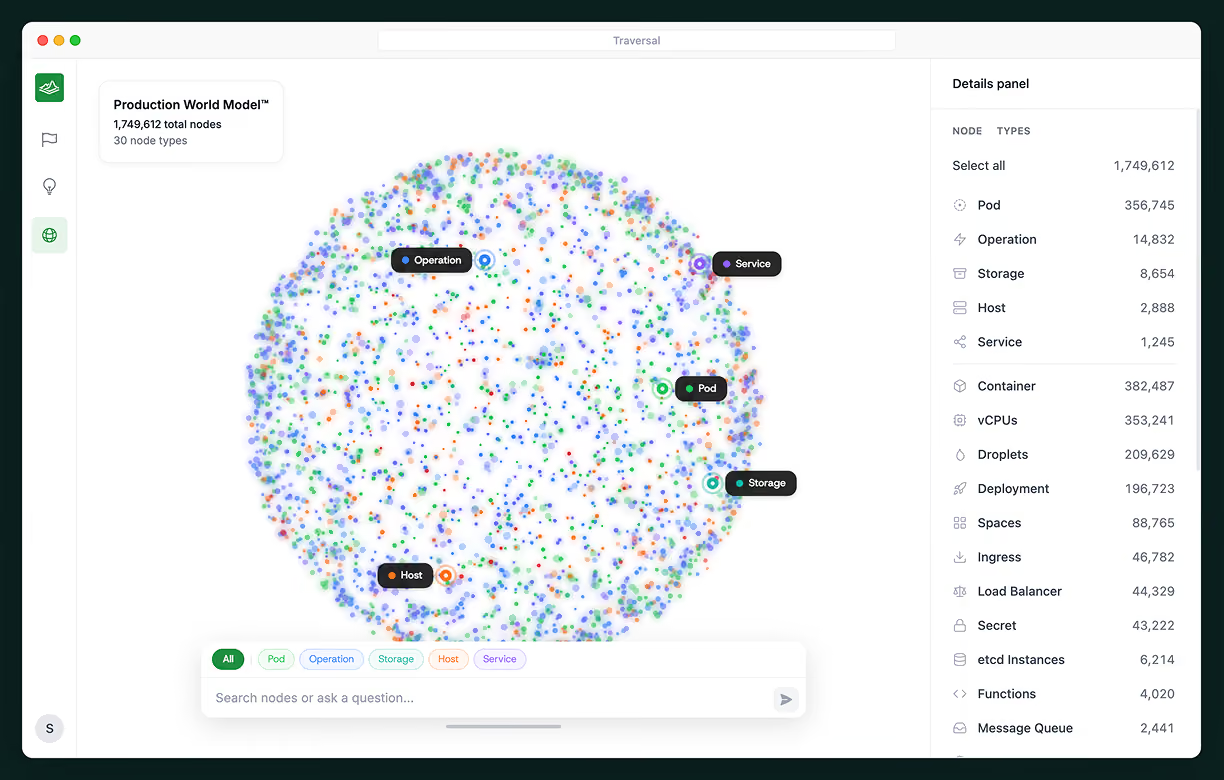
A live, autonomously updating causal map of your entire production environment featuring over 100M+ entities.
Distills petabytes of telemetry by 1:1000 scale, without losing any causal signals.
Autonomously and continuously learns from your runbooks, docs, and incidents. No manual tuning or markdown files required.
A live, autonomously updating causal map of your entire production environment, featuring over 100M+ entities.
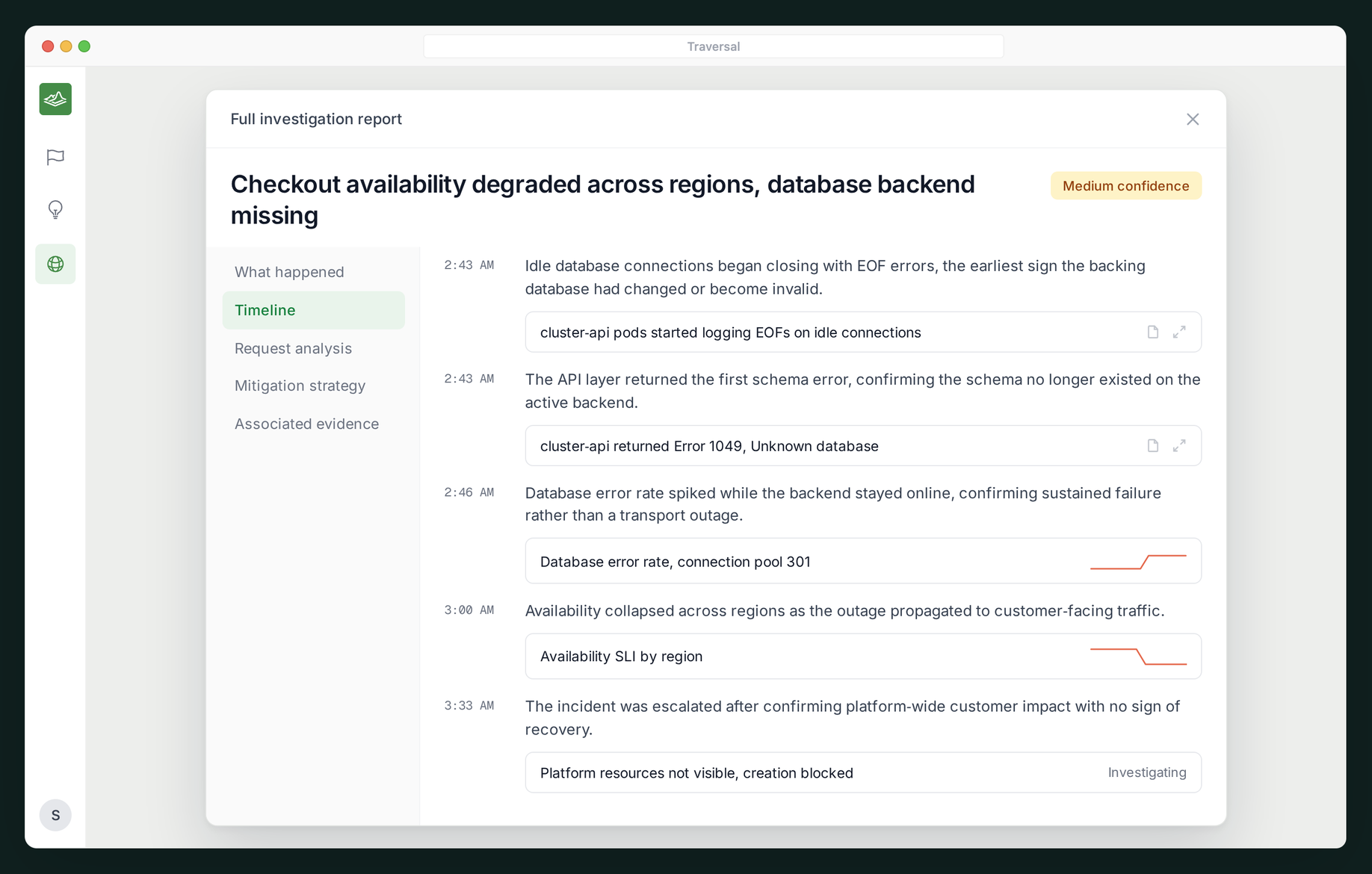
Searches 1K+ hypotheses in parallel to identify root cause across 10+ hops, featuring a <1% false positive rate.
WHY TRAVERSAL WINS
Grounded in years of causal reasoning and AI research.
That research is what makes causal reasoning at this scale possible. Traversal's Production World Model™ maps your entire environment continuously and autonomously, so the causal context is always current. The Causal Search Engine™ then searches that live model for the one root cause consistent with your system, not a shortlist correlated at alert time, like Rootly.
Built for what enterprise scale actually demands.
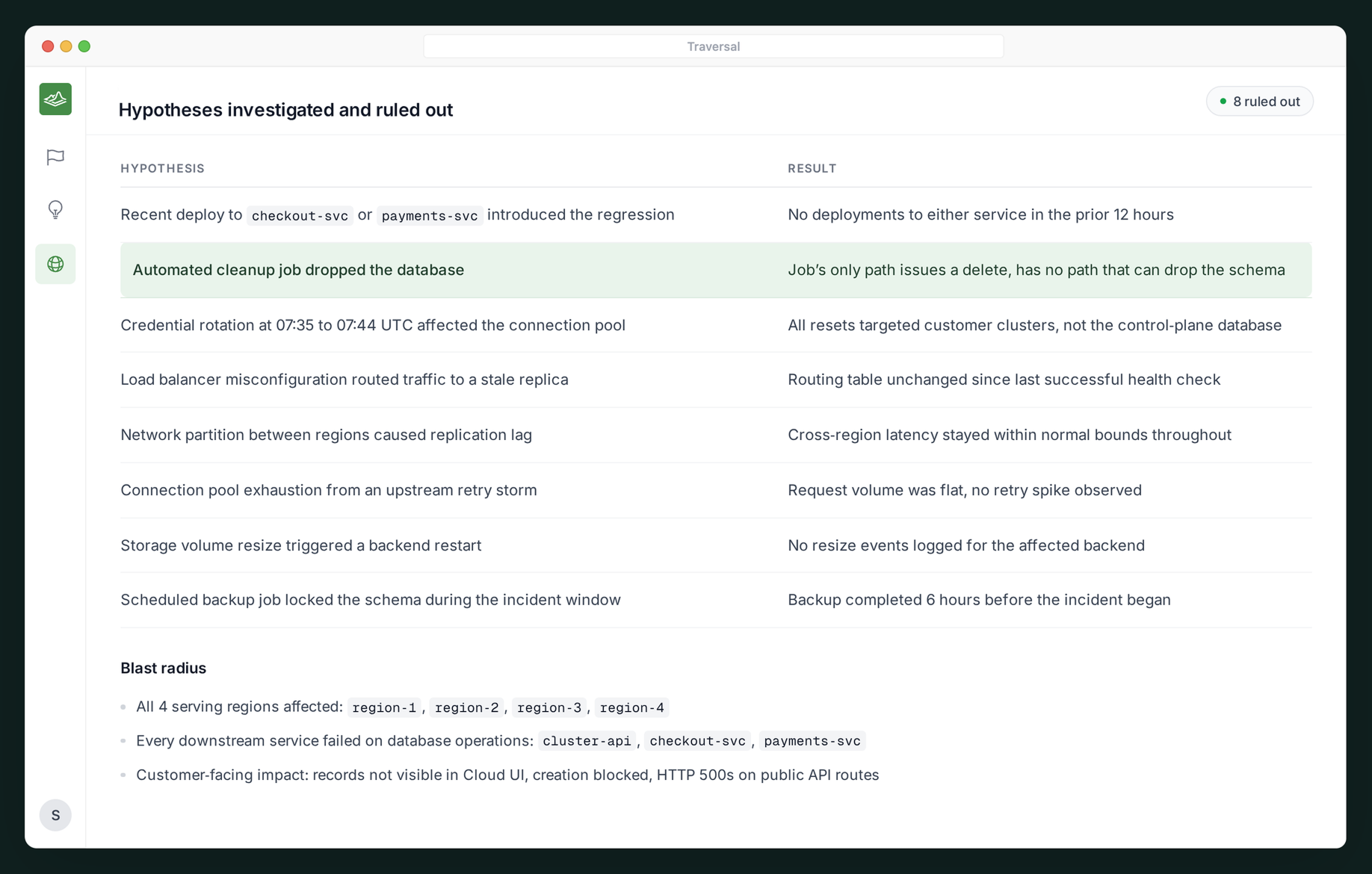
Production incidents don't stay confined to one service. Traversal tracks blast radius across regions and dependencies systematically, ruling out what didn't cause it, not sampling or approximating. At enterprise scale, correlation-based approaches like Rootly's surface more coincidences, not fewer; reasoning through cause and effect is what keeps the signal clean as the system grows.
Nothing to teach it. Nothing to maintain.
Traversal learns from every investigation automatically: no runbooks to write, no rules to tune, no forward-deployed engineering to keep it current. Rootly's AI gets better by building a library of past incidents to match against, which takes time, volume, and manual effort to pay off. Traversal reasons about cause and effect in your systems from day one, without anyone teaching it what to look for.
Battle-tested in mission-critical environments


“We took real customer incidents that used to take our engineers an hour or more to resolve — and Traversal’s agents were identifying root causes in under a minute.“


“We worked with Traversal to build a self-healing system for common web hosting issues like DDoS and disk errors. With 95%+ accuracy, it lets thousands of customers solve problems instantly, cutting downtime and support costs.“


“Instead of the company's engineers responding to incidents across their infrastructure manually, Traversal completes comprehensive RCA in minutes, ingesting 250 billion logs of interest every day.“


“For a F&B company, operating at Fortune 50 scale requires intelligent automation beyond traditional monitoring. Traversal’s AI SRE agents cut through this enormous complexity, automatically triaging alerts and surfacing root causes in minutes rather than hours.“


"[A key part of the] decision was because you have the BYOC product—for us, as a security-first company, that's a big plus. And we don't need to maintain extra context on our end. You handle all of that for us: building the Production World Model™, reading the documentation and other sources."
Frequently asked questions
Are Traversal and Rootly the same product category?
Not quite, even though both use the "AI SRE" label. Rootly AI SRE is an investigation layer built on top of an incident management platform: on-call, chat-led response, retrospectives, and status pages. Traversal is causal AI SRE from the ground up: a continuously updated model of your production environment that multi-hop root cause analysis runs on natively, not a feature layered onto a coordination tool.
What does Rootly AI SRE do?
Per Rootly's own product description, it analyzes alerts, code changes, telemetry, and past incidents, runs parallel hypothesis checks, and surfaces probable root causes with confidence scores
How is Traversal's root cause different from Rootly's confidence-scored probable causes?
Traversal targets one evidence-backed causal diagnosis and a remediation path. Rootly's confidence-scored probable causes leave a ranked shortlist for your team to compare and debate inside the incident record.
Does Traversal replace on-call scheduling or status pages?
No. Traversal isn't an on-call scheduler or a status page product. It investigates production failures and delivers diagnosis into the channels and workflows your team already uses.
Which has more accurate root cause analysis?
Across petabyte-scale enterprise production environments, Traversal reports 82%+ accurate root causes in under 5 minutes on average, where accuracy means output that produces mitigation steps.
What enterprise controls should we verify before choosing?
Confirm data residency and training policy, access levels (Traversal is read-only by default), BYOC/BYOM options if required, and how each product shows its reasoning,