Can an AI SRE Actually Help You Find the Root Cause?

An AI SRE can find the root cause when it reasons causally over a live model of your production environment. Point a general-purpose large language model (LLM) at your dashboards instead, and you mostly get a plausible explanation.
An AI SRE is an AI agent that takes on site reliability engineering (SRE) investigation work. A Fortune 100 financial services company reached 82% root cause analysis (RCA) accuracy with Traversal across its in-scope applications.
The real test behind "Can an AI SRE actually help you find the root cause?" is the kind of output you get. A plausible explanation sounds right in the war room; a causally consistent diagnosis holds up when you check it against what your system actually did.
The clearest way to judge the gap is on your own incident data.
Book a Demo to see how Traversal turns your incident data into one evidence-backed root cause.
What does it mean to find the root cause?
Finding the root cause means identifying the specific change or condition that set an incident in motion, with evidence showing how it produced the symptoms. Naming whatever looked most abnormal during the incident is a different act.
RCA is the work of getting from the alert to that starting condition, across three layers:
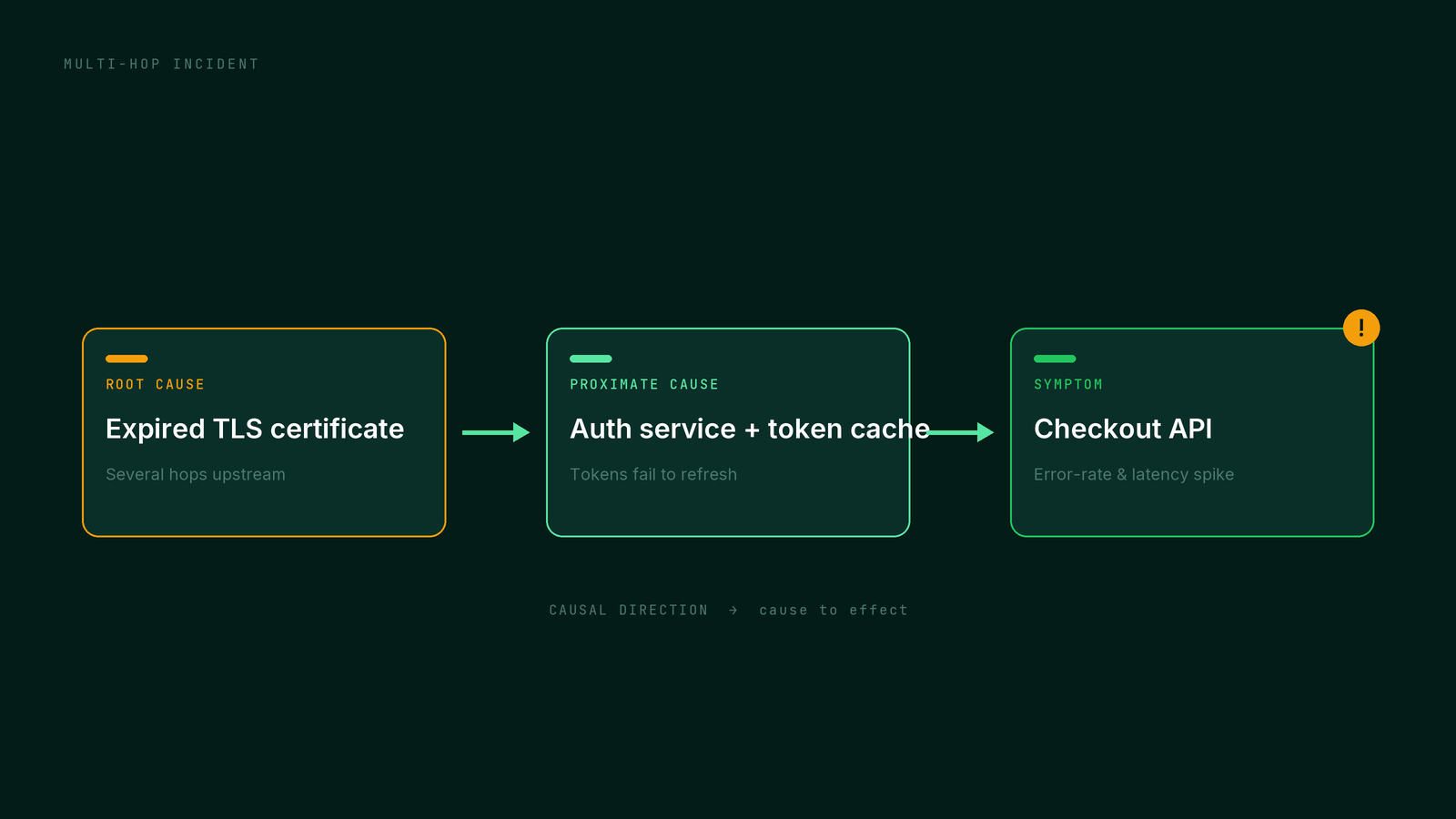
- Symptom: What you observe, such as a rising error rate or a latency spike on a checkout API.
- Proximate cause: The immediate mechanism, such as a saturated connection pool in the service behind that API.
- Root cause: The change or condition that started the chain, such as a bad deploy or an expired certificate.
Distributed systems blur these layers. Many signals can spike together, and the root cause often sits several service boundaries away from the alert. Engineers call this a multi-hop incident, because the failure crosses dependencies before anyone sees it.
Google's guidance on effective troubleshooting warns that correlation is not causation. Its SRE book adds that coincidental correlations multiply as systems grow and more metrics are monitored.
The same chapter notes that proving a cause in production can be difficult, and often only probable causal factors emerge. An incident can involve more than one contributing change. The requirement is an explanation consistent with how the system behaved, and a tidy label is no substitute.
Why does finding the root cause matter for incident recovery?
The root cause determines which mitigation will hold. A wrong diagnosis sends engineers after the wrong fix and keeps the incident open.
Microsoft's root cause research, an April 2025 preprint, called RCA "a critical and time-consuming step" in incident management. Its authors stated that identifying the root cause accurately and early can significantly reduce time-to-mitigate. For leaders, four costs follow from getting the diagnosis wrong:
- Mitigation choice: The same Google troubleshooting guidance puts stopping the bleeding first. Knowing what broke tells you which lever to pull.
- Rework: Acting on a wrong hypothesis means rollbacks and restarts that change nothing while customers keep seeing errors.
- War-room load: Each cross-team escalation pulls senior engineers off roadmap work to rule out their own services.
- Repeat incidents: Fixing a symptom leaves the cause in place, so the same failure returns under a new alert.
A wrong first diagnosis adds a second investigation on top of the first. That extra loop stretches MTTR (mean time to recovery), the metric leaders report upward.
Can a general-purpose LLM find the root cause on its own?
Rarely, on the evidence so far. Frontier models wired to telemetry and tools tend to return a confident, plausible answer that names a symptom rather than the cause.
Many teams first try pointing a frontier model at their observability tools. Two benchmarks show where the approach breaks.
Across 11 frontier LLMs, agents in the OpenRCA 2.0 benchmark study (June 2026 preprint) recovered the exact root-cause set in 20.7% of cases on average. The testbeds were synthetic fault-injection setups on three open-source microservice systems. The authors caution that the results do not automatically transfer to production.
A companion finding matters more for buyers. When an agent named a correct service, about one time in five it could not show a verified causal path to the symptom.
Traversal AI Research co-authored a second benchmark with Columbia University and Cornell Tech, built on production-fidelity RCA tasks in an instrumented test application. On the ORCA-bench on-call benchmark (2026), the strongest of five frontier models identified every root cause in only 25.3% of incidents at medium difficulty.
Its authors expect real-world performance to be lower still. Removing source-code access hurt every model.
Why do LLM agents chase symptoms instead of causes?
In Traversal's view, they chase symptoms because they have no model of how the system fits together. Without one, the loudest signal looks like the answer, even if it's far from it.
A general-purpose agent was built to reason over whatever text lands in its context window. Mid-incident, it has to rebuild topology and dependencies from scratch, one query at a time. The OpenRCA 2.0 authors described three recurring failure patterns:
- Loudest-signal fixation: Agents settled on the service with the biggest anomaly, even when that signal was downstream amplification.
- Early commitment: The first plausible cause ended the search before competing explanations were tested.
- Missing data mistaken for health: A service that had stopped emitting data looked fine, because the agent saw no anomaly in what wasn't there.
Traversal's research team sees a second ceiling in access: observability APIs were built for humans querying one view at a time. An agent can therefore test only a narrow slice of hypotheses before cost and latency stop it. On-call engineers have a blunt phrase for the result: "confidently wrong."
Will better models close the gap?
Not on their own, based on Traversal's benchmark. In Traversal's view, the limit is structural, so a stronger model wired to the same tools inherits the same blind spots.
Traversal tested this on real Sev-1 to Sev-3 incidents at a large financial-services enterprise. The baselines were frontier models with direct access to production tools through MCP (Model Context Protocol) connectors or raw APIs. Judges worked blind, with no answer key.
When Traversal was benchmarked against frontier models in that 2026 study, judges rated its RCA better 83% of the time than the strongest MCP setup. Traversal also finished first on average while working within a smaller time budget. The gap widened as the underlying models improved.
What does an AI SRE need to find the root cause?
An AI SRE needs five things: a live model of your production environment, complete evidence, hypothesis elimination, self-maintaining context, and a verifiable evidence chain. Each counters a failure pattern above.
- A live model of the system
- What it is: A current map of services, dependencies, baselines, deploys, and code, kept up to date without a hand-maintained configuration management database (CMDB).
- Why it matters: Without a map, the agent must guess how services connect while the incident is still unfolding.
- What to ask: How does the model stay current after a deploy, a migration, or a new service?
- Available evidence
- What it is: Access to telemetry, source code, and change history during an investigation.
- Why it matters: In ORCA-bench, removing source-code access lowered accuracy for every model tested.
- What to ask: Which data sources does the investigation read, and how does it adapt when one is missing?
- Hypothesis elimination
- What it is: Testing many explanations in parallel against topology and timing, then discarding every one that contradicts the system.
- Why it matters: Elimination separates a causally consistent diagnosis from the first story that fits.
- What to ask: Can it show why each rejected explanation failed?
- Context that maintains itself
- What it is: Runbooks, postmortems, and team heuristics captured from past investigations, without engineers hand-maintaining files.
- Why it matters: Static runbooks drift, and stale context points investigations at last quarter's architecture.
- What to ask: Who keeps the context current, and how much of it is discovered automatically?
- A verifiable evidence chain
- What it is: The path from cause to symptom, with the signals that support each hop.
- Why it matters: A service name alone gives engineers nothing to check before they act.
- What to ask: Can an engineer verify each hop of the chain against raw data?
Side by side, the two approaches diverge at every layer.
How does Traversal find the root cause?
Traversal builds a causal model of your production environment before an incident starts. It then tests hypotheses against that model in parallel to return one evidence-backed root cause and a remediation path.
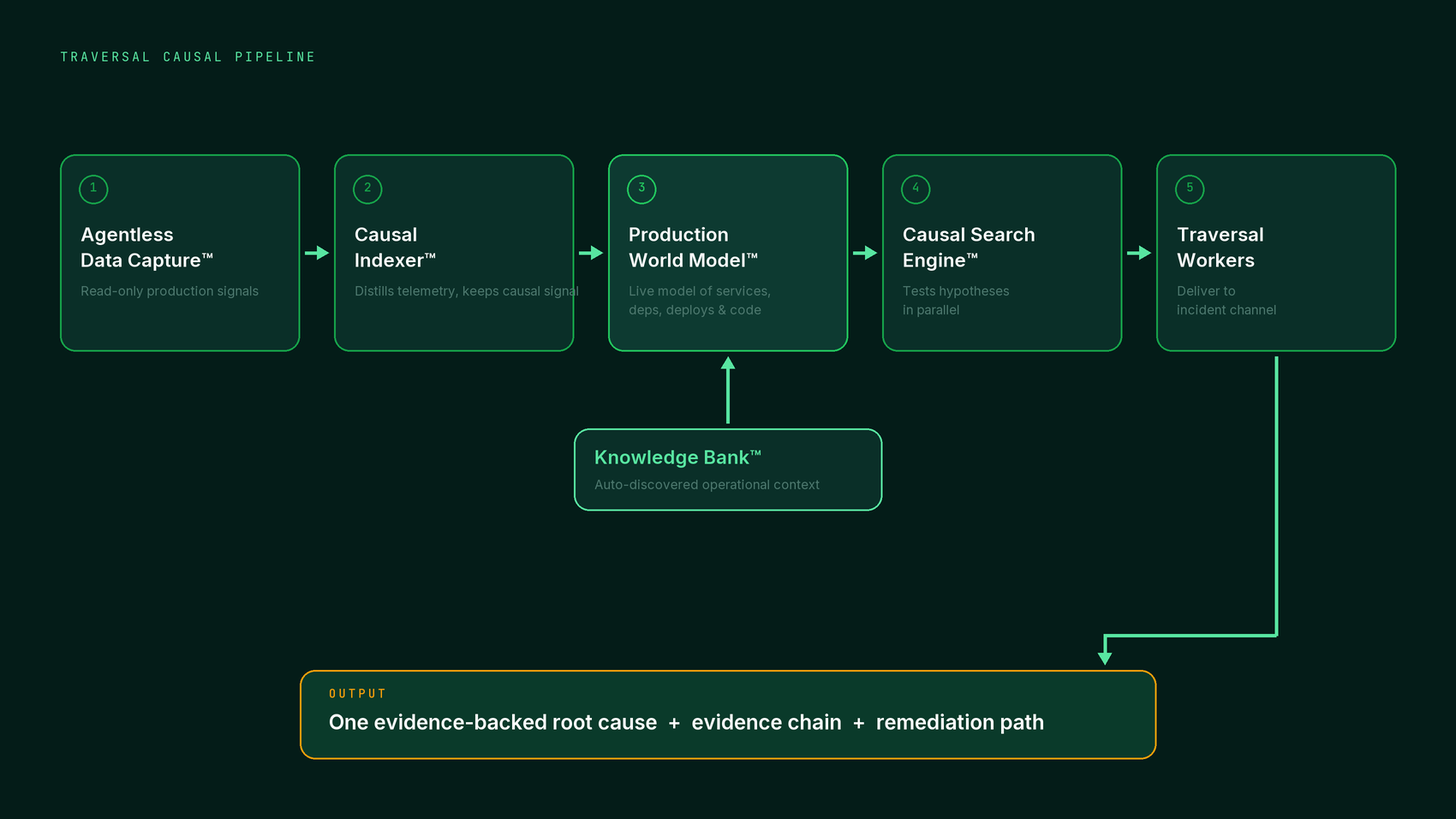
In Traversal's view, the gap closes only when the model of the system exists before the incident does. Traversal's pipeline turns production data and operational knowledge into that causal context, in this order:
- Agentless Data Capture™: Captures production signals with read-only access, without agents or sidecars on your hosts.
- Causal Indexer™: Distills high-volume telemetry while preserving causal signal, so reasoning at petabyte scale stays economical.
- Production World Model™: Maintains a continuously updated model of services, dependencies, deploys, and code.
- Knowledge Bank™: Traversal auto-discovers most of this operational context after each investigation, and humans refine the last mile with tribal knowledge.
- Causal Search Engine™: Tests hypotheses in parallel across multi-hop dependencies and eliminates explanations that break timing or topology.
The output is one causally consistent diagnosis: a single evidence-backed root cause, the evidence chain behind it, and a remediation path. Traversal investigates, diagnoses, and recommends; your team decides and executes.
One incident from the enterprise benchmark shows the difference. A single unhealthy pod in a large fleet produced nearly all the failures. Traversal compared it with its healthy peers and recommended draining it.
The direct-access baselines each landed somewhere plausible: a shared infrastructure event, a downstream provider issue, a database hang, and a recent config deploy. Each was confident, and none matched the evidence.
The same causal approach sits behind the RCA accuracy the Fortune 100 financial services company reported. Traversal runs on-premises or in your own cloud (BYOC, bring your own cloud), with your own models (BYOM, bring your own model).
How should you test whether an AI SRE finds real root causes?
Test it blind on your own past incidents and score the reasoning, not only the answer. A vendor demo on a clean sandbox tells you little about your production environment.
Traversal's guide on how to evaluate an AI SRE covers the full buyer framework. The core method fits in six steps.
- Pick real incidents
- Action: Choose past Sev-1 to Sev-3 incidents with a human-confirmed cause, including several multi-hop cases.
- Pass signal: The set includes incidents that took several teams hours to diagnose.
- Give it only what on-call had at the start
- Action: Provide the alert timestamp, ticket text, and tool access. Block postmortems, chat history, and later tickets.
- Pass signal: The system cannot see the answer before it produces its own.
- Score the causal path
- Action: Have the engineers who handled each incident grade the output blind.
- Pass signal: The output shows how the cause produced the symptom, beyond naming a service.
- Measure latency to a usable diagnosis
- Action: Clock the time from alert to a diagnosis an engineer could act on.
- Pass signal: Low latency holds on multi-hop cases without a drop in accuracy.
- Include no-incident and vague cases
- Action: Mix in quiet periods and alerts with thin or misleading descriptions.
- Pass signal: The AI reports that nothing is wrong when nothing is.
- Check the upkeep and the boundary
- Action: Ask who maintains context files, and where data and models run.
- Pass signal: Context stays current without a dedicated owner, and deployment fits your security boundary.
Can an AI SRE actually help you find the root cause?
Yes, when it has the right architecture: causal reasoning over a live model of your production environment, with a verifiable evidence chain. Point a general-purpose LLM at dashboards instead, and you get a plausible explanation that still needs an engineer to prove it. Test any vendor blind on your own incidents before you commit budget.
The research shows general-purpose models stalling at symptoms. In Traversal's view, the limit is structural rather than a matter of model size. Traversal's approach pairs a live system model with hypothesis elimination to close that gap.
Book a Demo to see Traversal return one evidence-backed root cause on incidents like yours.
FAQ
Measure it on your own incidents with the bar set to a usable, evidence-backed root cause while the incident is still open. Judge latency alongside accuracy because an early wrong answer still adds time.
Alerting and AIOps are designed to signal that something is wrong and group related alerts. AI root cause analysis investigates why it happened by testing explanations against how the system actually behaves.
No. An AI SRE takes on the investigation work, while engineers decide on and carry out the fix and own novel design decisions.
The main risk is a confident answer that names a symptom, which sends teams after the wrong fix. Require an evidence chain you can verify before anyone acts on it.
Yes. A well-built AI SRE connects to the observability, code, and change-management systems already in use, without requiring replacement or re-instrumentation.