What Data Leaves Your Environment When You Deploy an AI SRE Platform?

When you deploy an AI SRE platform, the honest question is not how smart the model is. It is how much of your production data has to leave your environment for the platform to work. For a whole class of tools, the answer is "a lot."
The answer buyers should demand is "almost nothing," and that depends on architecture, not promises. A common misconception clouds the evaluation: "it's read-only, it's just telemetry, so nothing sensitive leaves." That framing conflates two different things. Read-only controls what the platform can access. It says nothing about what leaves. Access and egress are not the same. A platform can have read-only access to everything and still export every byte it reads to a vendor cloud or third-party model. The architecture, not the permission model, determines where your data ends up.
The Data An AI SRE Actually Touches
An AI SRE is software that reads your production signals to investigate incidents and recommend fixes. That definition sounds narrow until you see what "production signals" actually means.
According to Google's SRE guidance on AI in site reliability engineering (2026), an AI SRE requires real-time telemetry (metrics, logs, and request-level signals), service topology and dependency graphs, historical incident data, engineering playbooks and documentation, and SLOs and error-budget status. Those telemetry signals are the ones the CNCF's OpenTelemetry project standardized (CNCF, 2026). That is not a shallow skim. It is deep, continuous access to the operational state of your systems.
The trap is thinking "it's just telemetry" makes this safe. Logs routinely carry PII. They carry secrets and tokens. They carry internal hostnames, SQL queries, request headers, and confidential business data. A single log line can expose a customer email, an API key, or an internal service name that maps your architecture. Telemetry is sensitive data. Reading deeply is not the same as exporting, but most platforms do both, and the distinction matters.
Why "Read-Only" Doesn't Mean "Nothing Leaves"
Read-only is a permission boundary. Egress is a data-flow boundary. They are not the same thing, and conflating them creates false confidence.
Read-only controls access, not egress. A read-only agent cannot write to your systems. It can still ship everything it reads to a vendor cloud or third-party model. The permission model limits what the platform can change. It says nothing about where your data goes.
The model crossing is the hidden leak. If reasoning runs on a third-party LLM, your data is in someone else's tenancy. That creates a new processing relationship. Under GDPR Article 28, third-party processors of EU personal data require a Data Processing Agreement. Logs frequently contain PII and fall under the same residency rules as primary data. IBM's 2025 research found that breaches involving data spread across multiple environments averaged $5.05 million, compared to $4.01 million for on-premises-only breaches.
Blast radius compounds the stakes. Google's SRE guidance (2026) observed that a faulty AI action in production can cause immediate, widespread disruption, with a blast radius far larger and faster-propagating than a human operator's. The more data an AI touches, the more damage a failure (or exfiltration) can do.
The cost is not only risk. Telemetry egress at petabyte scale is expensive. AWS's published pricing gives customers 100 GB of free data transfer out to the internet each month, aggregated across all AWS services and Regions; every gigabyte beyond that is metered in tiers up to 500 TB per month (AWS, 2026). At enterprise log volumes, that adds up fast.
Compliance exposure is real. IBM's 2026 Cost of a Data Breach report found the global average cost of a data breach climbed 12% year over year to a record $4.99 million. Data sovereignty and residency obligations do not disappear because the data is telemetry.
The Three Crossings: A Map Of Where Your Data Can Leave
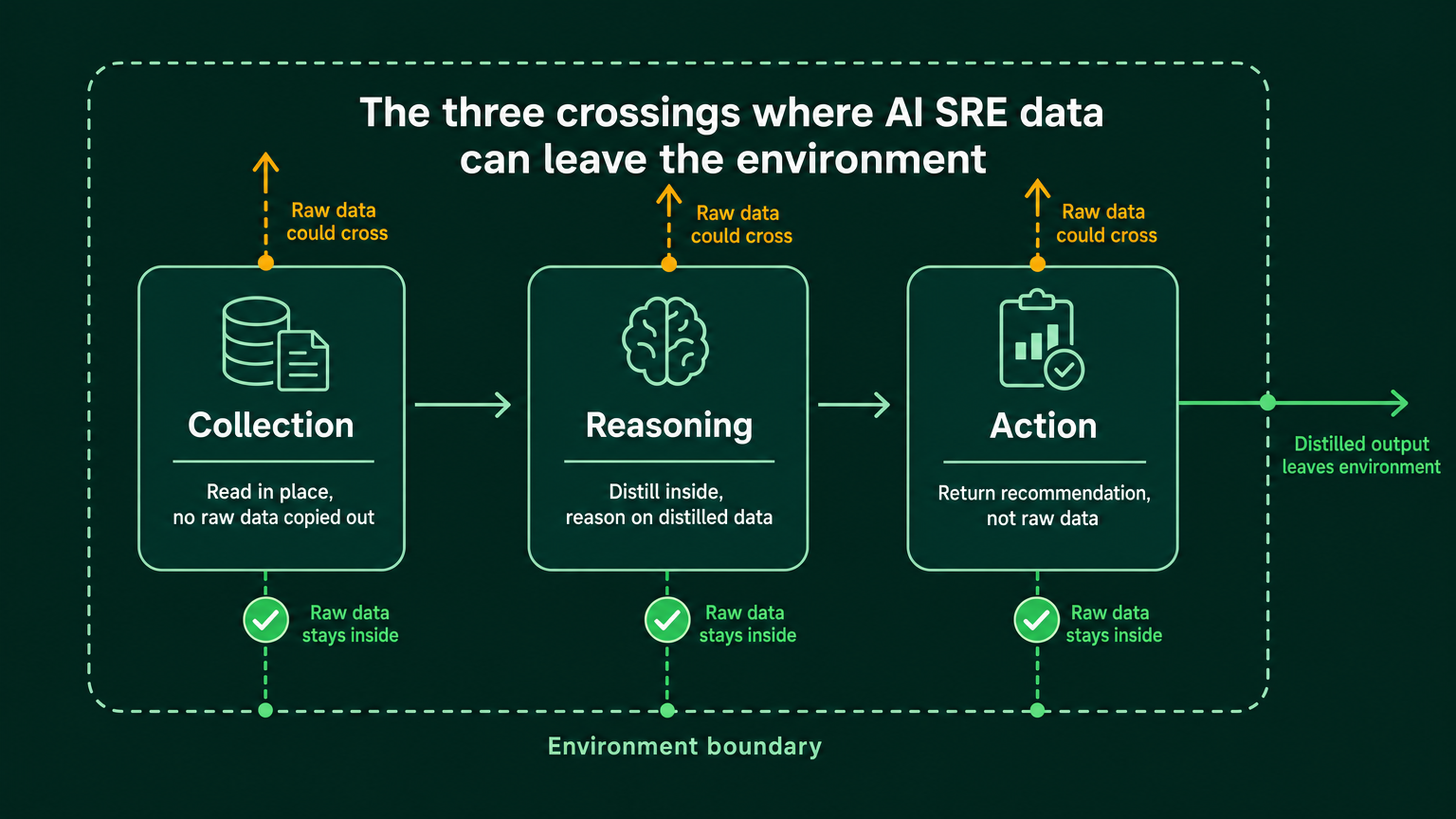
The question "what data leaves?" has three answers, because there are three places in the data flow where production data can cross your environment boundary. Understanding these crossings turns a vague security concern into an auditable checklist.
[[VISUAL type="flow"; alt="The three crossings where AI SRE data can leave the environment"; note="Left-to-right flow inside a dashed environment boundary: Collection and Reasoning stages; arrows show where raw data would cross the boundary at each of the three crossings, and where an in-environment design keeps it inside."]]
The Collection Crossing
Does the platform pull raw logs and metrics out of your environment to ingest them, or does it read them in place? Agent-based and sidecar-based architectures often require shipping telemetry to a vendor cloud for processing. An agentless, read-only architecture can capture the same data without copying it outside your boundary.
The Reasoning Crossing
Where does the model run, and does it see raw data or a distilled representation? If reasoning happens on a third-party LLM, your production telemetry is sent to an external system you do not control. A platform that distills telemetry inside your environment, then reasons on that distilled representation (or lets you bring your own model), keeps raw data from ever crossing. This is the difference between "our model is secure" and "your data never leaves."
The Action Crossing
What leaves when the platform recommends or takes action? A write-access agent can push changes back into your environment, creating a bidirectional data flow. A read-only platform that returns a recommendation (not an action) limits the crossing to the output of reasoning, not your raw input. An audit trail of data accessed (not just actions taken) closes the visibility gap.
What It Looks Like When Data Stays Put
Abstract architecture is one thing. Seeing the data flow in practice makes the difference tangible.
Traversal built its architecture around one principle: your data should not have to leave your environment for an AI SRE to reason about it. Here is how that works in a real incident.
- Agentless Data Capture™ reads production signals in place. It is read-only, schemaless, API-based, supports both push and pull, and requires no sidecars. No raw telemetry is copied out of your environment at the collection crossing.
- Causal Indexer™ distills that telemetry roughly 1,000:1 inside your environment. The sensitive raw stream (the logs with PII, secrets, hostnames) stays inside the boundary. What moves forward is a causal representation, not your raw data.
- Production World Model™ holds a continuously updated model of your environment. Knowledge Bank™ stores runbooks, documentation, and past incidents (mostly auto-discovered, not hand-maintained). Both stay in place.
- Causal Search Engine™ reasons across 10+ dependency hops to return a single, evidence-backed root cause with an evidence chain and a remediation path. If you use Traversal's default model or choose Bring Your Own Model (run Traversal with your preferred LLMs, including self-hosted or customer-managed models), that reasoning happens in your environment, not a third-party cloud. Humans decide and act.
At every crossing, the architecture keeps raw data inside the boundary. The answer to "what leaves?" is "almost nothing."
The Real Cost Of Getting Egress Wrong
Security review timelines are the first friction. When your AI SRE ships production telemetry to a vendor cloud, InfoSec has to evaluate a new data-processing relationship, a new tenancy, and a new set of residency questions. That adds weeks or months to procurement.
Compliance exposure is the second. In regulated industries (financial services, healthcare, public sector), data residency is not optional. If logs containing PII leave your environment, you inherit the compliance obligations of everywhere they land.
Trust is the third. When an auditor asks for a record of what data left your environment and where it went, you need an answer. If your AI SRE cannot produce that audit trail, you have a trust problem that no vendor attestation can close.
Relief framing matters here: when there is no data egress, security review moves faster. Traversal deploys inside Fortune 100 environments (including American Express and PepsiCo) with an agentless, read-only design that shortens InfoSec review. Across enterprise clients, Traversal delivers roughly 40% average mean time to recovery (MTTR) reduction. That reliability outcome does not come at the price of a new data-exfiltration surface.
What Enterprise-Grade Data Handling Actually Requires
Before evaluating any AI SRE vendor, run through this checklist. The questions are vendor-neutral. The answers reveal whether your data stays put.
Traversal answers every row by design. Agentless Data Capture™ reads in place. Causal Indexer™ distills roughly 1,000:1 inside your boundary. Production World Model™ and Knowledge Bank™ (mostly auto-discovered, not hand-maintained) keep context local. Causal Search Engine™ reasons across 10+ hops and returns a single, evidence-backed root cause. BYOC and BYOM let you run the full platform in your environment on your approved model. The audit trail shows what was accessed, not just what was done.
What Traversal Is
Traversal is AI SRE for the enterprise, built to reason about production causally at enterprise scale. Deployment is agentless, sidecarless, read-only, and BYOC/BYOM, running entirely in the customer's environment. The output is a single, evidence-backed root cause with an evidence chain and a remediation path. Humans decide and act.
A Fortune 100 financial-services customer achieved over 82% RCA accuracy and a 32% MTTR reduction while ingesting 250 billion logs per day.
The distinction that matters is access versus egress. A capable AI SRE needs deep access to your production data. That does not mean your production data has to leave.
FAQ
It depends on the architecture. Many AI SRE platforms ship raw logs, metrics, and telemetry to a vendor cloud or third-party model for processing, but Traversal distills telemetry roughly 1,000:1 inside your environment so raw sensitive data stays put.
No. Traversal supports Bring Your Own Cloud (BYOC) and Bring Your Own Model (BYOM), so reasoning runs in your environment on your approved or self-hosted model, not a third-party tenancy.
No. Read-only controls what the platform can change, not where your data goes, and a read-only agent can still export everything it reads.
Yes. Traversal runs entirely in your environment, with BYOC deployment and BYOM support for self-hosted or customer-managed LLMs.
When raw data never leaves your boundary, you do not create new processing relationships or residency obligations. Compliance becomes a deployment property rather than a vendor attestation you have to audit.