
Traversal vs NeuBird
Learn how Traversal reasons causally across your entire production environment, see why it’s architected for the enterprise from day one, and understand why every investigation starts with full production context, instead of gathering it after the alert fires like NeuBird.

Traversal
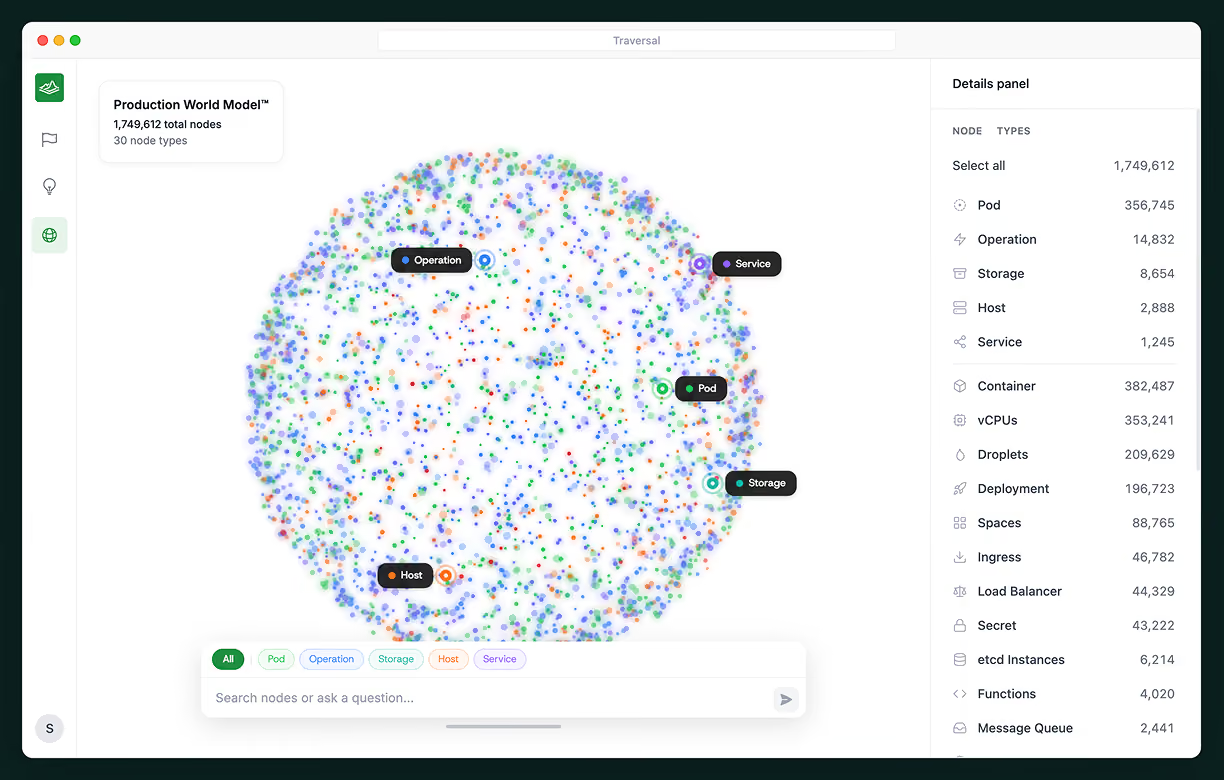
A live, autonomously updating causal map of your entire production environment featuring over 100M+ entities.
Distills petabytes of telemetry by 1:1000 scale, without losing any causal signals.
Autonomously and continuously learns from your runbooks, docs, and incidents. No manual tuning or markdown files required.
A live, autonomously updating causal map of your entire production environment, featuring over 100M+ entities.
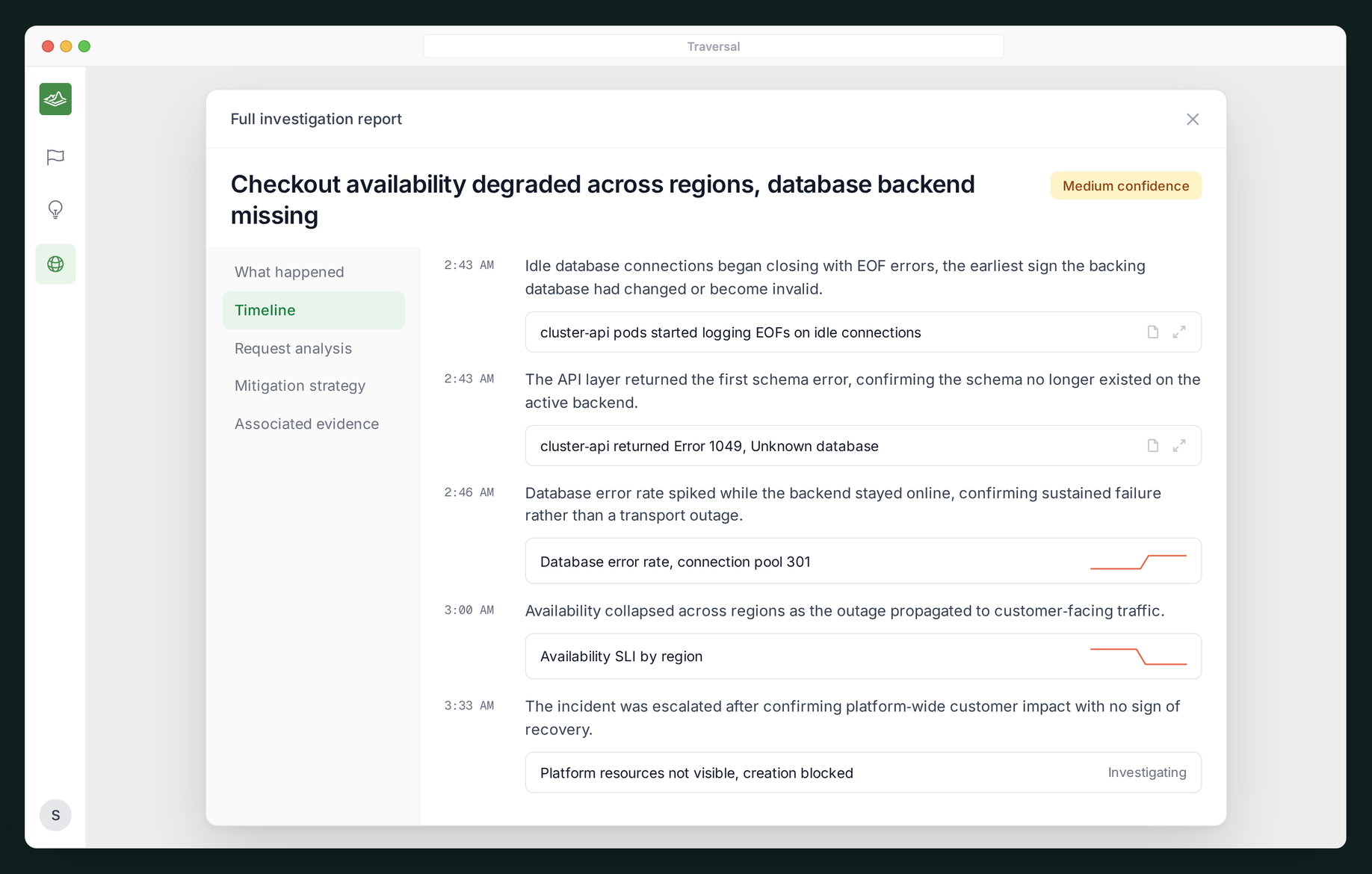
Searches 1K+ hypotheses in parallel to identify root cause across 10+ hops, featuring a <1% false positive rate.
WHY TRAVERSAL WINS
Grounded in years of causal reasoning and AI research.
Traversal’s Production World Model™ is where that research shows up: a continuously updated map of every pod, host, service, and dependency in your environment, built before anything breaks. When an incident hits, the Causal Search Engine™ starts from that map instead of a blank page. NeuBird queries your tools once the alert fires and pieces the picture together mid-incident. Traversal walks in already knowing how your system connects.
Built for what enterprise scale actually demands.
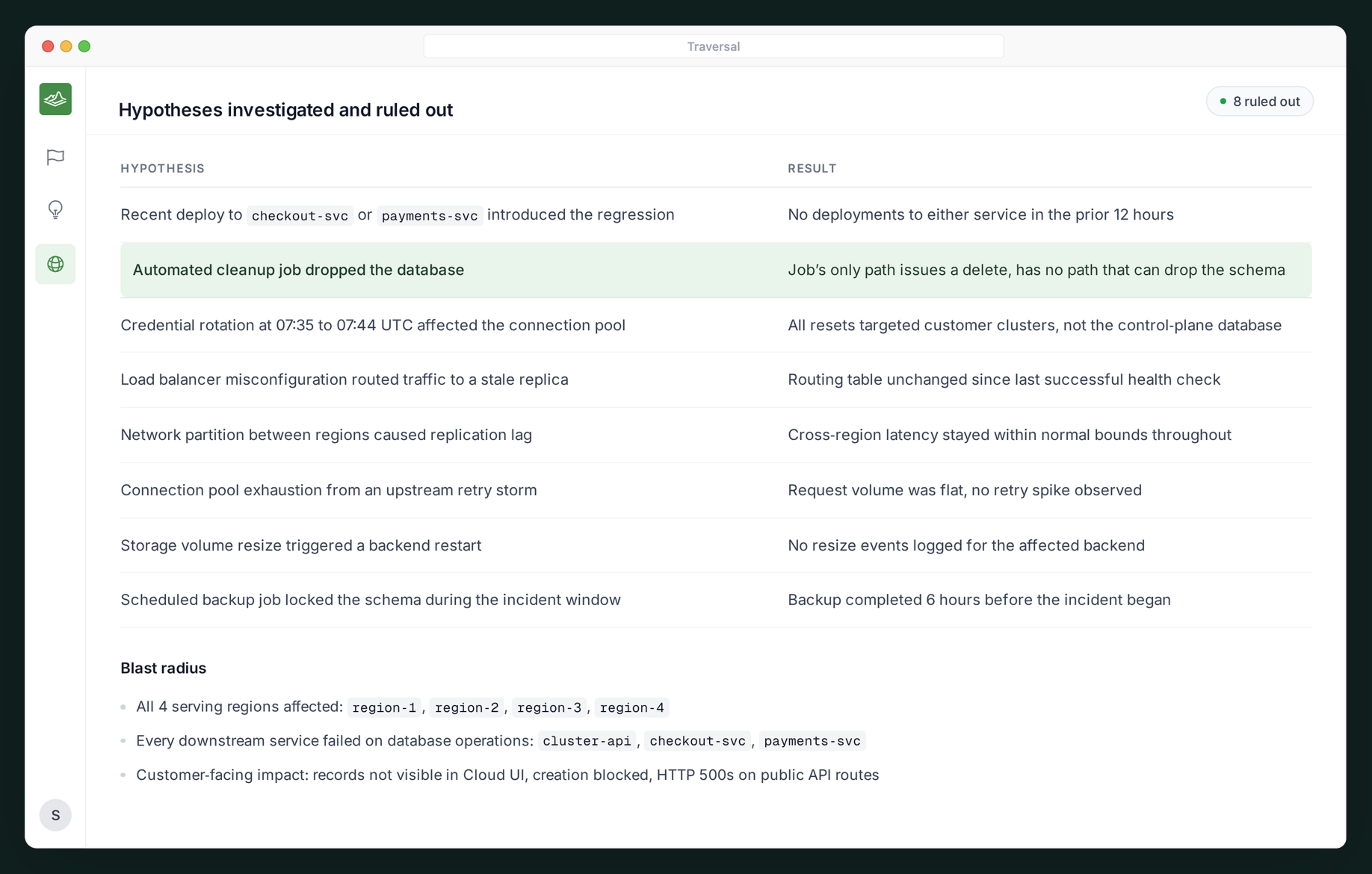
The costliest incidents start in one service and surface in another, often owned by a different team. Traversal tests every plausible hypothesis against the full dependency path, rules each one out with evidence until a single cause remains, and maps the blast radius across every affected region and downstream service. NeuBird has to assemble that path under incident pressure. Traversal has it from the first query, so answers get sharper as your system grows, not noisier.
Nothing to teach it. Nothing to maintain.
Every investigation makes Traversal smarter about your environment. Knowledge Bank™ captures what each one reveals on its own, so engineers refine the edges instead of maintaining the whole. NeuBird’s memory grows only from conclusions on-call engineers sign off on. That helps when a familiar failure repeats and does little for the one nobody has seen before. Traversal brings causal reasoning to that first-of-its-kind incident from day one.
Battle-tested in mission-critical environments

“We took real customer incidents that used to take our engineers an hour or more to resolve — and Traversal’s agents were identifying root causes in under a minute.“


“We worked with Traversal to build a self-healing system for common web hosting issues like DDoS and disk errors. With 95%+ accuracy, it lets thousands of customers solve problems instantly, cutting downtime and support costs.“


“Instead of the company's engineers responding to incidents across their infrastructure manually, Traversal completes comprehensive RCA in minutes, ingesting 250 billion logs of interest every day.“


“For a F&B company, operating at Fortune 50 scale requires intelligent automation beyond traditional monitoring. Traversal’s AI SRE agents cut through this enormous complexity, automatically triaging alerts and surfacing root causes in minutes rather than hours.“


"[A key part of the] decision was because you have the BYOC product—for us, as a security-first company, that's a big plus. And we don't need to maintain extra context on our end. You handle all of that for us: building the Production World Model™, reading the documentation and other sources."
What is the difference between Traversal and NeuBird?
The main difference is when each AI SRE builds its understanding of production. NeuBird queries telemetry in place when an investigation starts and remembers conclusions engineers approve. Traversal maintains a continuously updated Production World Model™ of your environment, so every investigation begins with dependencies, baselines, and recent changes already in hand.
Is Traversal a good NeuBird alternative for enterprise teams?
Yes, especially for large, distributed environments where the costliest incidents cross teams and services. Traversal is built for novel, multi-hop failures, runs either on-premises or in your own cloud, and can deliver outcomes through proactive Traversal Workers that decide for themselves when to engage.
How do NeuBird and Traversal handle incidents nobody has seen before?
NeuBird’s memory surfaces past approved conclusions when related symptoms recur, so a brand-new failure has no prior entry to draw on. Traversal’s Causal Search Engine™ tests hypotheses across the dependency path in its Production World Model™, returning a single, evidence-backed root cause even when the cause sits several services away from the symptom.
Does NeuBird or Traversal require manual configuration to stay accurate?
NeuBird’s documentation describes instructions and runbooks teams write to guide investigations, along with tools to test changes against past sessions. Traversal learns context on its own. Its Knowledge Bank™ is mostly auto-discovered after each investigation, and engineers review or refine what it captures instead of maintaining it from scratch.