What Are the Best AI Tools for Incident Management? 5 Platforms Compared for 2026

The best AI tools for incident management in 2026 are Traversal, PagerDuty, incident.io, Rootly, and Datadog Bits Investigation. AI incident management software applies machine learning and AI agents to incident work, from alert triage and coordination to root cause investigation, remediation, and postmortems.
Each platform is ranked on where its AI works in the incident lifecycle, what data it can reach, and how the AI is sold. In Uptime Institute's 2026 outage analysis, 57% of respondents to Uptime's 2025 annual survey of data center and IT infrastructure operators said their most recent major outage cost more than $100,000. For the second year in a row, one in five said their most recent impactful outage cost more than $1 million.
Many AI features summarize the incident channel or group related alerts, which helps responders orient. Traversal's position is that the hardest minutes go to working out why production broke. The useful buying question is which stage your incidents lose time in, and whether a tool's AI can reach the data that explains it.
Book a demo of Traversal's AI SRE to see how it investigates a multi-hop incident and shows the evidence behind each root cause.
Top 5 AI Tools for Incident Management in 2026
Tools are ordered by how far their AI moves an incident from first alert to an evidence-backed explanation, then by coordination and routing strength. Competitor details come from each vendor's current documentation.
1. Traversal
Traversal is an AI SRE for enterprise production environments where the root cause often sits several services away from the first alert. Its agents work from telemetry, code, change history, and operational knowledge rather than the alert text alone.
Where its AI works: Triage and investigation first, with supported remediation where a team enables it.
Its pipeline starts with Agentless Data Capture™, which reads existing telemetry, code, and change history without agents or sidecars. The Causal Indexer™ distills that data by up to 1,000:1 while keeping causal signal. The Production World Model™ keeps a continuously updated causal model of the environment.
The Knowledge Bank™ automatically learns from each incident, as well as making runbooks, docs, and past incidents available during investigations. The Causal Search Engine™ tests hypotheses across multi-hop dependencies and returns an evidence-backed root cause. The pipeline runs agentless and read-only, on premises or in the customer's own cloud (BYOC).
Agentic capabilities run on that pipeline: Alert Intelligence, Incident RCA, Self-healing, Production Support, and Code Resilience. Traversal's autonomous alert triage capability evaluates every alert against historical behavior and cross-system relationships. Multi-hop Incident RCA works across apps, services, infrastructure, and networking to find the cause.
With Traversal Workers, Incident Workers became the default incident experience. They join Slack or Microsoft Teams incident channels when an incident fires, investigate without prompting, and leave a draft postmortem when the incident closes. Alert Workers, in public beta, triage noisy alert channels.
The PepsiCo case study shows Traversal autonomously triaging 500,000+ alerts per month, investigation time cut by 70%, and a 700+ high-severity alert backlog eliminated. Across enterprise customers, Traversal averages 82%+ RCA accuracy in under five minutes.
Best for: Enterprise SRE and platform teams running large, distributed systems where investigation dominates live incident time.
Strengths:
- Multi-hop causal investigation that shows its evidence
- Proactive Workers in Slack and Microsoft Teams
- Self-healing for fixes a team lets run on its own, verified against production
- On-premises or BYOC deployment, plus Knowledge Bank auto-discovery
Potential limitations:
- Not an on-call scheduling product, so teams pair it with their on-call scheduling tool
- Built for large, complex estates; a team with a handful of services may not need multi-hop causal search
2. PagerDuty
PagerDuty is an on-call, alerting, and incident management platform, and it says 70% of the Fortune 100 trust it. Its flagship plan is now the PD Reliability Platform, renamed from Operations Cloud.
Where its AI works: Noise reduction before a page, then investigation and communication during the incident.
AIOps (Signal Intelligence) groups alerts and runs event orchestration. Paige, PagerDuty's SRE agent, surfaces likely root causes from connected data and recommends diagnostic and remediation steps. Scribe transcribes incident calls, Shift handles schedule conflicts, and AI drafts post-incident reviews and status updates.
Best for: Large organizations with complex escalation policies already standardized on PagerDuty.
Strengths:
- Mature routing and escalation
- Broad AI coverage across noise, coordination, and communication
- Paige connects to about 20 monitoring and code sources
- Teams can view, edit, or redact Paige's memory
Potential limitations:
- Outside PD Reliability Platform plans, AIOps and PagerDuty AI (PagerDuty Advance) are separate add-ons; Paige in the Operations Console needs both
- Each Paige request uses four AI actions from a capped plan allowance
- The escalation-policy trigger and Paige in Microsoft Teams are still early access
- Investigation depth depends on the connectors a team configures
3. incident.io
incident.io is a Slack- and Microsoft Teams-native platform for incident response, on-call, status pages, and post-mortems. Investigations, its AI SRE, became generally available on August 5, 2026.
Where its AI works: Coordination in chat and incident-scoped investigation.
Investigations posts a root cause hypothesis with cited evidence and can hand code fixes to coding agents as pull requests a human merges. A "wait for investigation" option can hold an escalation from paging until the first hypothesis is ready. In September 2026, incident.io reported a median of about 3 minutes from incident opening to an accurate first channel message (vendor-reported).
Best for: Engineering-led organizations that run incidents in Slack or Teams and want process and AI investigation in one place.
Strengths:
- Chat-native incident command
- Published per-user pricing for core plans
- Scribe call transcription and AI-native post-mortems
Potential limitations:
- Investigations is a paid add-on that requires Response, with no published price
- Investigations run on incidents rather than directly on alerts
- Automatic investigations have rolling hourly, daily, and weekly limits
- Connecting telemetry and code requires Investigations, and AI alert grouping is in beta
4. Rootly
Rootly combines on-call, chat-based incident response, retrospectives, and an AI SRE. On July 28, 2026, it acquired ThinkHive, an AI agent reliability platform.
Where its AI works: Coordination, retrospectives, and investigation.
The @Rootly agent in Slack handles catch-up, incident fields, paging, and status updates, and AI drafts retrospectives from timelines and transcripts. Rootly AI SRE tests competing causes, and its docs say the model cannot declare a root cause on its own.
Best for: Chat-first SRE teams, including teams migrating off Opsgenie or PagerDuty, that want on-call, response workflow, and AI investigation together.
Strengths:
- Configurable incident workflows
- Results marked "inconclusive" when evidence does not confirm a cause
- Broad AI connectors across code, telemetry, and documentation tools
- On-Call and Incident Response each listed at $20 per user per month
Potential limitations:
- AI SRE is priced through sales, requires Incident Response, and is enabled per team by Rootly's account team
- Live investigations do not read Slack history or vendor status pages
- Its docs list Datadog gaps, such as no change and deploy correlation over OAuth
5. Datadog (Bits Investigation)
Bits Investigation became Datadog's first generally available AI agent on December 2, 2025, under its earlier name, Bits AI SRE. It sits alongside Watchdog anomaly detection, Incident AI summaries, and Datadog On-Call.
Where its AI works: Investigation over Datadog telemetry, launched manually or automatically when monitors alert.
A March 2026 update brought typical investigations to about 3 to 4 minutes (vendor-stated) and added a step-by-step view of the agent's work. On October 15, 2026, Datadog released Scout 1.0, its own SRE-specialized model behind Bits Investigation.
Best for: Teams whose telemetry already lives in Datadog and who want paging, incident management, and AI investigation next to their monitors.
Strengths:
- Deep access to Datadog's own telemetry
- One vendor for monitoring, paging, and incident management
- On-Call at $20 per seat per month, Incident Management at $30, or a $40 bundle
Potential limitations:
- Reasoning is built on Datadog data; third-party sources are in preview, and source code is GitHub-only
- AI credits (about four per investigation) are billed on top of seats, and unused credits do not roll over
- By default, each monitor triggers one automatic investigation per 24 hours
- Microsoft Teams support and one-click infrastructure actions are in preview; US government sites are unsupported
Quick Comparison of AI Incident Management Tools
The tools differ most in the incident stage their AI works on and the data it can reach. The last column shows how each vendor sells its AI, not list prices.
RankPlatformBest forWhere its AI worksRelevant strengthSupported limitationHow the AI is sold1TraversalEnterprise teams with multi-hop incidentsTriage, investigation, supported remediationEvidence-backed multi-hop root causeNot a paging toolContact sales2PagerDutyLarge on-call estatesNoise reduction, coordination, communication; Paige investigationMature escalation, broad AI coverageCapped AI actionsIncluded in PD Reliability Platform; add-ons elsewhere3incident.ioChat-native engineering orgsCoordination in chat; incident-scoped InvestigationsSlack and Teams incident commandInvestigations run on incidents, not alertsInvestigations add-on to Response4RootlyChat-first SRE teamsCoordination, retrospectives, AI SREReports "inconclusive" instead of guessingNo Slack history in live investigationsAI SRE via sales; requires Incident Response5DatadogDatadog-standardized stacksInvestigation over Datadog data; pagingOne surface for monitors, paging, incidentsThird-party data in previewAI credits on top of seats
What Is AI Incident Management Software?
AI incident management software uses machine learning and AI agents to do incident work responders used to do by hand. That includes deciding which alerts matter, coordinating the response, investigating root cause, applying fixes, and writing the postmortem.
Tools differ mainly in which stages their AI performs:
- Triage: deciding which alerts warrant action.
- Coordination: declaring the incident, assigning roles, and notifying responders and stakeholders.
- Investigation: working from symptoms to the change or condition that caused them.
- Remediation: applying a mitigation to restore service, or a fix that removes the cause.
- Learning: writing the postmortem and feeding production context back to development.
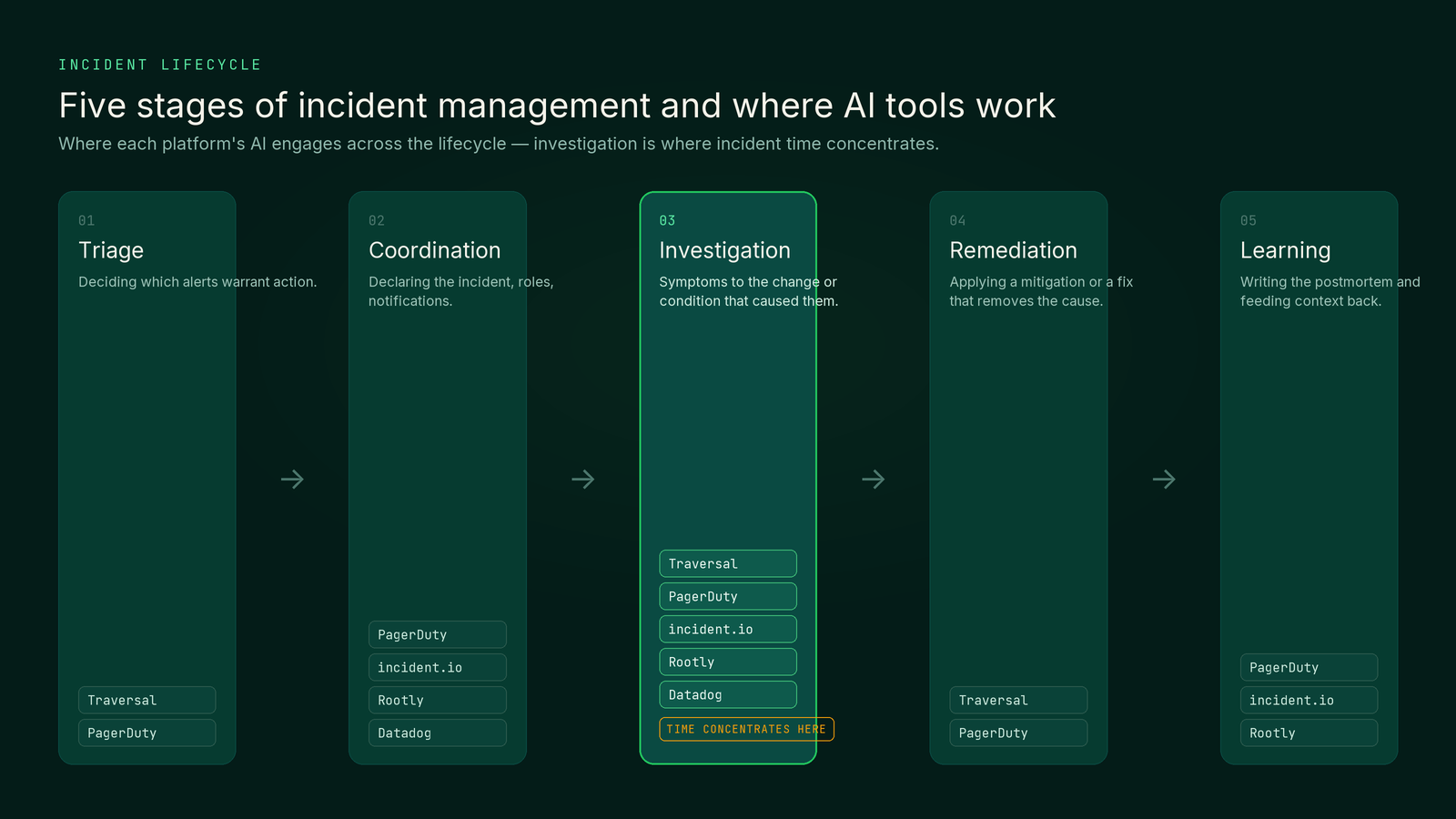
AIOps-style alert grouping and AI summaries mostly help triage and coordination. Investigation needs reasoning over telemetry, recent changes, and service dependencies. Security SOAR and XDR products handle security incidents, a separate market outside this comparison.
Where Does AI Actually Shorten an Incident?
AI shortens an incident when it cuts the time responders spend working out why production broke. Summaries and alert grouping help responders orient, but they do not identify the change or dependency that caused the failure.
Google's SRE monitoring guidance from 2016 says a monitoring system should answer two questions: what's broken, and why. Paging and notification mostly serve the first. One r/devops thread described an AI tool answering an exhausted connection pool with advice to "check database connectivity."
In a 2026 preprint survey of Microsoft operations engineers, 40.6% of 101 infrastructure and operations respondents wanted AI help orienting during incidents. Surveyed in July 2025, those respondents defined orientation as identifying affected services, recent changes, and similar past incidents.
The cause often sits several services away from the symptom. If a config change in one service breaks checkout two services downstream, an AI that reads only the alert and the chat cannot connect the two.
Paging and coordination platforms were built around people: who is on call, who gets notified, and who holds which role. Their native records are schedules, escalation policies, and chat, not a model of how services depend on each other. Several vendors here now connect AI to telemetry and code, so depth depends on those connectors and the reasoning over them.
Traversal's AI SRE benchmark findings cover 25 real Sev 1 to Sev 3 incidents at a large financial-services enterprise. Judges preferred its root cause analysis 83% of the time over the strongest frontier model with observability access, and up to 90% over the weakest. Traversal's average latency was 9.5 minutes, while DIY setups ran at two to three times that.
Coordination still matters: someone has to declare the incident, notify stakeholders, and run the call. Many teams pair a coordination tool with an AI SRE.
How to Evaluate AI Incident Management Tools
DORA research on AI adoption from its 2025 report found 90% of technology professionals use AI at work. That figure is self-reported and covers software development, not incident response. For an incident tool, the question is which stage its AI improves on your own incidents.
In a 2026 survey of technology leaders by CloudBees, 81% of 213 respondents reported more production issues they attribute to AI-generated code. The May 2026 figure is self-reported, with a ±8% margin of error.
Five criteria separate the tools in practice:
- Evidence behind the root cause: does the tool show what it checked and ruled out, or only ranked guesses?
- Data reach: which telemetry, change, code, and knowledge sources can the AI read?
- When the AI engages: on every alert, on declared incidents, when invoked, or proactively, and with what rate limits?
- What it can change: read-only investigation, pull requests a human merges, or supported remediation?
- How the AI is priced: included, add-on, credits, or per-request units, and what happens during an incident spike?
Test with your real integrations, since vendor docs tie investigation quality to connected sources. Traversal's guide to evaluating an AI SRE product recommends about 10 representative historical incidents, then live incidents the vendor has not seen. Grade each answer as ideal (pinpoints the causing change), good (narrows scope to the right team), or poor (sends responders down a false trail).
2026 Market Changes That Affect Your Shortlist
Atlassian ended new Opsgenie sales on June 4, 2025, and will shut it down on April 5, 2027, deleting unmigrated data. Teams still on Opsgenie need a replacement plan.
Freshworks agreed to acquire FireHydrant on December 15, 2025, closed in early January 2026, and plans to make it the incident layer inside Freshservice.
Renames matter when reading vendor docs: PagerDuty's SRE Agent goes by Paige, and Operations Cloud is now the PD Reliability Platform. Datadog's Bits AI SRE is now Bits Investigation.
Choosing the Right Platform for Your Team
Fit depends on where incidents lose time and where your data lives:
- Investigation is the bottleneck in a large, distributed estate: Traversal, paired with your existing paging tool.
- Complex escalation policies already run on PagerDuty: PagerDuty, with its AI plan and action allowance scoped up front.
- Incidents run in Slack or Teams, and process consistency is the gap: incident.io or Rootly.
- Telemetry lives in Datadog: Datadog Bits Investigation.
Combined setups are common: a paging and coordination tool plus an AI SRE for triage and investigation. Teams can limit Traversal's Self-healing remediation workflows to fixes they choose to let run on their own. Changes outside that scope follow the team's normal review and approval process.
Book a demo with Traversal to plan a test on your past incidents and compare Traversal's evidence-backed root causes with what your current tooling surfaces.
FAQ
AI tools can take over alert triage and much of the investigation, and some can apply fixes a team has approved to run automatically. People still coordinate across teams, own the response, and decide on changes outside that approved scope.
AIOps tools use machine learning to group and suppress alerts so fewer reach a human. An AI SRE investigates incidents to identify an evidence-backed root cause and, where supported, a fix.
No. Most teams keep their paging and on-call tool and add an AI SRE for triage and investigation. Traversal, for example, does not manage paging and is designed to pair with an existing paging tool.
They can reduce MTTR when they shorten investigation time on your own incidents. Traversal reports an 85% or greater MTTR reduction across enterprise customers, and vendor claims should be tested on representative incidents from your environment.
Check how AI is billed before a pilot, since pricing may involve add-on plans, per-request actions, AI credits, or sales-enabled pricing. Estimate costs for a month with an incident spike, not just an average month.


What Are the Best AI SRE Tools for Financial Services? 5 Platforms Ranked for 2026

Traversal Now Sees Your AWS Stack: Introducing CloudWatch and AWS Account Integrations