What Are the Best AI SRE Tools for Financial Services? 5 Platforms Ranked for 2026

The best AI SRE tools for financial services in 2026 are Traversal, Resolve AI, Datadog Bits Investigation, Rootly AI SRE, and Komodor. An AI SRE investigates alerts and incidents across production data, identifies root cause, and supports remediation.
We ranked them on four criteria: investigation accuracy on real incidents, deployment inside the institution's data boundary, a reviewable reasoning record, and governed remediation. Accuracy determines whether responders have an evidence-backed account of an incident while regulatory notification clocks run. In-boundary deployment and an evidence record determine whether a platform clears InfoSec and third-party risk review at all.
Traversal's Fortune 100 financial services deployment shows accuracy and in-boundary deployment together. On an on-premises deployment, the company reached 82% RCA accuracy across in-scope applications and a 32% reduction in potential MTTR within those applications.
Top 5 AI SRE Platforms for Financial Services
Each platform is ranked by investigation depth on real incidents, deployment options for regulated data, the evidence it produces, and how it governs remediation. Every entry covers what the product does, then who it fits, its strengths, and its documented limitations.
1. Traversal
Traversal's AI SRE Platform covers Alert Intelligence, Incident RCA, Self-healing, Code Resilience, and Production Support. Its agents investigate multi-hop incidents across apps, services, infrastructure, and networking. Traversal is the frontier lab behind the first AI SRE platform validated within the Fortune 100.
The depth comes from the data pipeline. Agentless Data Capture™ feeds the Causal Indexer™, which feeds the Production World Model™, a continuously updated causal model of the environment. The Causal Search Engine™ reasons over that model, and the Knowledge Bank™ adds runbooks, docs, and past incidents.
Every diagnosis arrives with its reasoning chain: the hypotheses evaluated, the hypotheses ruled out, and the evidence behind the conclusion. Deployment is agentless, read-only, and sidecarless, with BYOC, Bring Your Own Model, or private on-premises options. It needs no required markdown files or extensive manual tuning: Traversal learns your environment automatically.
At the Fortune 100 financial services company, Traversal captures 250 billion logs of interest per day on premises. Separately, a leading global crypto exchange chose Traversal after a head-to-head evaluation against other AI SRE vendors, partly because BYOC fit its data residency requirements. Within 7 days, it saw a projected 40%+ MTTR reduction and 75% RCA accuracy across evaluated incidents.
Across enterprise customers, Traversal averages 82%+ RCA accuracy in under five minutes. Traversal Workers join Slack or Microsoft Teams incident channels and run the investigation there.
- Best for: Banks, payment networks, and exchanges with dispersed teams and complex production environments where root cause sits several dependencies from the symptom and data must stay in-boundary.
- Strengths: Multi-hop causal investigation, in-boundary deployment options, a reasoning record for every diagnosis, and financial-services production proof.
- Potential limitations: Built for complex enterprise estates, so smaller teams on one stack may not need multi-hop depth. Pricing is quote-based.
2. Resolve AI
Resolve AI runs AI SRE agents that triage alerts, investigate with parallel hypothesis testing, and propose mitigations and fix pull requests.
It runs as cloud-hosted SaaS, with an optional in-cluster Satellite that redacts sensitive data before it leaves the customer's environment. Access is read-only by default, and write actions need human approval, though admins can set some GitHub Actions workflow tools to run automatically. Resolve AI states SOC 2 Type 2, HIPAA, and GDPR compliance and names Coinbase and MSCI as customers.
- Best for: Fintech and crypto teams comfortable with a SaaS control plane that want an investigation-first agent in Slack.
- Strengths: Investigation-focused agents, approval-gated writes, and named financial customers.
- Potential limitations: The control plane is SaaS by design, and its published security docs do not state data-residency options. Pricing is credit-based, with no public list prices.
3. Datadog Bits Investigation
Bits Investigation, formerly Bits AI SRE, is Datadog's investigation agent. It starts on monitor alerts, tests hypotheses in parallel against Datadog telemetry, and suggests code fixes. An investigation view exposes each step the agent takes, and Datadog positions that view for regulated teams.
It runs as SaaS on regional Datadog sites, with HIPAA support and zero data retention with third-party AI providers. Published pricing starts at $500 per 500 AI credits per month on an annual commitment (or $1.30 per credit on demand). Datadog estimates about 6.5 credits per investigation.
- Best for: Institutions already standardized on Datadog that want investigation inside a tool they already license.
- Strengths: No new vendor onboarding for Datadog customers, transparent per-investigation pricing, and a step-by-step investigation view.
- Potential limitations: The agent reasons over the telemetry Datadog holds, and third-party telemetry integrations and remediation guardrails were in preview. It isn't supported on Datadog for Government sites, and AI credits aren't available to FedRAMP customers.
4. Rootly AI SRE
Rootly AI SRE puts investigation inside Rootly's incident management platform. When an alert fires, it runs parallel hypothesis checks and returns verdicts with confidence levels, including "inconclusive" when evidence is thin.
Rootly's core strength is coordination: chat-based incident response, status updates, and retrospectives. The product was built to organize people around an incident, so investigation runs as one step inside that workflow.
Rootly states SOC 2 Type II, HIPAA, GDPR, and CCPA compliance. Rootly lists fintech customers including Brex, SoFi, Affirm, and Wise.
- Best for: Fintech teams already running Rootly for incident response that want investigation in the same workflow.
- Strengths: Strong coordination and incident record-keeping, explicit confidence levels, and named fintech customers.
- Potential limitations: Requires Rootly Incident Response and is priced on request. Inference runs only in US infrastructure, and Rootly's docs advise against treating AI SRE as read-only.
5. Komodor
Komodor's Agentic Operations Platform absorbed its earlier Klaudia agent. It runs AI SRE workflows for alert intelligence, troubleshooting, incident management, and self-healing, with roots in Kubernetes operations.
It offers the widest deployment range here: Komodor Cloud, self-hosted agents in your cloud or on-premises, a self-hostable control plane, air-gapped clusters, and bring-your-own model. Governance includes human approvals for risky actions, destructive-action protection, short-lived credentials, and full audit of agent actions. Komodor holds SOC 2 Type II and names Prudential and Nelnet as financial references.
- Best for: Kubernetes-heavy platforms at institutions whose data cannot leave the network, including air-gapped environments.
- Strengths: Self-hosting depth, built-in guardrails, and Kubernetes expertise.
- Potential limitations: The platform packaging relaunched in September 2026, and its deepest proof points still come from Kubernetes. Pricing is custom.
Quick Comparison
The table sets the five AI SRE tools side by side on the buying criteria that matter most to regulated institutions.
PlatformBest forDeployment optionsRelevant strengthSupported limitationTraversalComplex, mixed estates at banks, payment networks, and exchangesBYOC, private on-premises, Bring Your Own ModelMulti-hop causal RCA with a reasoning recordQuote-based pricing; more depth than single-stack teams needResolve AISaaS-comfortable fintech and crypto teamsSaaS with optional in-cluster SatelliteInvestigation agents with approval-gated writesNo stated data-residency optionsDatadog Bits InvestigationDatadog-standardized institutionsSaaS on regional Datadog sitesStep-by-step investigation view; published pricingBuilt around Datadog data; not on Datadog for Government sitesRootly AI SRETeams already on Rootly Incident ResponseSaaSIncident coordination with confidence-scored verdictsUS-only LLM inference; docs advise against treating it as read-onlyKomodorKubernetes-heavy, self-hosted, or air-gapped platformsCloud, self-hosted agents, self-hosted control plane, air-gappedWidest self-hosting range with guardrailsRelaunched September 2026; Kubernetes-centered proof
Why Financial Services Raises the Bar for AI SRE
A regulated institution evaluates an AI SRE twice: as an incident tool and as a third-party, AI-driven system. Each role adds its own requirement.
Incident Clocks Make Investigation Latency a Compliance Issue
The OCC, Federal Reserve, and FDIC issued the 36-hour incident notification rule in 2021. US banks must notify their primary federal regulator within 36 hours of determining a notification incident occurred. Non-malicious failures can qualify, including a failed upgrade or change that causes widespread outages.
New York adds a second clock for covered entities. The amended NYDFS cybersecurity regulation (effective November 2023) requires notice within 72 hours of determining a qualifying cybersecurity incident, including one at a third-party provider. Covered entities' incident response plans must also cover root cause analysis of how and why the event occurred.
Both clocks start at determination, and not every outage qualifies. Responders still need a written, evidence-backed account of what happened, early in the incident. A ranked list of anomalies that moved together doesn't provide one.
In the Uptime Institute outage analysis (May 2025), 54% of respondents said their most recent significant outage cost over $100,000. One in five said it cost more than $1 million. That survey spans industries, not financial services alone, and Uptime cautions that outage data is uncertain.
The Vendor Becomes Part of Your Risk Surface
The 2023 interagency third-party risk guidance from the Federal Reserve, FDIC, and OCC says using a third party does not diminish a bank's responsibility. Due diligence covers the vendor's security, operational resilience, and incident reporting. The guidance is non-binding, and the agencies proposed replacement guidance on September 11, 2026 that is not yet final.
Model risk guidance leaves agentic tools to each bank. The revised interagency model risk guidance, SR 26-2 (April 2026), replaced SR 11-7 and places generative and agentic AI outside its scope. Banks govern AI SRE tools under their own risk-management practices instead.
That puts explainability on the buyer's checklist. The GAO report on financial AI (May 2025) found that insufficient explainability may inhibit independent review and audit. A reasoning record is a buyer criterion here, not a regulatory mandate.
Data egress widens the review further. A SaaS control plane moves some telemetry or derived results outside the institution's boundary as part of how it works. Reviewers will ask what data leaves your environment, which is a separate question from what the platform can read.
How to Evaluate AI SRE Tools for Financial Services
Score every shortlisted platform against the same five criteria, in this order.
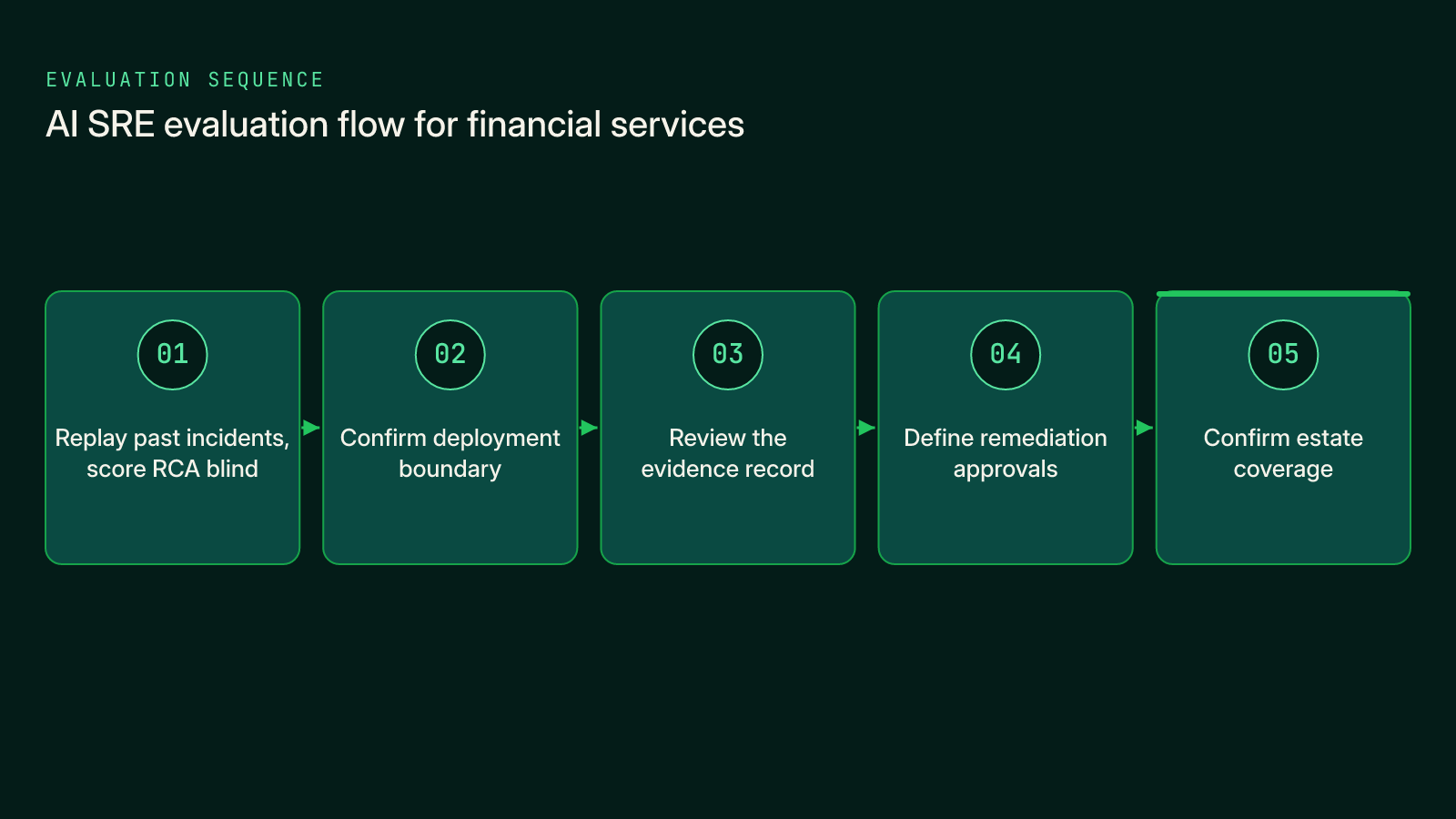
- Investigation accuracy on your own incidents. Replay recent Sev 1–3 incidents and have your engineers score RCA quality blind, as in a head-to-head evaluation.
- Deployment inside your data boundary. Compare SaaS, in-cluster components, BYOC, on-premises, and air-gapped options. Ask what leaves the environment and whether you can bring your own model.
- A reviewable evidence record. Look for the hypotheses tested, the hypotheses ruled out, the evidence behind the conclusion, and audit logs of agent actions.
- Governed remediation. Ask which actions the agent can take, who approves them, and how each action is scoped. Approval gates are standard, so ask how autonomy expands over time.
- Coverage of a heterogeneous estate. Test across Kubernetes, serverless, mainframe, on-premises systems, and multiple observability vendors.
Criterion one also informs the build-versus-buy decision. In Traversal's benchmark on high-severity incidents, 25 real Sev 1–3 incidents at a large financial-services enterprise were investigated. Traversal was judged the better RCA 83% of the time against the strongest frontier-model-plus-observability-access setup, and up to 90% against the weakest.
Traversal's average latency was 9.5 minutes, while the do-it-yourself setups ran at two to three times that latency. On these incidents, connecting a frontier model to observability tools did not match purpose-built causal investigation.
Criterion two decides what InfoSec reviews. Traversal's guide explains why security teams require BYOC for AI SRE, with data kept in the institution's own cloud account.
Choosing the Right Platform for Your Team
Match the platform to your estate and your review constraints:
- Traversal: Complex, heterogeneous environments that need multi-hop root cause inside the institution's boundary.
- Resolve AI: SaaS-comfortable fintech or crypto teams that want an investigation agent.
- Datadog Bits Investigation: Environments already standardized on Datadog.
- Rootly AI SRE: Teams whose priority is incident coordination, with investigation attached.
- Komodor: Kubernetes-heavy platforms that must self-host or run air-gapped.
Dynatrace Intelligence is a reasonable alternative for institutions already standardized on Dynatrace that value its certification set, including ISO 27001 and ISO 42001.
These categories also combine. An incident management platform can coordinate people while an AI SRE investigates cause, and the two run side by side. A confirmed root cause still goes through change approval, and specialist teams still apply many fixes.
For a deeper checklist, see Traversal's guide on how to evaluate an AI SRE.
FAQ
Several can. Traversal supports BYOC and private on-premises deployment, while Komodor offers a self-hostable control plane. Resolve AI runs as SaaS but offers an optional in-cluster component that redacts sensitive data before it leaves the customer’s environment.
Start with autonomous investigation and approval-gated remediation for scoped, reversible actions, then expand autonomy as accuracy is proven on your incidents. Compare how each platform scopes and records actions.
AIOps groups and deduplicates alerts based on patterns in alert metadata. An AI SRE investigates the underlying system state to determine why an incident happened and what to do about it.
Run a scoped proof of value on one application using recent real incidents and read-only integrations. Agree on an RCA scorecard in advance and have your own engineers judge the results.
No. AI SRE tools take over the investigative search that consumes senior engineers during incidents, freeing them to focus on approvals, remediation decisions, and reliability work.

Traversal Now Sees Your AWS Stack: Introducing CloudWatch and AWS Account Integrations

How Can You Effectively and Efficiently Monitor Distributed Systems?