AI Debugging for Production Systems: Why Finding the Root Cause Beats Finding the Symptom

AI debugging tools promise a simple thing: ask what broke during an outage, and get an instant answer. However, on-call engineers describe a very different reality.
In a live incident, many of these tools act like a confident advisor that has no idea what is happening inside the running system. That gap is the whole problem. Debugging production is not about summarizing signals or grouping alerts. It is about explaining cause.
AI debugging for production systems means using AI to detect, diagnose, and fix incidents in live, running software, not to write code in an editor. The tools that fall short share one flaw. They show correlation (what changed), instead of causation (why it broke).
Book a Demo to see how Traversal finds the root cause of an incident, not just the symptom.
What is AI Debugging for Production Systems?
AI debugging for production systems is the use of AI to find, explain, and fix problems in live production environments. It works on the system in production, not on code caught inside a development tool before release.
This is runtime debugging, and it is a different job from code-writing debugging. A developer debugging in an editor works with one codebase on one machine. Production debugging happens on the moving system, while it serves traffic across many services at once.
Think of it like the difference between reading a car's manual and listening to the engine while the car is driving. The clues are scattered across logs, metrics, events, and recent changes. Something has to gather those clues fast and turn them into a clear root cause.
Why is Debugging Production Systems So Hard?
Modern production is large, fast, and distributed. A few forces make it especially hard to debug.
- Cloud-native scale. In CNCF's 2025 annual survey, 82% of container users said they run Kubernetes in production, up from 66% in 2023. Each service adds more moving parts to reason about.
- The cost of downtime. ITIC's 2024 downtime survey covered more than 1,000 firms. It found a single hour of downtime now exceeds $300,000 for over 90% of mid-size and large enterprises.
- A high uptime bar. ITIC's 2024 research also found that 90% of organizations require at least 99.99% availability. That leaves roughly 52 minutes of unplanned downtime per year.
- Cascading failure. Why multi-hop failures spread explains the pattern. Microsoft reported that a single CrowdStrike update in July 2024 affected about 8.5 million Windows devices. One small change spread far because systems are interconnected.
- Long incident lifecycles. IBM's 2024 Cost of a Data Breach report found the average security breach ran 258 days, a seven-year low. Organizations using AI and automation extensively detected and contained those breaches 98 days faster.
The harder the environment, the more the real question shifts from what broke to why. That is where most tooling was never designed to help.
Why Do Traditional Tools Fall Short?
Observability platforms, AIOps, and alerting systems were built to surface signals to humans. They were not built to let software reason about cause. That design choice is the root of the gap.
These tools are excellent at correlation: they show what changed, what looks anomalous, and which metrics moved together. They rarely explain causation, the actual reason one thing led to another.
Correlation tells you what changed. Causation tells you why.
- Dashboards show symptoms. A spike on a chart tells you something is wrong. It does not tell you which change, in which service, set off the failure.
- Log search returns a pile. When an engineer asks which logs matter, the honest answer across hundreds of services is often "which logs?" Volume is not the same as an answer.
- Alert grouping is not root cause. Bundling related alerts reduces noise, but a tidy cluster of alerts still leaves the underlying cause unexplained.
Every one of these gaps points back to the same limit. The tools describe the surface of an incident, and a human still has to supply the reasoning.
What Does an AI SRE Look Like in Production?
An AI SRE is the causal approach put to work across the whole incident lifecycle. Traversal is the first and only AI SRE validated inside the Fortune 100, and it is built to reason about production causally at enterprise scale.
Under the hood, five components do the work:
- Agentless Data Capture™. Reads logs, metrics, code, and production data with no agents or sidecars to install.
- Causal Indexer™. Distills that production data up by 1000x without losing causal signal.
- Production World Model™. Keeps a continuously updated, causal model of how the entire production environment behaves.
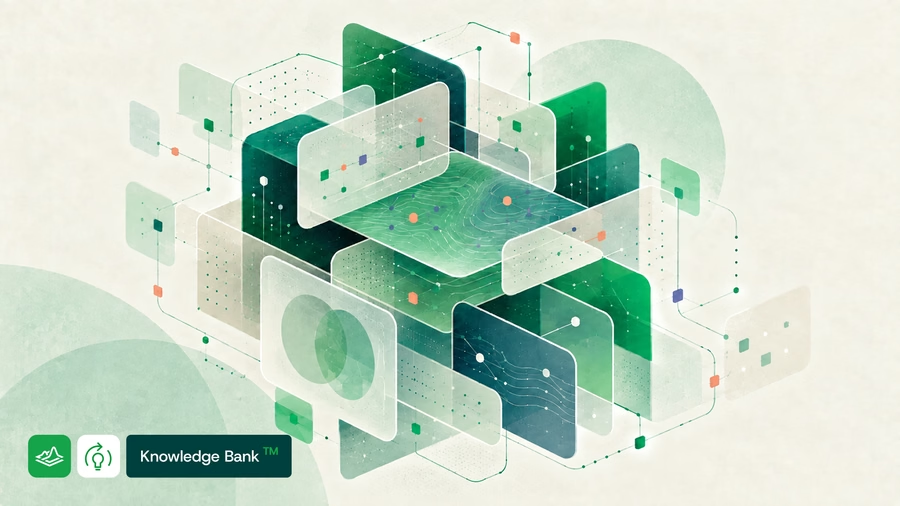
- Knowledge Bank™. Makes runbooks, docs, and past incidents usable in real time.
- Causal Search Engine™. Parallel searches 10K+ hypotheses, reasoning across 10 or more hops, from apps to services to infrastructure to networking, to find one root cause.

Together these map to a find, fix, and prevent lifecycle. Alert Intelligence triages noise and catches issues early. Incident Root Cause Analysis explains why an incident happened with evidence. Self-healing carries out fixes that compress recovery time. Code Resilience feeds production lessons back into development so the same failure does not return.
The results follow the same pattern. Across its Fortune 100 customers, Traversal reports 82%+ accurate root causes in under 5 minutes on average. Accuracy here means output that produces the steps to remediate an incident, not a vague pointer.
Those same customers see 85%+ improvement in mean time to resolve (MTTR) and mean time to detect (MTTD), along with $10M+ in first-year savings. Enterprises including American Express, PepsiCo, Capital One, and DigitalOcean run Traversal in production, with many seeing value in under two weeks.
Book a Demo to watch Traversal's Incident RCA live in your own production environment.
What Are the Risks and Limits of AI Debugging?
AI in production is not automatic trust. The honest risks are real, and they shape how an AI SRE should be built.
- Plausible but wrong answers. An AI that guesses can sound certain and still be mistaken, which is dangerous during an outage.
- Incomplete runtime context. A model cut off from the live system gives advice that is disconnected from what is actually breaking.
- The trust question. Teams debate whether AI should act on production directly or only advise.
The answers to these risks are design choices, not promises. Insist on evidence-backed output that shows its reasoning, so an engineer can check the work. Keep a human in the loop for high-risk actions. Choose a read-only, agentless, run-in-your-own-environment posture that limits blast radius while the system earns trust.
One misconception is worth naming directly. Summarizing signals and correlating logs is not the same as finding root cause. A tool can do the first perfectly and still never explain why an incident happened.
It's a Causality Problem, Not an Observability Problem
Debugging production is a causality problem, not an observability problem. Observability and alerting are good at showing what broke, but the cost and speed of modern incidents demand a clear answer to why. AI helps only when it is built to reason about cause across a live system, then fix and prevent the failure.
Book a Demo to put an AI SRE that explains why, not just what, to work on your production systems.
FAQ
An AI SRE gathers live signals, models how a system behaves, and reasons across dependencies and recent changes to explain why an incident happened, providing an evidence-backed root cause analysis. Strong versions then propose or carry out a fix.
Accuracy depends on whether the AI reasons causally or just summarizes signals. Across its Fortune 100 customers, Traversal reports 82%+ accurate root causes in under 5 minutes, where accuracy means output that produces the mitigation steps.
It uses live operational data such as logs, metrics, events, and recent code or configuration changes. Reasoning about cause also requires knowing how services depend on one another, not just the raw signals.
AI observability surfaces correlations and anomalies for a human to interpret, which is still about what changed. An AI SRE reasons about causation across the system and acts across the incident lifecycle.
The main risks are confident but wrong answers and actions taken without enough runtime context. A read-only, evidence-backed, human-in-the-loop posture keeps AI useful while limiting the blast radius of any action.