The Safest Way to Automate Incident Response

The safest way to automate incident response is to automate the investigation first, under read-only access. Let actions run on their own only where the cause is proven and the action is bounded and reversible. Everything else gets a human decision backed by evidence.
In our experience, most teams put their guardrails on the action and leave the diagnosis to chance. They add approval gates to restarts, rollbacks, and scaling events, then hand the approver whatever the dashboards happen to show. An approval click on a wrong diagnosis is not a safeguard.
Incident response automation becomes safe when the system understands the failure before it touches production. Safety is a property of understanding before it is a property of action.
Automation is only as safe as the root cause it acts on. See how Traversal gives your team an evidence-backed diagnosis before anything changes in production.
What is the safest way to automate incident response?
Automate in the order that risk allows: coordination first, investigation second, and action last, only where the diagnosis is proven and the change is reversible. Each layer carries a different blast radius, so each earns automation on different terms.
- Coordination. Opening channels, paging owners, and drafting status updates change nothing in production. The risk is low, so automate this layer first.
- Investigation. Read-only evidence gathering and root cause analysis touch data, not system state. Automate this layer fully, with rate limits on every query.
- Action. Gate each change on diagnosis confidence and blast radius. Humans decide on anything state-dependent or irreversible.
Much of the automated incident management guidance we see starts with the third layer. That order puts the riskiest step on the weakest foundation, because every action inherits whatever the investigation got wrong.
The trap: automating the fix before you understand the failure
In Traversal's view, standard safe-automation advice concentrates on the action. Add an approval gate, scope the permissions, log the click, and assume the diagnosis behind it is sound.
That assumption carries more risk than it appears to. Every automated remediation is itself a production change. Google SRE's change-management finding attributed roughly 70% of its outages to changes in a live system.
Consider a runbook that restarts a pod after an out-of-memory kill. If a traffic surge is still driving the memory pressure, the restarted pod climbs straight back into the same failure. The alert fires again, the runbook runs again, and the loop hides the surge that caused it.
Context changes the risk as well. Restarting a service on a staging node and restarting it on a payment-path node look identical in the runbook. The blast radius is entirely different.
Runbook automation was built to execute an answer someone already worked out. Checking whether that answer still fits the failure in front of it was never part of its design.
An approval gate inherits the same limit. The approver can only protect production as well as the evidence on the screen allows.
Why safe incident automation is hard
Every safeguard downstream inherits the quality of the diagnosis upstream. In the OpenRCA 2.0 benchmark preprint, agents on 11 frontier LLMs recovered the exact root-cause set of injected faults in 20.7% of cases on average. The same agents identified at least one correct root-cause service in 76.0% of cases, a June 2026 fault-injection result rather than production data.
- Diagnosis quality. Naming one correct service falls well short of knowing the full cause. Partially right is not safe enough to act on automatically.
- Context-dependent actions. An identical command carries a different blast radius depending on what sits upstream and downstream of the target.
- Read access is not free. Read queries add load to the systems they inspect. Investigation therefore needs rate limits and safety checks.
- Drift with infrastructure as code. Changes that bypass the IaC pipeline create state the next deploy may revert. Propose the change through the pipeline instead.
- Trust erosion. One confident wrong action can set back automation adoption more than many correct ones advance it.
None of these obstacles goes away with a stricter approval policy. Each one sits in the reasoning that comes before the action.
The autonomy curve: earn each level of incident automation
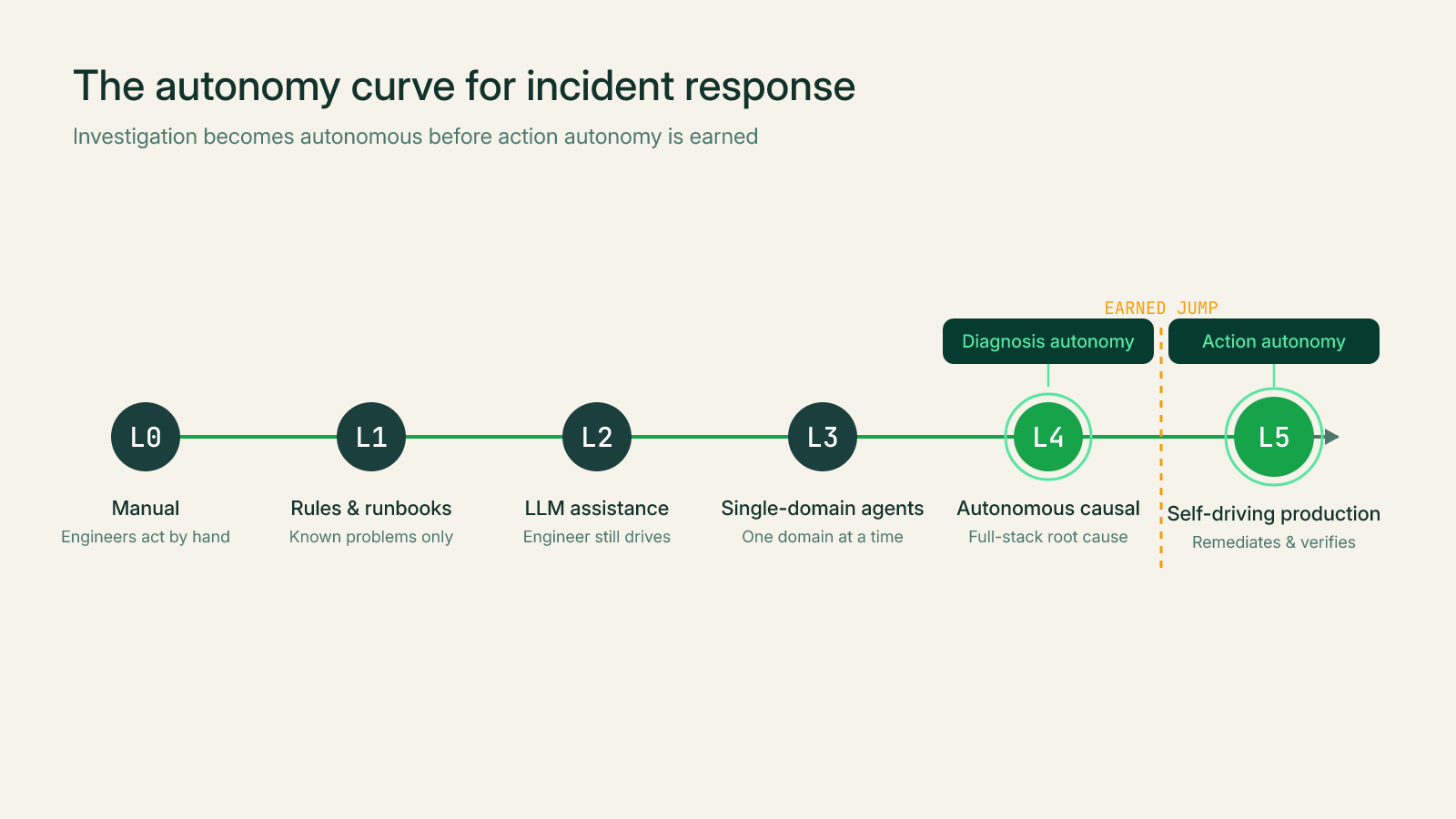
Automation maturity is easier to govern when it has a scale. Traversal's autonomy curve for production measures how many human dependencies a system removes. The move from L4 to L5 is earned through measured accuracy.
The curve matters because it separates two questions teams often merge. Can the system work out why production broke, and should it change production on its own?
- L0 (manual). Engineers gather evidence, form hypotheses, and act by hand.
- L1 (rules and runbooks). Automation handles known problems and stalls on novel ones, because every path was written in advance.
- L2 (LLM assistance). Assistants summarize incidents and write queries, while the engineer still drives the investigation.
- L3 (single-domain agents). Agents investigate inside one domain, such as Kubernetes or databases, without a view across the rest of the stack.
- L4 (autonomous causal investigation). The system investigates across the full environment and reaches a root cause, while humans control critical decisions.
- L5 (self-driving production). This is the destination, where systems remediate and verify their own changes without waiting on a person.
Safe automation means fully automating investigation at L4 before granting action autonomy at L5. That jump is a question of trust in the diagnosis behind every change.
Skipping levels is how teams end up automating actions on L1 or L2 diagnoses. A runbook trigger or an assistant's summary then carries the weight of a production change it was never built to justify.
Each level also changes what a person reviews. At L2 the engineer checks a summary, while at L4 the engineer weighs an evidence chain and decides whether to act.
What safe incident response automation looks like in practice
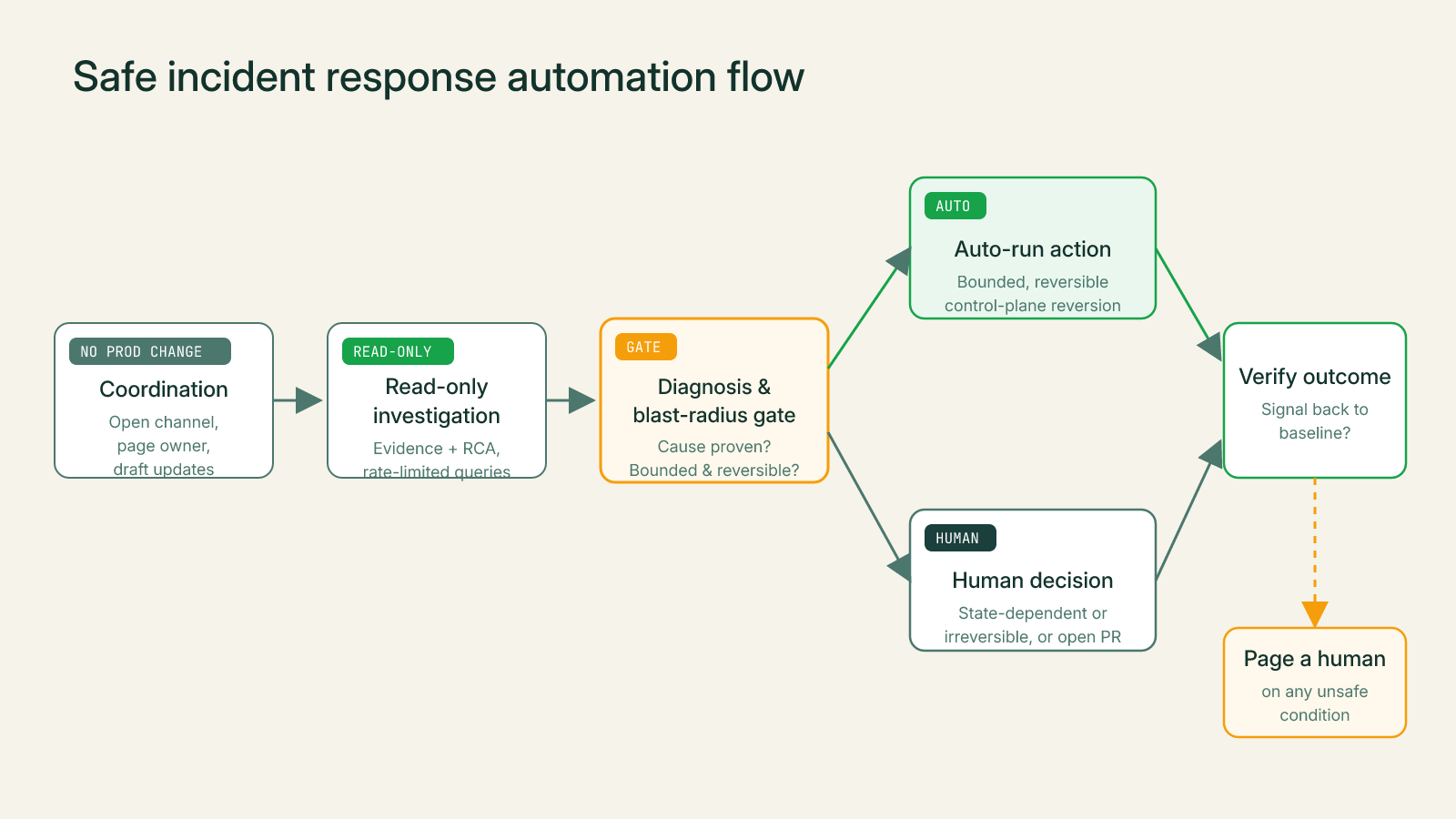
A safe incident response workflow adds automation one stage at a time, and each stage has its own entry criteria.
- Automate coordination first.
- Inputs: Incident declaration and service ownership data.
- Actions: Open the incident channel, page the owning team, and draft status updates.
- Criteria: No production state changes at this stage.
- Automate the investigation under read-only access.
- Inputs: Telemetry, recent changes, dependency maps, and prior incidents.
- Actions: Gather evidence, test hypotheses, and return one root cause with an evidence chain and a remediation path.
- Criteria: Read-only, rate-limited queries with auditable reasoning.
- Gate every action on diagnosis confidence and blast radius.
- Criteria: The cause is proven, the action is reversible, the scope is bounded, and the precondition still holds at execution time.
- Actions: Auto-run only control-plane reversions whose safe end state never changes.
- Routing: Send state-dependent actions to a human, or open a pull request through the normal pipeline.
- Precedent: NIST's cybersecurity incident response guidance suggests automating some containment while letting handlers contain manually, instead of or alongside automation.
- Verify the outcome and default to humans.
- Actions: Check that the signal returns to baseline within a short window, and page a human if it doesn't.
- Criteria: On any unsafe condition, stop and hand control back.
- Precedent: Google's guidance on automation risk says to assess every action for safety before execution and default to human operators when conditions turn unsafe.
- Expand autonomy only with evidence.
- Inputs: Backtests on past incidents and scoped pilots.
- Actions: Widen scope stage by stage, with explicit evaluation criteria at each stage.
- Criteria: Measured accuracy on the current scope before the next scope opens.
The gate column below works as the contract between automation and the engineers who answer for production.
Incident stepAutomate by default?Gate / conditionCoordination (channels, paging, status drafts)YesNo production state changesEvidence gathering and RCAYesRead-only access, rate-limited queries, auditable reasoningKnown control-plane reversionYes, when conditions holdProven cause, fixed safe end state, verification window with human fallbackState-dependent remediation (restart, scale, rollback)NoHuman decision on the evidence, or a pull request through the normal pipelineCustomer-facing communicationDraft onlyHuman review before anything is publishedIrreversible changesNoHuman decision required
Run the out-of-memory restart from earlier through these gates. Coordination opens the channel and pages the service owner without touching the cluster.
The read-only investigation then checks whether request volume is still climbing and which upstream change shifted traffic toward the pod. If the surge is ongoing, the restart precondition fails, and the action routes to a human with the evidence attached.
The engineer might scale the deployment or roll back the upstream change instead. Either way, the decision rests on why memory climbed rather than on which alert fired.
What you're betting when automation acts on a wrong diagnosis
A wrong automated action rarely stays contained. It extends the outage, adds a second change to unwind, and becomes the part of the incident everyone remembers.
Engineering credibility follows the same pattern. A platform team spends years earning permission to touch production, and one confident bad call can cost that permission in an afternoon.
Security review raises its own stakes. Any agent with production access needs access controls, audit logs, and data residency that InfoSec will sign off on.
The exposure grows with the autonomy you grant. A wrong diagnosis at L2 wastes an engineer's time, while the same diagnosis behind an automated action changes production on bad evidence.
So the investigation deserves the strictest scrutiny in automated incident response. Every later safeguard depends on it.
What enterprise-grade safe automation actually requires
Each requirement follows from the same principle: the reasoning has to be trustworthy before any remediation leans on it.
- Production modeled in advance. The pipeline: Agentless Data Capture™, Causal Indexer™, Production World Model™ (with Knowledge Bank™), and Causal Search Engine™, delivered through Traversal Workers.
- Multi-hop causal reasoning that returns one answer. Traversal returns a single, evidence-backed root cause and remediation path. Your team sets the gates for what runs next.
- Read-only access and a deployment model InfoSec accepts. Traversal's read-only security architecture runs on-premises or in your cloud (BYOC), with your own model (BYOM).
- Context that doesn't depend on hand-maintained runbooks. The Knowledge Bank is mostly auto-discovered operational context from Traversal's investigations, with human input as last-mile refinement.
- Delivery where the incident happens. Incident Workers in Slack and Teams join the incident channel, run the investigation end to end, and draft the postmortem.
Building the model ahead of time matters for safety. A model assembled mid-incident starts from nothing at the worst moment, while a continuously updated one arrives with dependencies and recent changes already mapped.
In Traversal's view, read-only access and human approval are table stakes for any AI SRE. What separates platforms is the causal depth of the investigation and how much context the system builds on its own.
Phased rollout is how this principle holds up at enterprise scale. In a Fortune 100 financial services pilot, the company took a phased, security-first approach on an on-premises deployment, with evaluation criteria at each stage.
Traversal reached 82% RCA accuracy on in-scope applications and a 32% reduction in potential mean time to recovery (MTTR). In the remaining cases, it narrowed the investigation scope and identified which teams needed to be involved.
What Traversal is
Traversal is the AI SRE for the enterprise. It reasons causally across production, following failures multi-hop through services and dependencies, to return an evidence-backed root cause and a remediation path.
Traversal's AI SRE platform investigates with low latency under read-only access, inside the customer's environment. Teams can automate incident response from the diagnosis outward, and self-driving production is the destination the platform is building toward.
Prove why it broke before you automate what to do about it.
FAQ
No. Automation can take over coordination and investigation, but novel, state-dependent, and irreversible decisions still need an engineer who can weigh evidence and business context.
Start with coordination tasks that do not change production, then automate read-only investigation, and only then consider bounded, reversible actions.
Oversight catches the cases where the diagnosis is incomplete or the context has changed, which is exactly when an automated action does the most damage.
No. Safety also requires rate-limited queries, auditable reasoning, and a diagnosis accurate enough to support any action.
Track mean time to recovery, root cause accuracy, escalations avoided, and how often automated actions are rolled back or handed back to humans.




What Are the Best AI SRE Tools for Financial Services? 5 Platforms Ranked for 2026