Outage or cyberattack? How to triage a major outage in the first hour

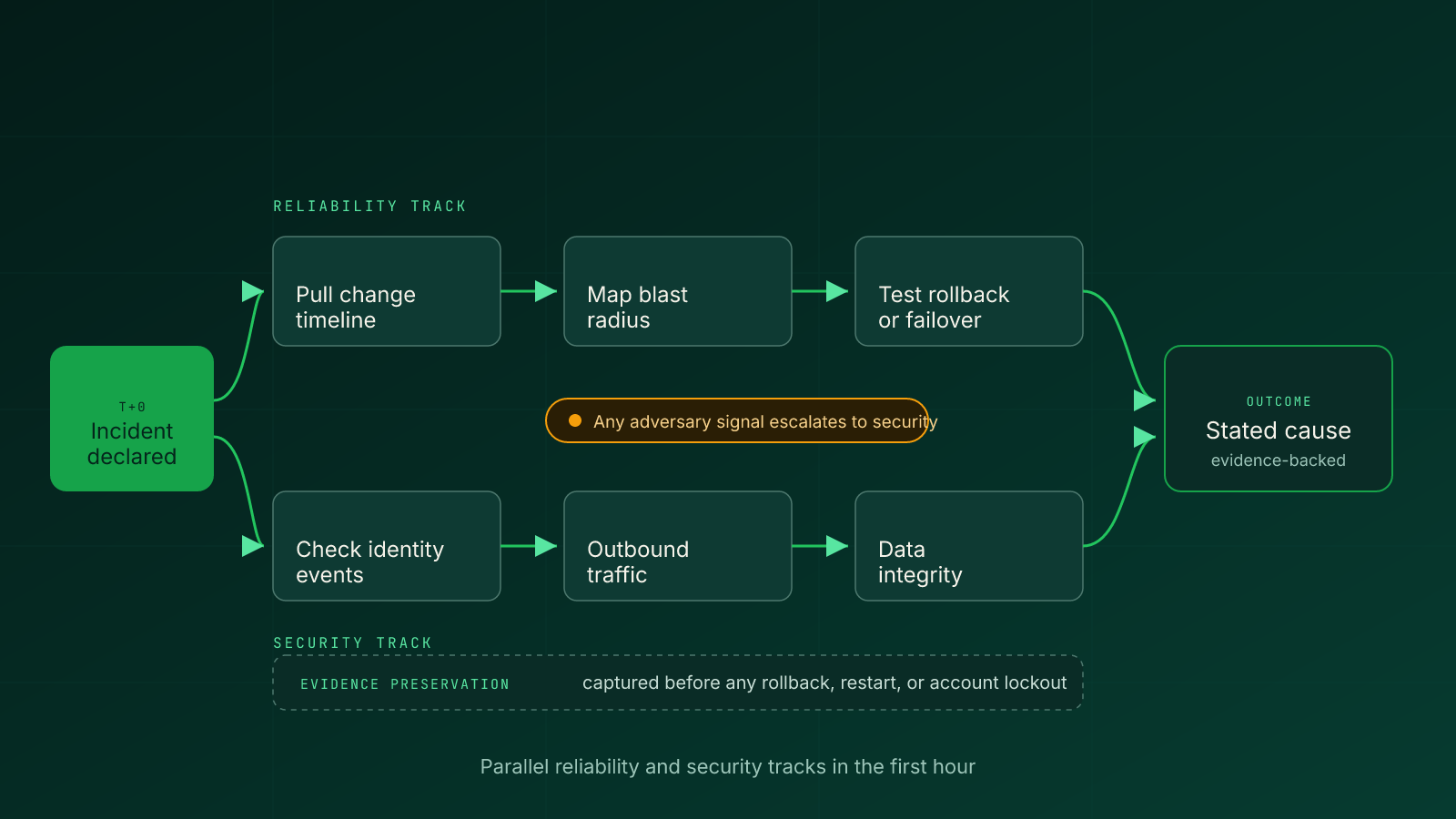
Treat a major outage as an internal fault until evidence says otherwise, and test that presumption while security checks for adversary signals in parallel. Three checks carry the first hour: what changed, whether the blast radius stops at a rollout or dependency boundary, and whether adversary signals exist.
"What changed" covers deploys, configuration pushes and maintenance inside the failure window. Adversary signals include unexplained privileged activity, unexpected outbound traffic, and encrypted or altered data.
The outage or cyberattack question is a root cause question, so the evidence that answers it is evidence responders already need to restore service. Teams that wait for a security verdict before testing changes lose time they cannot recover. Eight major disruptions between 12 and 17 November 2026 prompted public questions about coordination, yet every operator that published a cause pointed to something internal.
What happened in the November 2026 outage cluster?
Between 12 and 17 November 2026, Microsoft 365, Workday, the FAA, AWS, JPMorgan Chase, United Airlines, Apple and the NSA had major disruptions. Each operator that published a cause described an internal fault, while AWS and United had not published one.
CSA's outage cluster analysis, published 18 November, found that every organization with a published cause pointed to something internal. None had attributed its failure to an adversary, and CSA described the causes as preliminary.
DateOrganizationApprox. durationStated causeAttack ruled out by12 to 13 NovMicrosoft 365About 24 hoursMicrosoft's preliminary report cited a latent defect from a July 2026 gateway updateMicrosoft, which reported no sign of malicious activity13 to 14 NovWorkdayRoughly 17 to 18 hoursWorkday's status notice said DR-site services "unexpectedly connected to Production databases"A Workday spokesperson, who said it was not a cybersecurity incident13 NovFAA ground stopAbout 3:30 to 8:15 pm ETThe FAA cited a telecommunications network failure during router work, still under investigationThe FAA, which said it had no indication of a cyberattack15 NovAWS us-east-1About three hoursNot published by AWSNot addressed16 NovJPMorgan ChaseNot specifiedChase said a "software bug in on-premise hardware systems"Chase, which said there was no evidence it was cyber-related16 NovUnited AirlinesAbout 90 to 100 minutesNot published by UnitedUnited, which said there was no indication of a cybersecurity issue17 NovAppleNot specifiedApple said "an internal update" caused some outagesApple cited an internal update and did not attribute the outage to an attacker17 NovNSA classified networkNot disclosedThe NSA said "scheduled routine maintenance"Officials and anonymous sources, not the NSA
On 18 November, DNI Clayton's House testimony described separate service outages associated with maintenance and technical changes, not a coordinated or state-sponsored attack. He framed that assessment as "based on what we know today."
Every row above is an operator statement or a preliminary cause, and none is a final finding. Investigations at Microsoft, the FAA and the NSA were still open when CSA published.
Why do separate outages look like a coordinated attack?
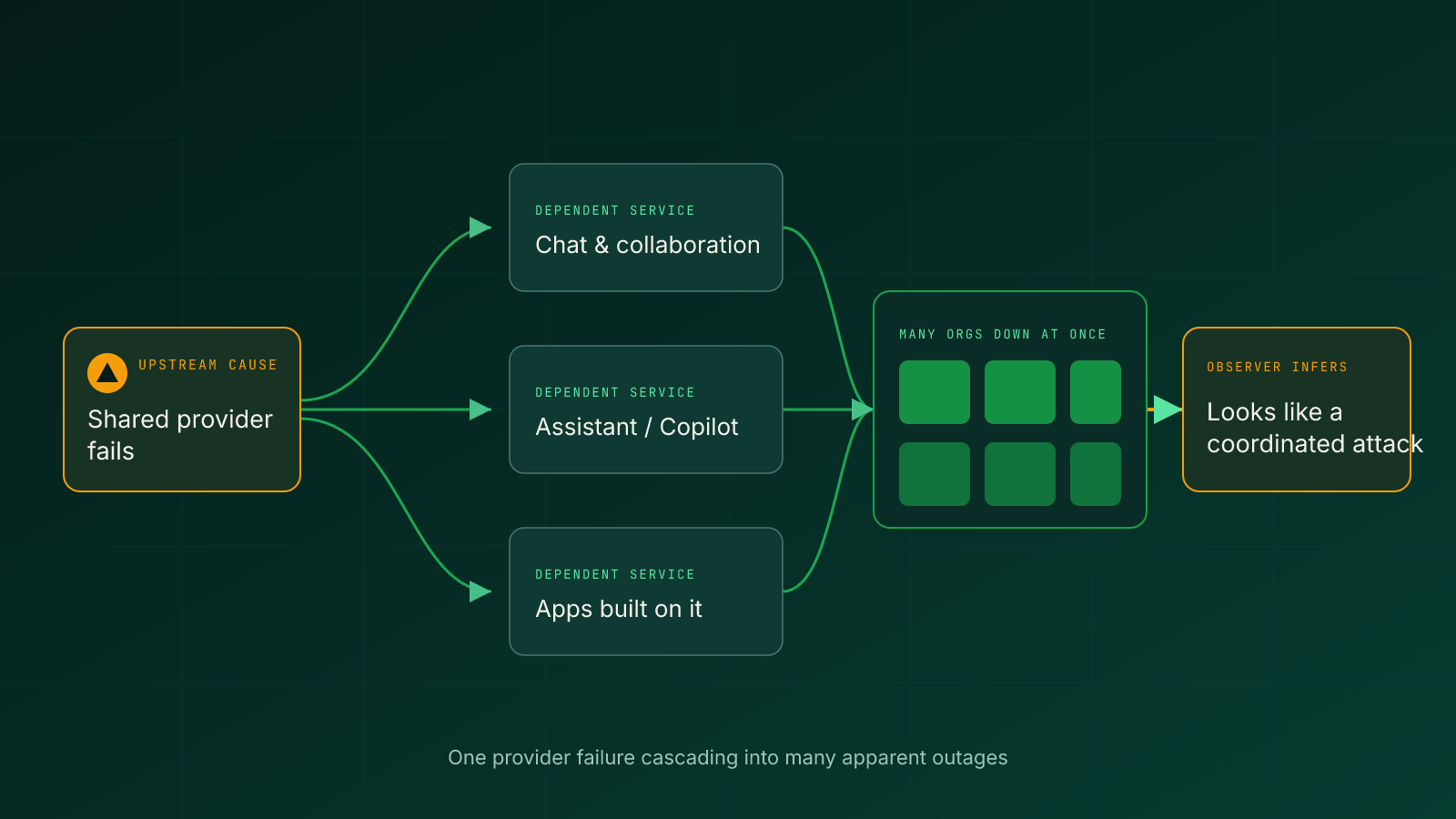
Separate outages look coordinated because shared dependencies carry one failure into many services, timing clusters by chance, and coincidental symptoms reinforce an attack story. Together they make a cluster of tech outages feel like a campaign before any evidence of one exists.
Shared dependencies do most of that work. According to CSA, the Exchange Online failure also disrupted services built on it, such as Teams and Copilot. CSA also notes that Chase said its bug affected other banks only through transactions with Chase.
Our inference: when one provider fails, observers see many organizations failing at once, and from outside that looks like a broad attack.
Coincidence then fills in the story. Cloudflare's November 2025 postmortem says the team initially wrongly suspected a hyper-scale DDoS attack. Its separately hosted status page went down at the same time, which led some responders to believe an attacker was targeting both.
The status page failure was a coincidence. The cause was a database permissions change that produced an oversized Bot Management feature file. An attack hypothesis pulls responders toward traffic analysis and away from the change timeline, which is where this cause sat.
Inside one enterprise, symptoms surface several hops from the cause, in services owned by different teams, so no one team sees the whole path. That pattern makes multi-hop incidents across teams slow to diagnose. Each team reports a local failure, and the link stays hidden until someone maps the dependencies.
Outage or cyberattack: what signals point to an internal fault?
Three signals point to an internal fault rather than a cyberattack. A change lines up with onset, the blast radius stops at a rollout or dependency boundary, and recovery responds to rollback.
Start from a presumption of internal fault, because the available evidence leans that way. Doug Madory, head of internet analysis at Infoblox, monitors as many as a dozen network outages a day. He told WIRED that only around one in a thousand outages he sees turns out to have been caused by hackers.
Survey data measures something different but leans the same way. In the Uptime Institute 2026 outage analysis, respondents cited configuration and change management failure for 41% of major network-related outages (n=122). Malicious cyberattack was cited for 9% of the same base, and respondents could select up to three causes.
A change or maintenance window lines up with onset
Pull the change timeline before the dashboards. List deploys, configuration pushes, feature flag flips, certificate rotations, infrastructure work and scheduled maintenance in the 30 to 60 minutes before onset.
The November cluster shows how varied those changes are. Stated causes included a gateway update, a disaster recovery site connecting to production databases, router work, an internal update and scheduled maintenance. Microsoft's defect came from a July update, so the change that introduced a fault can predate the incident by months.
A change inside the window only nominates a suspect. Confirm it by checking that the onset timestamp and the affected services match the change's reach before anyone acts on it.
The blast radius follows a boundary you control
Internal faults tend to take the shape of a rollout: one region, one cell, one tenant group, one dependency, or the services behind one gateway. Attacks can take other shapes, such as a targeted business function, privileged systems, or spread that ignores deployment boundaries.
Reading the shape means assessing the blast radius against two references, the dependency map and the rollout plan. If every affected service sits behind the changed component and the unaffected ones do not, the internal-fault hypothesis gains weight.
Recovery responds to rollback or failover
If rolling back the change or failing over restores service in stages, the internal-fault hypothesis strengthens. If symptoms persist or return after a clean rollback, widen the hypothesis set and bring in security.
Capture evidence before the rollback runs, because a rollback replaces configuration state that security may later need to examine.
What signals warrant a security escalation?
Escalate to security as soon as an adversary signal appears or the internal-fault hypothesis stops explaining the evidence. Start both tracks without waiting for a verdict.
The incident commander makes the escalation call, using signals like these.
SignalWhat it suggestsWho to involveUnexplained privileged or admin activity, new accounts or MFA changesPossible credential compromiseSecurity operations, identity teamUnexpected outbound traffic or data transferPossible exfiltrationSecurity operations, network teamEncrypted files, ransom notes or integrity changesPossible ransomware or tamperingSecurity operations, incident response lead, legalTraffic from unusual sources overwhelming a servicePossible abuse or DDoSNetwork team, security operationsChanges no one on the change record madePossible unauthorized accessSecurity operations, change ownerSymptoms that persist after a clean rollbackInternal-fault hypothesis failingSecurity operations, incident commander
Parallel tracks fit how standards bodies frame classification. NIST incident response guidance (SP 800-61r3, April 2025) defines adverse events as events with a negative consequence regardless of cause, including power failures and cyberattacks. It adds that further analysis is often needed to decide whether an adverse cybersecurity event is an incident.
NIST offers no first-hour sequence, so the parallel-track method here is our synthesis. Two of its recommendations still shape the first hour:
- Predefined shutdown authority. Policy should name which roles may disconnect or shut down technology assets, so nobody debates authority on the bridge.
- Evidence retention. Organizations should collect and retain incident evidence under their own preservation procedures.
In practice, the incident commander assigns one responder to capture logs, deployment records, identity events and a timestamped action log. That capture happens before anyone approves a rollback, restart or account lockout.
Root cause investigation can also surface a malicious cause directly. In the Cloudways customer story, a WordPress site slowed with 502 and 524 errors. Traversal identified a set of abusive IPs overwhelming the site and proposed blocking them and restarting affected services.
The issue was remediated end to end in under 5 minutes, versus the 60 to 90 minutes Cloudways Support normally spent. This was a single-site slowdown, not a major outage. The point is narrower: the malicious traffic emerged from evidence about the cause, without anyone guessing at an attack first.
What is the difference between root cause analysis and symptom analysis?
Symptom analysis describes what users and monitors see, such as errors, latency or lockouts. Root cause analysis identifies the change or condition that produced them, the only layer that can tell an attack from an internal fault.
Attacks and internal faults produce the same first-hour symptoms: 5xx errors, timeouts and failed logins. Symptom analysis alone cannot settle whether a failure is an outage or cyberattack.
Separate the three layers of root cause: the symptom users see, the proximate cause that triggered it, and the systemic cause behind it. Workday's notice describes a proximate cause, DR-site services connecting to production databases. Any systemic cause behind that connection has not been published.
Identifying root cause in seconds by hand is rare at enterprise scale. Responders get closest by checking changes and shared dependencies first.
Dashboards were designed to display signals for people to interpret. They show which metrics moved together and leave the causal reasoning to whoever is on the bridge.
Traversal's AI SRE takes on that reasoning. The Production World Model™ keeps a continuously updated causal model of services, dependencies and changes. The Causal Search Engine™ tests hypotheses across multi-hop dependencies and returns an evidence-backed root cause.
That pairing is the basis of evidence-backed Incident RCA, which is dependency-aware and change-aware. Across enterprise customers, Traversal delivers 82%+ accurate root causes in under five minutes on average. Low diagnostic latency matters here because a root cause that names a change gives security a specific claim to check.
How do you improve mean time to detection so the question gets answered sooner?
Improve mean time to detection by alerting on user-impacting signals and on dependency health you measure yourself. Then put change events on the same timeline as alerts, and cut alert noise so novel signals stand out.
Mean time to detection is the time from when a failure begins to when the team detects it. Knowing what mean time to detect measures keeps the number honest: the clock starts when the failure began, not when the first alert fired.
Earlier detection shrinks the window in which speculation about an outage or cyberattack fills the silence. It also lets responders check recent changes sooner. Four practices help:
- Measure dependencies yourself. Track your own success rate against external providers instead of waiting for their status pages to change.
- Put changes on the alert timeline. Record deploys, configuration changes and maintenance as events next to alerts.
- Detect on user-facing symptoms. Alert on error rates, failed logins and failed transactions, alongside infrastructure thresholds.
- Cut noise so novel alerts show. Suppress duplicates so a first-of-its-kind alert reaches the on-call responder.
Noise reduction at enterprise volume is the job of Alert Intelligence for triage, which triages alerts automatically and reduces noise. PepsiCo autonomously triages 500,000+ alerts per month with Alert Intelligence.
Detection is not diagnosis. A lower MTTD shortens the first hour only when diagnosis follows it.
What should you say publicly before the root cause is known?
Say what is affected, what you checked, and what is not yet ruled out, such as "no indicators of compromise identified to date; investigation ongoing." Do not declare that an outage was or was not an attack until evidence supports it.
A "no evidence" statement describes the state of an investigation at one moment. A premature all-clear that later reverses damages credibility. Clayton's testimony showed the qualifier in use when he framed his view as "based on what we know today."
Public companies face a separate clock. Under SEC cyber incident disclosure guidance, the Form 8-K Item 1.05 four-business-day deadline runs from determining that a cybersecurity incident is material, not from discovery. That determination must be made without unreasonable delay, so the incident commander should bring legal and communications into the bridge early.
The guide is a staff summary, so counsel should confirm how the rule applies. Name one spokesperson and one update cadence. Run executive updates on a channel separate from the working bridge, so responders keep investigating while leaders get regular status.
A team that starts with a change timeline, a dependency map and named security contacts can answer the outage or cyberattack question with evidence. The same work restores service, preserves what security needs, and gives the spokesperson accurate words.
FAQ
Start with the change timeline and dependency map, then check whether the outage’s onset and affected services match a change’s reach. At enterprise scale, this investigation can take far longer than seconds by hand; Traversal reports delivering root causes with 82%+ accuracy in under five minutes on average across enterprise customers.
Alert on user-impacting symptoms and your own measurements of dependency health, and put change events on the same timeline as alerts. Reducing alert noise helps novel signals surface before customers report them.
Symptom analysis describes what is failing and where users feel the impact. Root cause analysis identifies the change or condition that produced the failure.
Start restoring service and checking for adversary signals in parallel rather than waiting for a verdict. Preserve logs, deployment records, identity events and an action log before making changes that could destroy evidence.
Every operator that published a cause pointed to an internal fault, and none attributed its outage to an adversary. The Director of National Intelligence described the outages as separate rather than coordinated, while several investigations and causes remained preliminary.