Have Your Agents Call My Agents


Designing Traversal for agent-to-agent communication
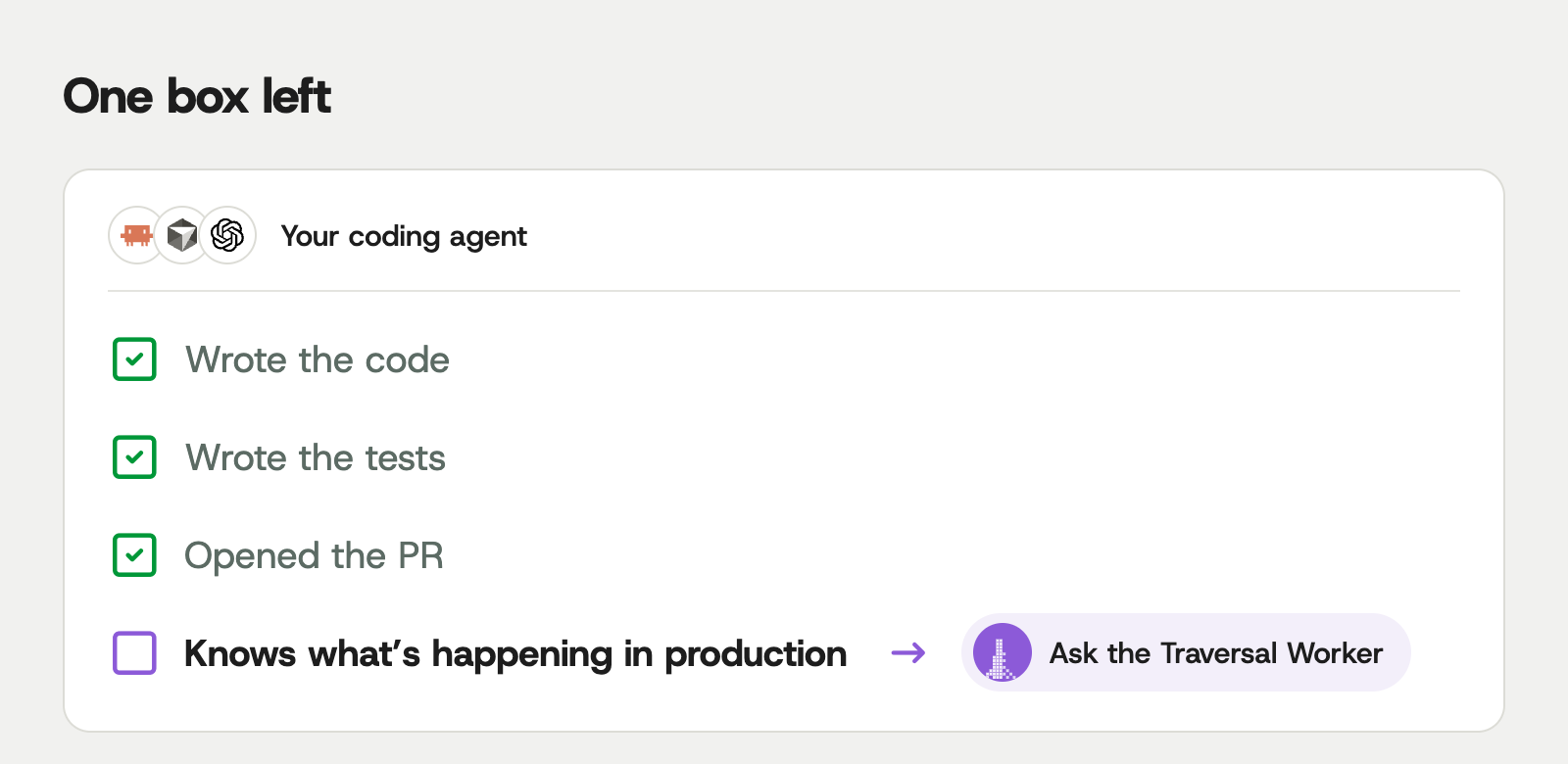
Every engineer now works with an agent that knows their code far better than it knows production, and what each of those agents does learn about production is gone when the session ends. As teams add agents, what they collectively know about their systems scatters across laptops and chat windows where no one else, human or agent, can use it.
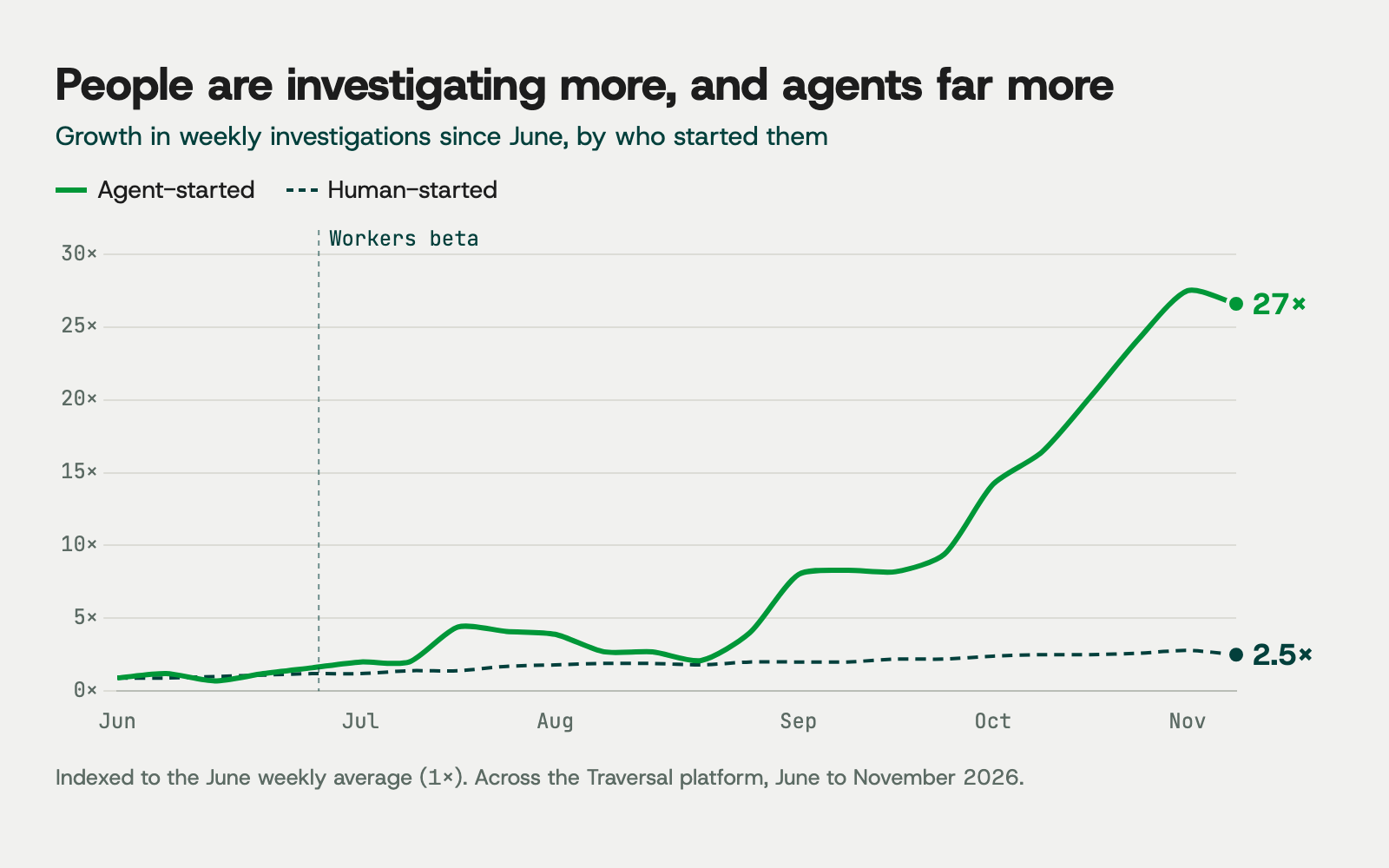
We built Traversal to be agent-native so that what agents learn across disparate sessions compounds instead of decaying. Nobody has to become a Traversal expert, because the agents they already use know when to ask it and what to ask. Agents are first-class callers of every part of the product, from investigations to Workers to the MCP, and what one agent learns reaches the next agent and the rest of the team.
The next engineer to join your incident will probably bring an agent with them, and that agent has no reason to start from zero when a Traversal Worker has been on the case since the first page. See Traversal in action today.
Designing for a caller that is an agent
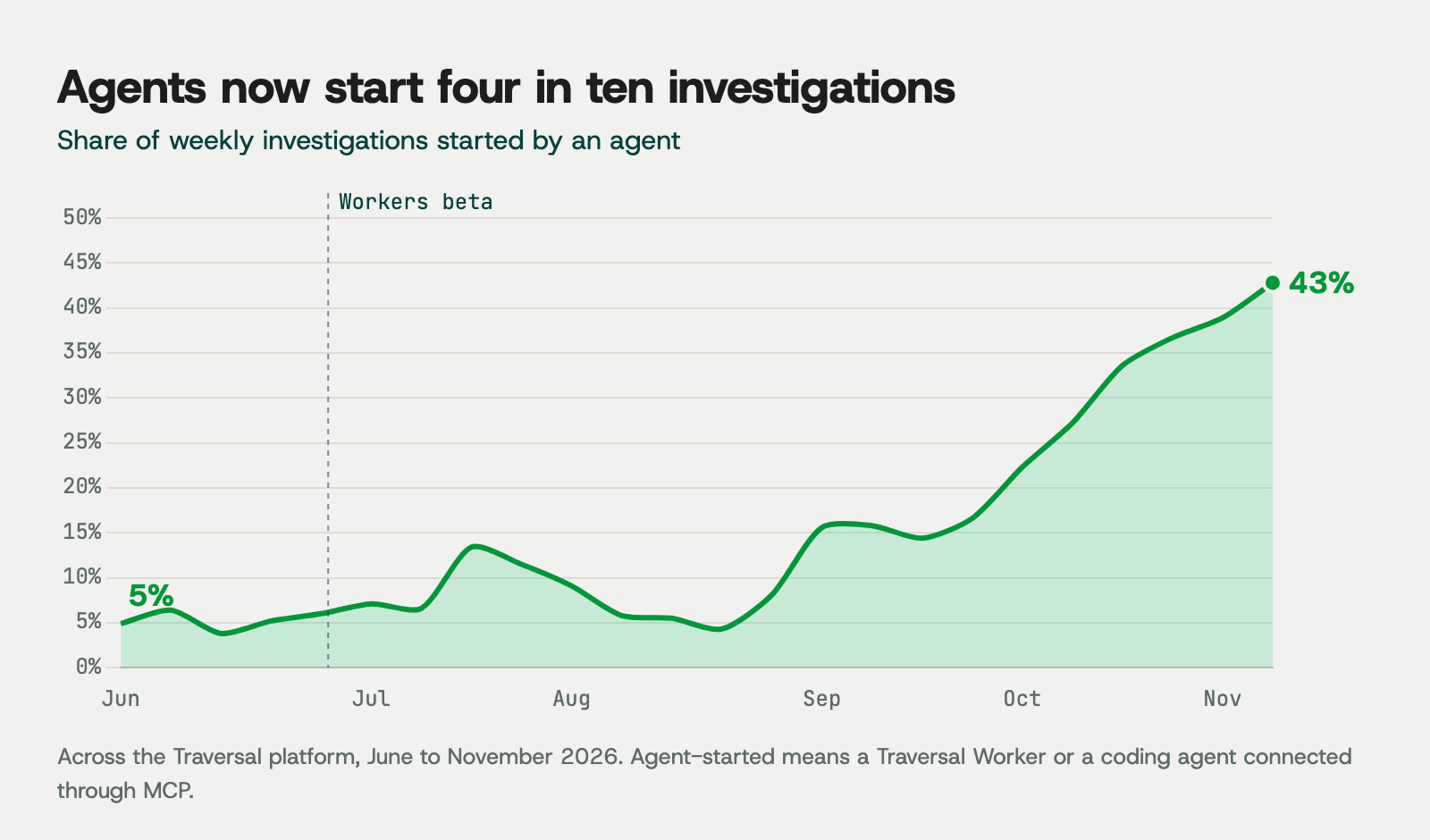
The first Traversal MCP put production investigation inside tools like Claude Code and Cursor, and it changed who we were talking to. The engineer talks to their agent and their agent talks to ours, so the question we receive and the answer we return are both handled by a model before a person sees either.
An agent is a different kind of caller. It follows instructions consistently, responds immediately, and is happy to iterate, and it brings capabilities of its own: the code, a terminal, and whatever else the engineer has connected. An investigation built for a person who starts it and waits for a finished report wastes all of that. What the agent does not have is production, so it can pass every test without knowing that the service it just changed is already struggling.
So we built Lightning Mode, a fast investigation mode designed specifically for agent-to-agent communication, around three principles:
- The output is written for an agent. It does not need to be formatted for a human reader, because the client will interpret it and decide what to show its user.
- The context is asymmetric, and the response should say so. Traversal sees production, while the client sees the code, a terminal, and whatever else the engineer has connected. The client tells Traversal what it can do, and Traversal answers with what it found and the directions worth taking next.
- The client drives. It decides whether to follow one of those directions, ask Traversal to go further, or conclude that the investigation is already deep enough for the question at hand.
It also had to work everywhere. The MCP specification moves quickly, and most clients implement only part of it, each a different part. Features that would help someone waiting on a long investigation, such as live progress and visibility into the agent's reasoning, are missing from many of the interfaces engineers actually use, which is one more reason a fast exchange serves an agent better than a long silent one. Agent callers get an interface built for them, rather than the human interface with a protocol in front.
The Worker as liaison
A Traversal Worker is where that knowledge lands. It lives in a channel, keeps persistent state, has its own UI, and receives messages from Slack, Microsoft Teams, and the web, deciding for itself when to investigate and when to speak. Because it persists, what it learns is still there for the next person or agent who asks.
A Worker sits between two audiences and talks to each differently. Facing the channel, it curates for a busy room: what it posts is easy to read, lands in the right thread at the right moment, and often is nothing at all. Facing other agents, it starts investigations and steers them as new information arrives, without shaping any of that exchange for people.
A Worker uses Lightning Mode for the same reason an MCP client does, but it isn't limited to it. Because we build the Worker's harness ourselves on Temporal, we don't have to accommodate the differences between arbitrary clients, and we can be far more opinionated about how a Worker and an investigation communicate. A Worker chooses the depth and effort each question deserves, from a fast first pass to a full deep investigation, and unlike most MCP clients, it receives live progress natively while the work runs.
Agents trade raw findings with each other behind the scenes, and the Worker turns the result into something a team of people can follow.
Connecting your coding agent to Workers
A Worker that has been in the channel all along holds everything it has read and every investigation it has run, which is often exactly the context a newly arriving agent needs.
The new Traversal MCP connects a coding agent to all of it, along with the runbooks, skills, and memories our own investigations use. A client can list the Workers in your organization, catch up on where any of them stands and what it has found, open the investigations behind its conclusions, start investigations of its own, and send a Worker a message.
Joining an incident from your editor
In practice this changes how an engineer joins an incident. You ask your coding agent about it, and the agent finds the Worker in the incident channel and reads its current state, so it is caught up before you have read a single message. It can then check the Worker's theory against the code in front of it, and when it learns something, it sends that finding to the Worker.
The Worker treats the message like any other new information: it can act on it, fold it into its investigation, and bring it to the channel when it changes the picture.
Provenance from end to end
Shared knowledge is only worth having if people can tell where it came from. A message sent through the MCP carries its origin, including who sent it, from which client, and when. Sign-in uses OAuth through your company's identity provider, so every sender is a named person rather than a shared API key.
When the Worker brings a finding into Slack, it cites the original message and credits the original contributor.
Why it matters what is underneath
Every Traversal agent runs on the Production World Model™ and the Causal Search Engine™, the same intelligence that finds root causes across the largest production environments in the world. Agent-to-agent communication is how that intelligence reaches every surface where engineers work.
Every agent makes the others smarter
Today each new coding agent works without seeing production and is one more place where knowledge about it collects and disappears. Connected to Traversal, a finding made in one engineer's editor reaches the Worker, the Worker brings it to the team with credit to whoever found it, and the next agent to ask starts from there. That holds for an incident, and equally for a deploy, a noisy alert, an on-call handoff, or a question about why a service is slow.
The setup docs cover how to connect a client to the new Traversal MCP, or you can book a demo today to see it in action.