Why an AI SRE That Requires Thousands of Markdown Files Isn't a Real AI SRE

A growing number of tools now carry the label “AI SRE,” but this can mean vastly different things. An AI SRE (an agentic AI system that investigates production incidents and finds root cause) should understand your systems on its own, without extensive manual configuration and hand-holding from engineers. Yet many AI SRE products sold this way only work after precisely that: your team hand-writing and forever maintaining thousands of markdown runbooks, internal docs, and per-service prompts.
If the intelligence lives in files your engineers must manually author and update, you did not buy an AI SRE. The whole point of an AI SRE is to relieve your team of that work, not relocate it. If you're still building the understanding yourself, nothing has actually changed, you've simply added an interface on top of the same manual effort.
This piece anchors on what actually separates a real AI SRE from an additional engineering project: whether your team has to build and maintain its understanding by hand, whether that's authoring runbooks or mapping schemas and tuning retrieval, or whether the system discovers and maintains that understanding on its own.
A real AI SRE should already understand your environment before the first alert fires.
Book a Demo to watch Traversal’s AI SRE in action.
The idea that, in order to use a vendor, we’re going to maintain a bunch of markdown files and custom write things in their UI is not something I love, or that 2,000 engineers are going to love. If we change something in our own repo, that’d be one thing, and I’d still be a little hesitant about that." - Member of Technical Staff, Leading Global Crypto Exchange
What "AI SRE" Actually Means (and What It Doesn't)
An AI SRE investigates an incident, works across services and dependencies, and isolates the root cause with the evidence behind it. It should do this the way an experienced engineer does, by causally reasoning about how the system behaves.
There is no official standard for the term. No standards body, and no research group, has published a formal definition of "AI SRE." That gap is exactly why vendors stretch the label to fit whatever they built.
The discipline it borrows from is well defined. As the Google SRE Book described it in 2017, site reliability engineering is what happens when you ask a software engineer to design an operations team. Google also reported that structured playbooks produced roughly a 3x improvement in MTTR (mean time to recovery) compared with improvising during an incident.
But there's a distinction worth drawing here: automating a runbook isn't the same as reasoning about a system. A runbook follows steps a human already wrote, while a real AI SRE figures out what's happening when no one wrote anything down at all.
The Markdown Trap: Why "Just Write More Runbooks" Fails
Most tools marketed as an AI SRE can only answer from what your team writes down and indexes, typically as markdown files; if it was never written down, the model has no way to know it. That pushes the real work onto your team. And "just write more and better runbooks" fails, for four reasons built into the approach:
- Docs drift the moment they ship: A runbook describes the system as it was written. Production keeps changing, so the file goes stale immediately, and 85% of human-error outages trace back to staff not following procedures, or flaws in the procedures themselves.
- Tribal knowledge never makes it to the page: The sharpest debugging instincts live in senior engineers' heads, not in any document. A retrieval system built on written files can't surface what was never written down in the first place.
- Confidence laundering hides weak answers: A stale runbook retrieved with a confident tone makes a wrong diagnosis sound authoritative. The failure isn't a visible error; it's a plausible-sounding wrong one.
- Every new service adds more to maintain: Each service means another runbook and prompt to own and update, indefinitely. At Fortune 100 scale, a single hour of downtime can exceed $300,000, so that toil isn't free.
What a Real AI SRE Discovers on Its Own
The failure isn't only operational, it's economic. Processing petabyte-scale telemetry, plus continuous re-indexing of thousands of docs, doesn't remove the setup burden, it just relabels it: your own engineers still have to map schemas, tune retrieval, and manage cost as data volume grows.
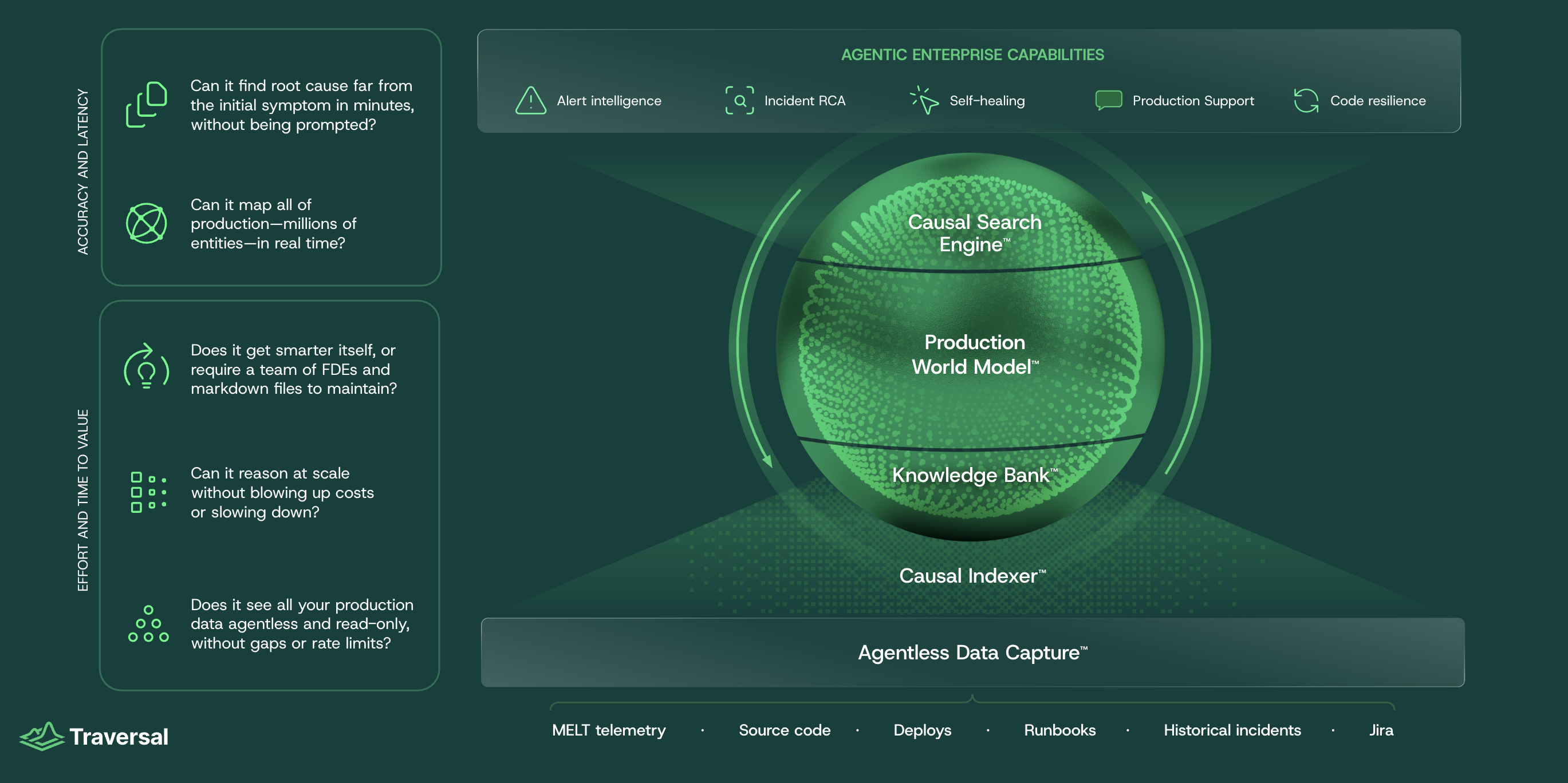
The design choice is simple: understanding the system is the AI SRE's job, not something your team does for it. Traversal's architecture is built around that principle at every layer, from how data comes in to how a root cause gets found. Traversal's Agentless Data Capture™ reads telemetry, code, and production data without agents, schemas, or sidecars. The Causal Indexer™ distills that raw data by 1000:1, while maintaining all key causal relationships, into the Production World Model™, a continuously updated causal representation of your environment. The Causal Search Engine™ reasons over that model, across 10+ dependency hops, explaining not just where an alert fired, but why the failure happened and where it originated. That's how Traversal investigates without being told what to look for. Traversal's Knowledge Bank™, the system's memory of how your environment actually behaves, starts with what you already have, including runbooks, postmortems, and service criticality docs. It auto-discovers the rest from every investigation, so the knowledge base keeps building itself. Human input is last-mile refinement, not the foundation.
What Enterprise-Grade Actually Requires
Once you know what discovery looks like, you can test for it in any vendor's proof of value (POV). Judge any AI SRE against these standards:
- Value without an authoring project: Insist on day-one discovery, not months of doc migration. If onboarding starts with "write your runbooks," the maintenance bill has already begun.
- Freshness that tracks a changing system: The model must update itself as production changes. A context source that depends on manual edits is stale by design.
- Deployment that fits enterprise constraints: Require agentless, read-only capture, SaaS or bring-your-own-cloud (BYOC), bring-your-own-model (BYOM), and on-prem or self-hosted residency. Your data and your model choices stay yours.
Proof should be specific, not aspirational. A global cryptocurrency exchange ran a rigorous head-to-head evaluation of Traversal and competing AI SREs in its own environment. The competitors required engineers to build and maintain markdown libraries before a root cause was ever returned; this was ongoing toil that scaled with the platform. Traversal required none. Within seven days, Traversal was operating at production-ready levels: a projected MTTR reduction of more than 40 percent, with no markdown authoring, no runbook migration, and no standing engineering investment from the exchange.
The absent maintenance burden is what compounds. A Traversal proof of value isn't an open-ended pilot: effort concentrates almost entirely at the front, agreeing on success criteria and granting read-only access, and value shows up before the evaluation ends rather than after a quarter of setup on faith.
Enterprise-grade also means being trusted where failure is expensive. Traversal is validated in production inside Fortune 100 environments, across industries including financial services and consumer goods. That is the bar a leading AI SRE has to clear.
Book a Demo to see Traversal in action.
FAQ
An AI SRE is an agentic system that investigates incidents and finds root cause, the way a senior site reliability engineer would.
AIOps tools mostly correlate signals and reduce alert noise for humans to interpret, while a real AI SRE reasons causally to return a single root cause with evidence. The distinction is correlation versus causation.
No. A real AI SRE should discover most operational knowledge on its own, from live telemetry and past investigations. You can feed it existing runbooks and docs if you have them, but it’s not a strict prerequisite.
Track lower MTTR (mean time to recovery), fewer high-severity incidents, and engineering hours reclaimed from manual investigation, then tie those to the downtime cost you avoid. For enterprises, an hour of downtime exceeded $300,000 for over 90% of mid-size and large firms in ITIC's 2024 survey, so the math adds up quickly.