What does the Chase outage teach about RCA for high-stakes financial systems?

On 16 November 2026, customers of Chase, several other large US banks, and Zelle reported problems. A Chase spokesperson pointed to a single origin: a software bug in an on-premise hardware system, which the spokesperson said was not cyber-related.
That gap between where a payments failure appears and where it starts is the central problem of RCA for high-stakes financial systems. Good root cause analysis (RCA) in payments separates where a failure surfaced from where it began. It also isolates the trigger from the underlying cause and confirms every affected transaction before the incident closes.
We found no detailed cause published by Chase as of 23 November 2026, so the lessons here concern RCA method, not a diagnosis of Chase.
What happened in the November 2026 Chase outage?
On Monday, 16 November 2026, JPMorgan Chase customers reported slow transactions. A Chase spokesperson attributed the issue to "a software bug in an on-premise hardware system" and said it was not cyber-related. Chase said transactions were posting normally again by about 6:30pm ET that day.
According to Al Jazeera's explainer on the Chase outage, Downdetector reports, which users self-report, peaked around 2pm ET. Customers at other banks also reported problems.
Chase said other banks may have seen slow transactions only where they were party to a transaction with Chase. It called the problem "not a systemic issue."
Zelle said its network was operating normally. Capital One and Truist said their services were normal despite customer reports. The same reporting cautioned that restored posting does not mean every delayed payment has completed.
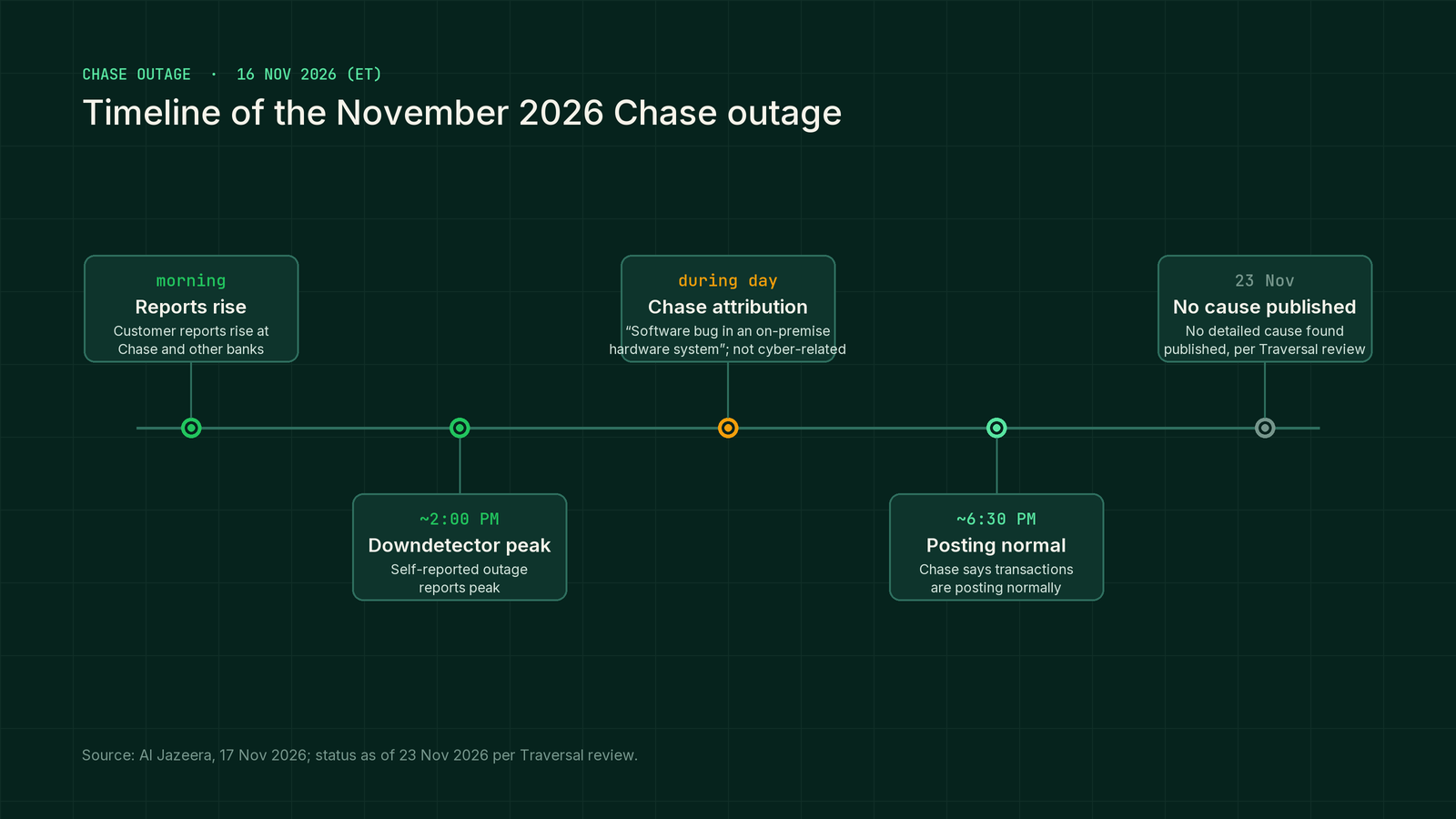
As of 23 November 2026, we found no detailed cause or post-incident report from Chase.
Why did one bank's software bug slow payments at other banks?
Chase's explanation is that other banks may have been affected only when they were on the other side of a transaction with Chase. A payment has two ends, so a slowdown at one bank appears as a delay at its counterparty, even when the counterparty's systems are healthy.
Chase has not disclosed which part of its processing was affected, so the mechanism described here is inference. From the counterparty's side, incoming payments stop arriving, outbound items sit pending, and customers call their own bank. That bank's dashboards may show nothing wrong, because nothing inside its boundary failed.
Customers reach Zelle through participating banks and credit unions, so a problem at one bank can delay Zelle payments with other institutions while Zelle's network stays up. U.S. Bank said its own systems were not directly affected, though Zelle payments with other institutions could be delayed.
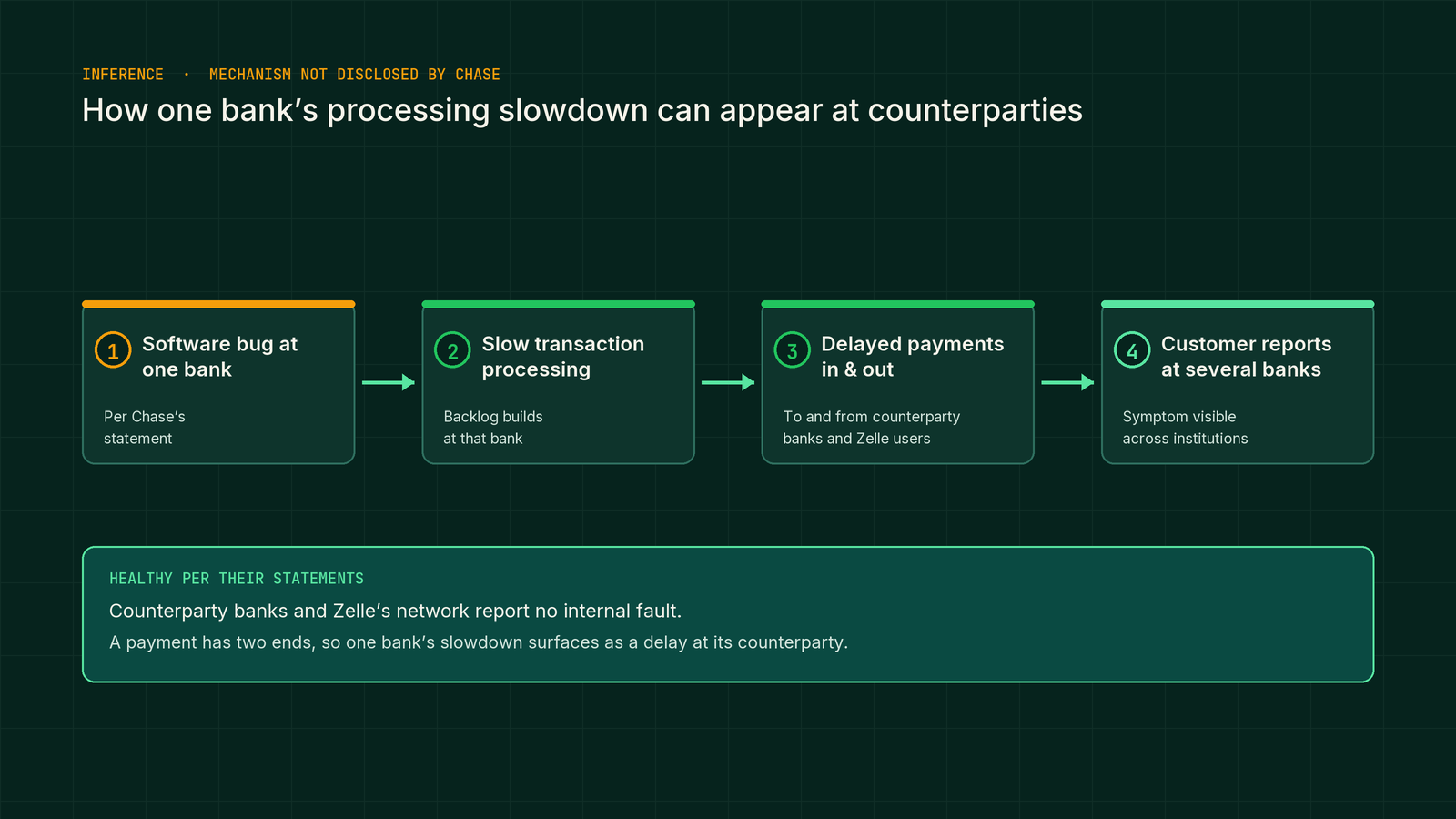
Simultaneous symptoms at several banks invite two stories: a shared cause or an attack. Chase says the incident was not cyber-related and not systemic. Our inference: one institution's fault, seen from every counterparty at once, can look exactly like a shared cause.
The bank that sees the symptom may have no cause inside its own boundary. Its postmortem should then record an external origin rather than invent an internal one. Traversal has written about how financial services incidents propagate across the services a single transaction touches.
How do you run RCA for high-stakes financial systems?
Mitigate first, then work through four ordered steps: separate symptom, trigger, and cause; reconcile transactions; build the evidence record; and assign corrective actions. Each step depends on evidence from the one before it.
Mitigation and diagnosis are separate jobs. Google's SRE guidance on postmortems recommends rolling back a bad rollout before diagnosing it, and keeping postmortems blameless and focused on process and technology.
Separate the symptom, the trigger, and the underlying cause
These three layers are Traversal's working framework, not a regulatory definition. The symptom is what customers and counterparties see: slow transfers, stale balances, delayed Zelle payments. The trigger is the event that set it off, such as a change, a hardware fault, or a capacity limit.
The underlying cause is the set of conditions that let the trigger become a customer-facing outage: missing safeguards, tight coupling, or no fallback. Many RCAs stop at the trigger because it is visible and recent. Fixing only the trigger leaves those conditions in place.
Take a hypothetical, not drawn from Chase. A month-end batch job pushes a shared message queue past capacity, and real-time payments on the same queue back up. Counterparties see the symptom, the batch volume is the trigger, and the missing isolation between batch and real-time traffic is the underlying cause.
A postmortem that names only the batch job lets the failure return. Traversal's analysis of why RCA breaks at enterprise scale covers this pattern in more depth.
The objection that there is no single root cause is fair when it means several contributing causes, and the record should list each one. 5 Whys chains are also easy to steer toward a convenient answer, so every link in the chain needs its own evidence.
Reconcile transactions before closing the incident
Posting normally again does not mean every payment landed. Reconciliation confirms what happened to each transaction in the incident window:
- Accepted but unposted payments: items the bank acknowledged that never reached the ledger.
- Duplicate postings: retries from customers or systems that posted the same payment twice.
- Stuck pending items: transactions still pending after processing recovered.
- Balance mismatches: displayed balances that disagree with the ledger of record.
- Counterparty confirmations: inbound and outbound items checked with each institution on the other side.
Treat a processor's status report as evidence to check against the ledger, not as the final record. This is practitioner guidance rather than a regulatory requirement. Until reconciliation confirms no stranded transactions, the RCA describes an incomplete picture of impact, so keep the incident open.
Build the record regulators and auditors will review
Three external frameworks shape what the record must support.
The OCC, Fed, and FDIC notification rule applies to banking organizations. They must notify their primary federal regulator within 36 hours of determining that a computer-security incident rises to the level of a notification incident. A failed system upgrade or change causing widespread outages is among the agencies' examples.
The clock starts at determination, not at the start of the incident, and deciding whether an incident qualifies depends on knowing its scope. Coverage depends on the rule's definitions of banking organization and bank service provider. Whether Chase's outage qualified is not public.
Bank service providers must notify affected bank customers as soon as possible after a qualifying disruption. The duty applies once they determine a computer-security incident has materially disrupted or degraded covered services for four or more hours. Previously communicated scheduled maintenance is excluded.
The Fed, FDIC, and OCC's interagency sound practices for operational resilience, SR 20-24 (revised 2 June 2026), is guidance rather than a new rule. It targets firms with $250 billion or more in assets, or $100 billion or more with $75 billion or more in specified activities. It does not use the phrase "root cause," but it covers business continuity, third-party risk, and incorporating lessons learned.
The root-cause wording comes from the Basel Committee operational resilience principles of March 2021, which are international principles rather than US law. Under Principle 6 (paragraphs 35 and 36), banks should identify and address root causes to prevent or minimise serial recurrence, and learn from incidents experienced by others. That second point makes the Chase outage relevant to every bank's incident program.
A reviewable record contains the timeline, blast radius, hypotheses tested and ruled out, evidence per conclusion, contributing causes, and owned corrective actions. Traversal's Incident RCA produces several of these directly: the hypotheses it tested and ruled out, a reconstructed timeline, and blast radius.
Turn findings into owned corrective actions
Blameless review and accountability fit together. The review avoids blaming individuals, while each corrective action still gets a named owner and a due date that examiners and auditors can verify.
Actions should target the underlying cause and the counterparty-facing failure mode, such as how the bank tells counterparties its processing has slowed.
Which signals matter during a payments slowdown?
Transaction-level signals separate a local fault from a counterparty problem: posting latency, pending-queue depth, accepted versus completed payments, counterparty errors, and balance freshness. Login and page-load health can stay green while money does not move.
Owners vary by organization. Downdetector-style data is self-reported, so it measures perceived impact, not failure directly.
What should engineering leaders ask after a banking outage?
Ask whether your RCA can find a cause outside your boundary and whether you can reconcile every affected transaction. Then ask whether you can produce evidence inside a notification window. Start with these:
- Which critical payment flows depend on a counterparty or shared network, and how would we detect that the fault is theirs?
- Do our postmortems allow an external origin, or do they force an internal cause?
- How long does it take us to reach an evidence-backed account, and does that fit a 36-hour clock that starts at determination?
- Can we list every transaction accepted but not completed during an incident window?
- Do our RCAs stop at the trigger?
- Are corrective actions owned and verified, and do we review other institutions' incidents for lessons?
Where does AI SRE fit in RCA for financial systems?
AI SRE takes on the investigation itself, testing candidate causes against a model of service dependencies and returning an evidence-backed root cause. In financial systems, that matters because the cause often sits several dependencies away from the symptom.
Observability and incident tools were built to collect signals and coordinate responders. Determining which change caused the downstream failures sits outside that design.
Traversal's pipeline starts with Agentless Data Capture™, which feeds the Causal Indexer™ and a continuously updated Production World Model™. The Causal Search Engine™ tests hypotheses across multi-hop dependencies, and the Knowledge Bank™ makes runbooks, documentation, and past incidents available during investigations. Traversal can run in the customer's own environment, including on-premises, which matters when payment data must stay inside the institution's boundary.
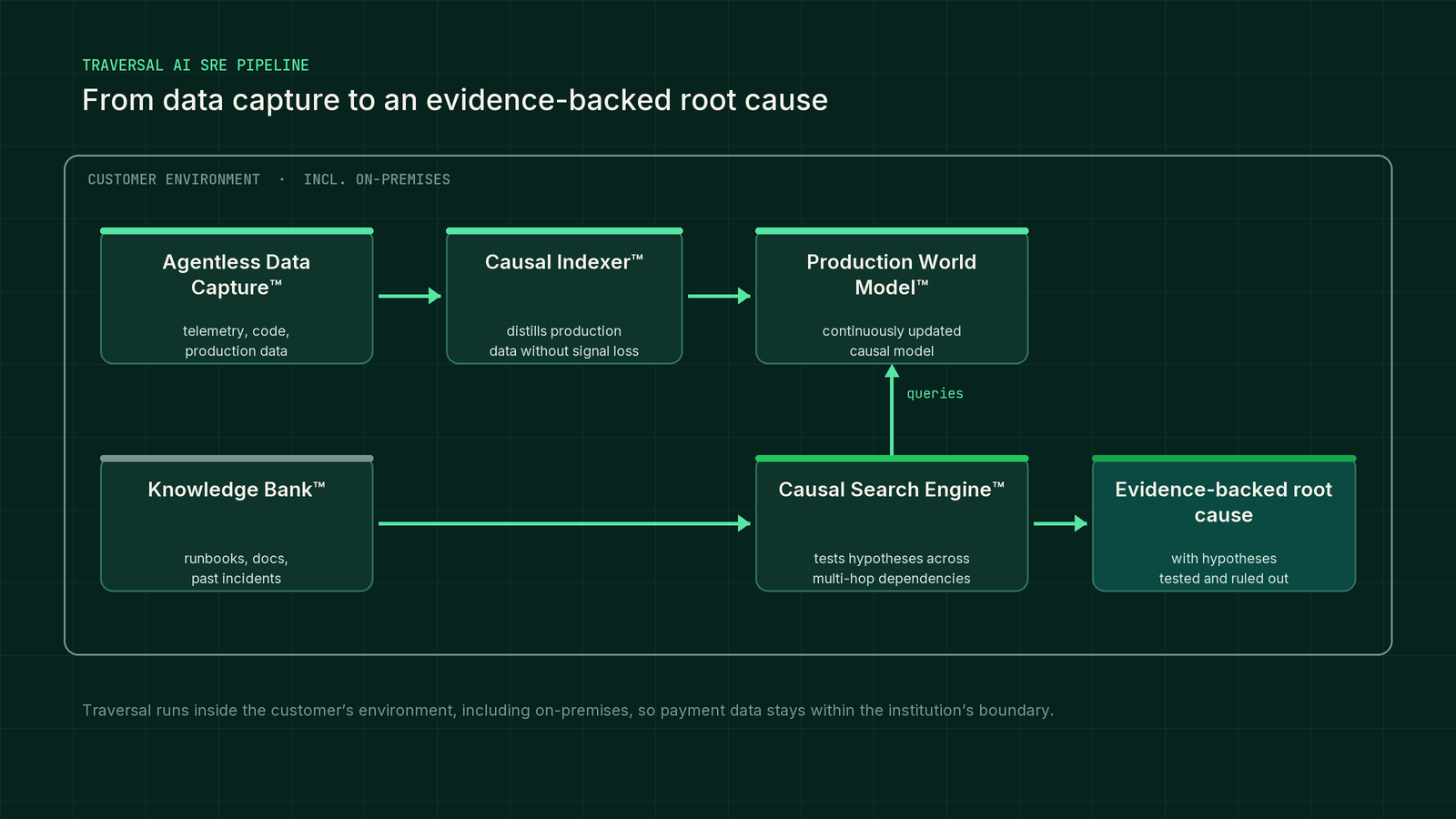
Traversal's Fortune 100 financial services deployment runs on-premises and captures 250 billion logs of interest per day. For that customer, a Fortune 100 financial services company, Traversal delivered 82% RCA accuracy across in-scope applications. Potential MTTR within those applications fell 32%.
Traversal's benchmark on high-severity banking incidents used 25 real Sev 1 to 3 incidents at a large financial-services enterprise. Head-to-head, Traversal's RCA was preferred 83% of the time against the strongest DIY frontier-model setup and up to 90% against the weakest. Average latency was 9.5 minutes, while DIY setups ran at two to three times that latency.
Each result comes from inside a single institution's estate, and AI SRE cannot inspect a counterparty's internal systems. Traversal's guide to AI SRE tools for financial services covers how regulated institutions weigh deployment boundaries and reviewable reasoning.
What does the Chase outage mean for your next RCA?
Your next payments incident may start outside your boundary. RCA for high-stakes financial systems has to name where the failure began, confirm every affected transaction, and produce evidence inside a notification window. Chase's outage shows the pattern clearly: symptoms at several institutions, one stated origin, and a public record that stops at the category of cause.
BCBS Principle 6 asks banks to learn from incidents experienced by others. Running the questions above against your own payment flows is one way to do that.
FAQ
RCA in banking explains why an operational incident happened, beyond its symptoms and immediate trigger, so the bank can address the underlying conditions. For technology incidents, it covers the systems, changes, and dependencies involved, including third parties.
A common sequence is to describe the problem, analyze data, identify root causes, take action, and verify the results. For payment systems, transaction reconciliation should also be completed before closing the incident so the analysis reflects the full customer impact.
RCA informs corrective and preventive action (CAPA) by identifying the root causes a plan should address. FDA draft guidance says to revisit the investigation if CAPA proves ineffective; the March 2026 draft is nonbinding.
A banking organization must notify its primary federal regulator within 36 hours of determining that a qualifying notification incident occurred. The rule does not cover every outage, and the clock starts at determination, not when the incident began.
Chase said the issue was a software bug in an on-premise hardware system and was not cyber-related. As of 23 November 2026, no more detailed cause had been published by Chase.